Division of Cardiology, Department of Internal Medicine, Wonju Christian Hospital, Yonsei University Wonju College of Medicine, Wonju, Korea.
Korean Circ J. 2010 Feb;40(2):55-61. doi: 10.4070/kcj.2010.40.2.55. Epub 2010 Feb 23.
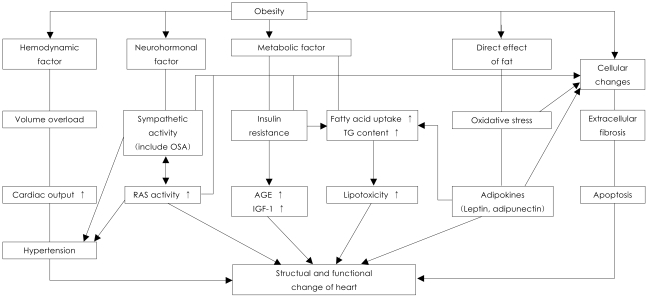
Overweight and obesity are rapidly increasing in prevalence due to adoption of the westernized life style in Korea. Obesity is strongly associated with the development of cardiovascular risk factors such as diabetes, hypertension, and dyslipidemia. In addition, accumulating evidence suggests that obesity per se has a direct effect on cardiac functional and structural changes that may not be the result of atherosclerosis. In this review, we focus on the view that obesity can influence on the structural and functional changes of the heart, drawing evidence from human and animal studies. We also review influencing factors such as physical, neurohormonal, and metabolic alterations that are associated with changes of the heart in obesity.
由于韩国采用了西方化的生活方式,超重和肥胖的患病率迅速上升。肥胖与心血管危险因素的发展密切相关,如糖尿病、高血压和血脂异常。此外,越来越多的证据表明,肥胖本身对心脏功能和结构的变化有直接影响,而这些变化可能不是动脉粥样硬化的结果。在这篇综述中,我们从人体和动物研究中得出证据,重点关注肥胖对心脏结构和功能变化的影响的观点。我们还回顾了与肥胖相关的心脏变化有关的影响因素,如身体、神经激素和代谢的改变。