Infectious Disease Epidemiology Unit, Bernhard Nocht Institute for Tropical Medicine, Bernhard-Nocht-Str. 74, D-20359 Hamburg, Germany.
Int J Environ Res Public Health. 2010 Jan;7(1):125-45. doi: 10.3390/ijerph7010125. Epub 2010 Jan 13.
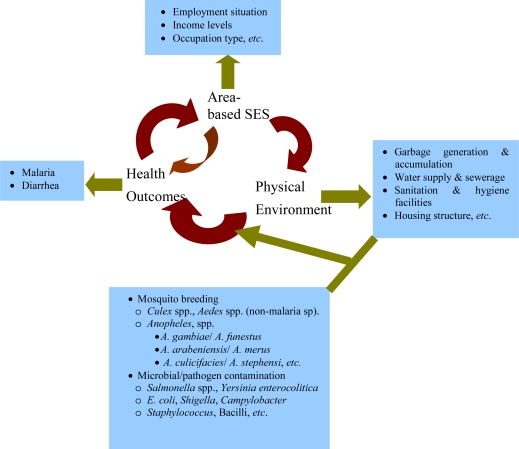
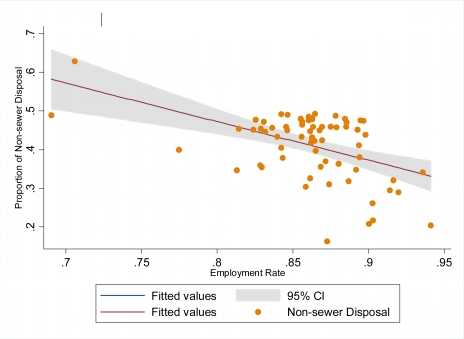
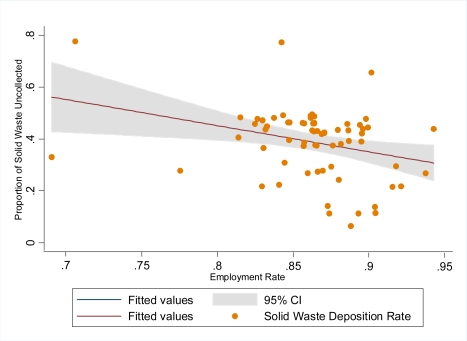
The influence of socioeconomic status (SES) on health inequalities is widely known, but there is still poor understanding of the precise relationship between area-based socioeconomic conditions and neighborhood environmental quality. This study aimed to investigate the socioeconomic conditions which predict urban neighbourhood environmental quality. The results showed wide variation in levels of association between the socioeconomic variables and environmental conditions, with strong evidence of a real difference in environmental quality across the five socioeconomic classes with respect to total waste generation (p < 0.001), waste collection rate (p < 0.001), sewer disposal rate (p < 0.001), non-sewer disposal (p < 0.003), the proportion of households using public toilets (p = 0.005). Socioeconomic conditions are therefore important drivers of change in environmental quality and urban environmental interventions aimed at infectious disease prevention and control if they should be effective could benefit from simultaneous implementation with other social interventions.
社会经济地位(SES)对健康不平等的影响是众所周知的,但人们对基于区域的社会经济条件与邻里环境质量之间的确切关系仍了解甚少。本研究旨在探讨预测城市邻里环境质量的社会经济条件。结果表明,社会经济变量与环境条件之间的关联程度存在很大差异,而且在五个社会经济阶层中,在总废物产生(p<0.001)、废物收集率(p<0.001)、下水道处理率(p<0.001)、非下水道处理(p<0.003)、使用公共厕所的家庭比例(p=0.005)方面,环境质量确实存在差异,这方面有很强的证据支持。因此,如果社会经济条件是环境质量变化的重要驱动因素,那么针对传染病预防和控制的城市环境干预措施如果要有效,就可以同时受益于与其他社会干预措施的同步实施。