Department of Animal Genetics, Breeding and Reproduction, College of Animal Science, South China Agricultural University, Guangzhou 510642, Guangdong, China.
BMC Genet. 2010 Mar 3;11:17. doi: 10.1186/1471-2156-11-17.
The elevation of egg production and the inhibition of incubation behavior are the aims of modern poultry production. Prolactin (PRL) gene is confirmed to be critical for the onset and maintenance of these reproductive behaviors in birds. Through PRL, dopamine D1 receptor (DRD1) was also involved in the regulation of chicken reproductive behavior. However, the genetic effects of this gene on chicken egg production and broodiness have not been studied extensively. The objective of this research was to evaluate the genetic effects of the DRD1 gene on chicken egg production and broodiness traits.
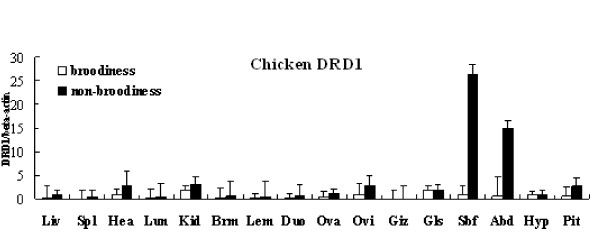
In this study, the chicken DRD1 gene was screened for the polymorphisms by cloning and sequencing and 29 variations were identified in 3,342 bp length of this gene. Seven single nucleotide polymorphism (SNPs) among these variations, including a non-synonymous mutation (A+505G, Ser169Gly), were located in the coding region and were chosen to analyze their association with chicken egg production and broodiness traits in 644 Ningdu Sanhuang individuals. Two SNPs, G+123A and C+1107T, were significantly associated with chicken broody frequency (P < 0.05). Significant association was also found between the G+1065A - C+1107T haplotypes and chicken broody frequency (P < 0.05). In addition, the haplotypes of G+123A and T+198C were significantly associated with weight of first egg (EW) (P = 0.03). On the other hand, the distribution of the DRD1 mRNA was observed and the expression difference was compared between broodiness and non-broodiness chickens. The DRD1 mRNA was predominantly expressed in subcutaneous fat and abdominal fat of non-broodiness chicken, and then in heart, kidney, oviduct, glandular stomach, hypothalamus, and pituitary. In subcutaneous fat and abdominal fat, the level of non-broodiness was 26 to 28 times higher than that of broodiness. In pituitary, it was 5-fold higher. In heart, oviduct, and kidney, a 2-3 times decrease from non-broodiness to broodiness was displayed. In glandular stomach and hypothalamus, the level seen in non-broodiness and broodiness was almost the same.
The polymorphisms of the DRD1 gene and their haplotypes were associated with chicken broody frequency and some egg production traits. The mRNA distribution was significant different between broodiness and non-broodiness chickens.
提高产蛋量和抑制孵化行为是现代家禽生产的目标。催乳素(PRL)基因被证实对鸟类这些生殖行为的开始和维持至关重要。通过 PRL,多巴胺 D1 受体(DRD1)也参与了鸡生殖行为的调节。然而,该基因对鸡产蛋量和抱窝性的遗传影响尚未得到广泛研究。本研究旨在评估 DRD1 基因对鸡产蛋量和抱窝性性状的遗传效应。
本研究通过克隆和测序筛选了鸡 DRD1 基因的多态性,在该基因的 3342bp 长度中发现了 29 个变异。这些变异中有 7 个单核苷酸多态性(SNPs),包括一个非 synonymous 突变(A+505G,Ser169Gly),位于编码区,选择了这 7 个 SNPs 分析它们与 644 只宁都三黄个体产蛋量和抱窝性性状的关系。两个 SNPs,G+123A 和 C+1107T,与鸡抱窝频率显著相关(P<0.05)。G+1065A-C+1107T 单倍型与鸡抱窝频率也存在显著关联(P<0.05)。此外,G+123A 和 T+198C 单倍型与初产蛋重(EW)显著相关(P=0.03)。另一方面,观察了 DRD1 mRNA 的分布,并比较了抱窝鸡和不抱窝鸡之间的表达差异。DRD1 mRNA 在不抱窝鸡的皮下脂肪和腹部脂肪中表达较多,然后在心脏、肾脏、输卵管、腺胃、下丘脑和垂体中表达。在皮下脂肪和腹部脂肪中,不抱窝的水平比抱窝高 26 到 28 倍。在垂体中,它高 5 倍。在心脏、输卵管和肾脏中,从不抱窝到抱窝显示出 2-3 倍的减少。在腺胃和下丘脑,不抱窝和抱窝的水平几乎相同。
DRD1 基因的多态性及其单倍型与鸡抱窝频率和一些产蛋性状有关。抱窝鸡和不抱窝鸡之间的 mRNA 分布有显著差异。