Hagedorn Research Institute, Gentofte, Denmark.
Diabetes. 2010 Jun;59(6):1539-48. doi: 10.2337/db09-1757. Epub 2010 Mar 3.
Common variants in the melatonin receptor type 1B (MTNR1B) locus have been shown to increase fasting plasma glucose (FPG) and the risk of type 2 diabetes. The aims of this study were to evaluate whether nonsynonymous variants in MTNR1B associate with monogenic forms of hyperglycemia, type 2 diabetes, or related metabolic traits.
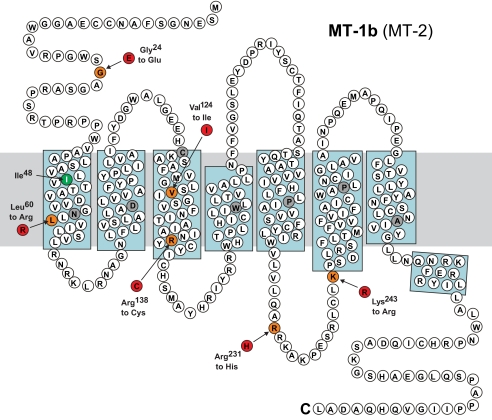
MTNR1B was sequenced in 47 probands with clinical maturity-onset diabetes of the young (MODY), in 51 probands with early-onset familial type 2 diabetes, and in 94 control individuals. Six nonsynonymous variants (G24E, L60R, V124I, R138C, R231H, and K243R) were genotyped in up to 22,142 Europeans. Constitutive and melatonin-induced signaling was characterized for the wild-type melatonin receptor type 1B (MT2) and the 24E, 60R, and 124I MT2 mutants in transfected COS-7 cells.
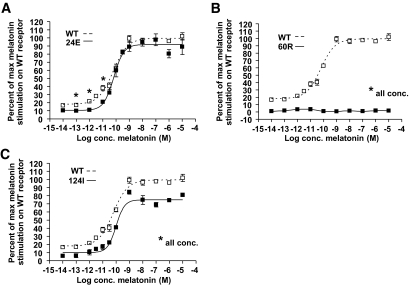
No mutations in MTNR1B were MODY specific, and none of the investigated MTNR1B variants associated with type 2 diabetes. The common 24E variant associated with increased prevalence of obesity (odds ratio 1.20 [1.08-1.34]; P = 8.3 x 10(-4)) and increased BMI (beta = 0.5 kg/m(2); P = 1.2 x 10(-5)) and waist circumference (beta = 1.2 cm; P = 9 x 10(-6)) in combined Danish and French study samples. 24E also associated with decreased FPG (beta = -0.08 mmol/l; P = 9.2 x 10(-4)) in the Danish Inter99 population. Slightly decreased constitutive activity was observed for the MT2 24E mutant, while the 124I and 60R mutants displayed considerably decreased or completely disrupted signaling, respectively.
Nonsynonymous mutations in MTNR1B are not a common cause of MODY or type 2 diabetes among Danes. MTNR1B 24E associates with increased body mass and decreased FPG. Decreased MT2 signaling does apparently not directly associate with FPG or type 2 diabetes.
褪黑素受体 1B(MTNR1B)基因座的常见变异可使空腹血糖(FPG)升高,并增加 2 型糖尿病的风险。本研究旨在评估 MTNR1B 中的非同义变异是否与单基因形式的高血糖、2 型糖尿病或相关代谢特征相关。
对 47 例临床发病的年轻成人型糖尿病(MODY)患者、51 例早发家族性 2 型糖尿病患者和 94 例对照个体进行 MTNR1B 测序。对多达 22142 名欧洲人进行了 6 种非同义变异(G24E、L60R、V124I、R138C、R231H 和 K243R)的基因分型。在转染的 COS-7 细胞中对野生型褪黑素受体 1B(MT2)和 24E、60R 和 124I MT2 突变体进行了组成型和褪黑素诱导的信号转导分析。
MTNR1B 突变并非 MODY 所特有,且研究中未发现任何 MTNR1B 变异与 2 型糖尿病相关。常见的 24E 变异与肥胖(比值比 1.20[1.08-1.34];P=8.3×10(-4))和 BMI(β=0.5kg/m(2);P=1.2×10(-5))和腰围(β=1.2cm;P=9×10(-6))的增加有关,丹麦和法国联合研究样本中该变异的患病率较高。丹麦 Inter99 人群中,24E 还与 FPG(β=-0.08mmol/l;P=9.2×10(-4))的降低有关。MT2 24E 突变体的组成型活性略有降低,而 124I 和 60R 突变体的信号转导分别明显降低或完全中断。
丹麦人中,MTNR1B 中的非同义突变不是 MODY 或 2 型糖尿病的常见原因。MTNR1B 24E 与体重增加和 FPG 降低有关。MT2 信号转导降低显然与 FPG 或 2 型糖尿病没有直接关系。