Eisenhofer Sabine, Toókos Ferenc, Hense Burkhard A, Schulz Sabine, Filbir Frank, Zischka Hans
Institute of Biomathematics and Biometry, Helmholtz Zentrum München, German Research Center for Environmental Health, Ingolstädter Landstrasse 1, 85764 Neuherberg, Germany.
BMC Res Notes. 2010 Mar 11;3:67. doi: 10.1186/1756-0500-3-67.
The permeabilization of mitochondrial membranes is a decisive event in apoptosis or necrosis culminating in cell death. One fundamental mechanism by which such permeabilization events occur is the calcium-induced mitochondrial permeability transition. Upon Ca2+-uptake into mitochondria an increase in inner membrane permeability occurs by a yet unclear mechanism. This leads to a net water influx in the mitochondrial matrix, mitochondrial swelling, and finally the rupture of the outer membrane. Although already described more than thirty years ago, many unsolved questions surround this important biological phenomenon. Importantly, theoretical modeling of the mitochondrial permeability transition has only started recently and the existing mathematical models fail to characterize the swelling process throughout the whole time range.
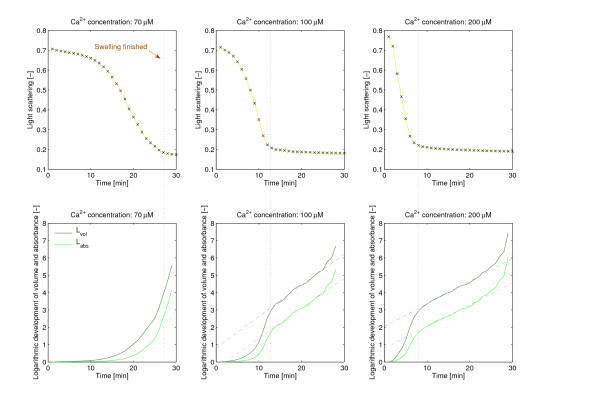
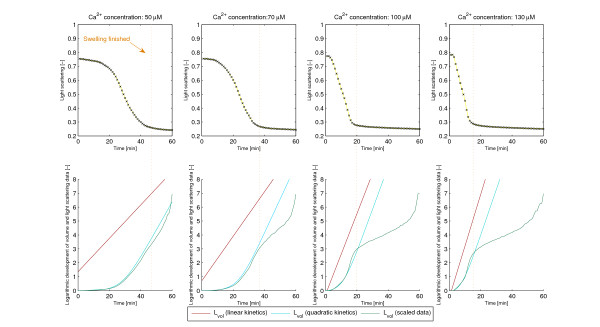
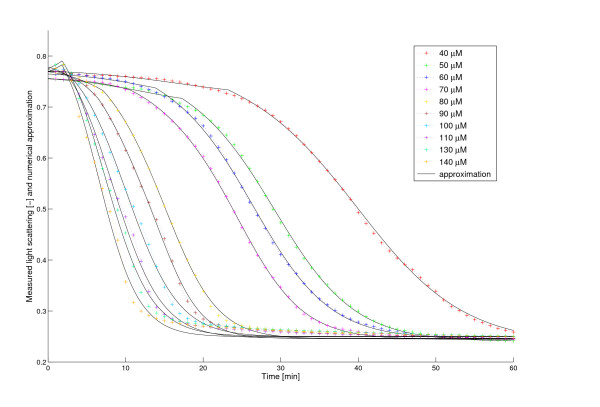
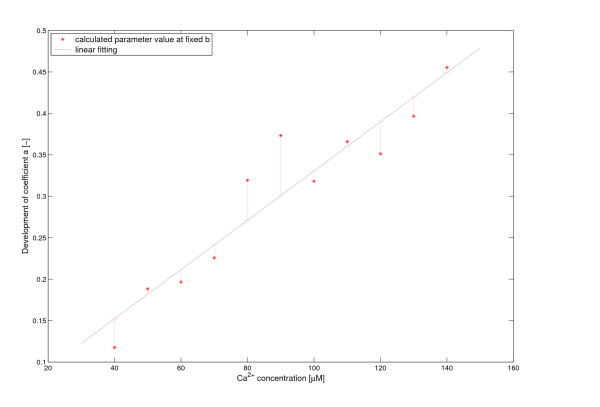
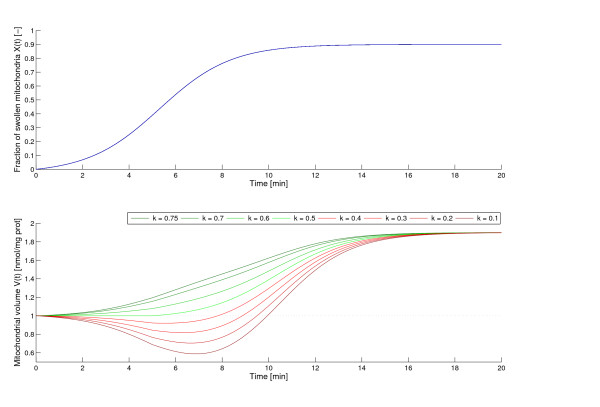
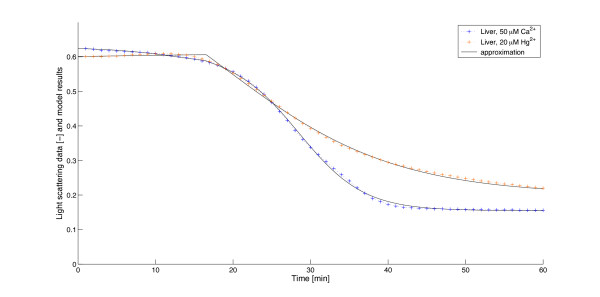
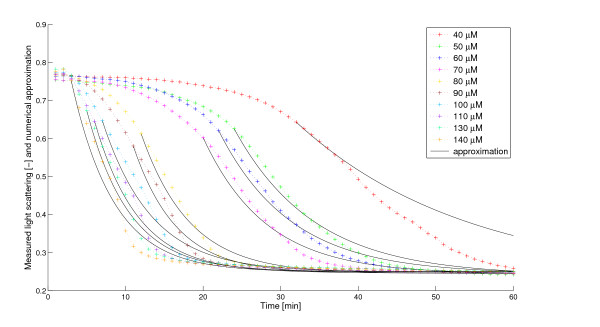
We propose here a new mathematical approach to the mitochondrial permeability transition introducing a specific delay equation and resulting in an optimized representation of mitochondrial swelling. Our new model is in accordance with the experimentally determined course of volume increase throughout the whole swelling process, including its initial lag phase as well as its termination. From this new model biological consequences can be deduced, such as the confirmation of a positive feedback of mitochondrial swelling which linearly depends on the Ca2+-concentration, or a negative exponential dependence of the average swelling time on the Ca2+-concentration. Finally, our model can show an initial shrinking phase of mitochondria, which is often observed experimentally before the actual swelling starts.
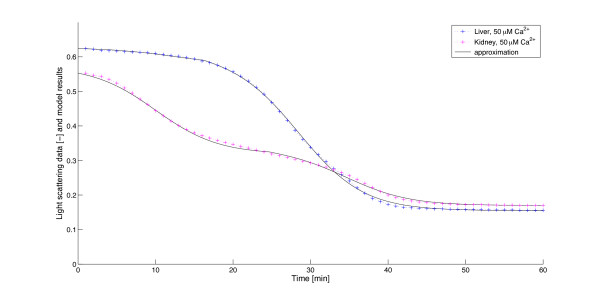
We present a model of the mitochondrial swelling kinetics. This model may be adapted and extended to diverse other inducing/inhibiting conditions or to mitochondria from other biological sources and thus may benefit a better understanding of the mitochondrial permeability transition.
线粒体膜的通透性改变是凋亡或坏死过程中的决定性事件,最终导致细胞死亡。这种通透性改变发生的一个基本机制是钙诱导的线粒体通透性转换。钙离子进入线粒体后,内膜通透性通过尚不清楚的机制增加。这导致线粒体基质中水的净流入、线粒体肿胀,最终外膜破裂。尽管这一重要生物学现象早在三十多年前就已被描述,但仍存在许多未解决的问题。重要的是,线粒体通透性转换的理论建模直到最近才开始,现有的数学模型无法描述整个时间范围内的肿胀过程。
我们在此提出一种新的线粒体通透性转换数学方法,引入一个特定的延迟方程,从而得到线粒体肿胀的优化表示。我们的新模型与整个肿胀过程中实验测定的体积增加过程一致,包括其初始延迟阶段及其终止阶段。从这个新模型可以推断出生物学后果,例如证实线粒体肿胀的正反馈线性依赖于钙离子浓度,或者平均肿胀时间对钙离子浓度呈负指数依赖。最后,我们的模型可以显示线粒体的初始收缩阶段,这在实际肿胀开始前在实验中经常观察到。
我们提出了一个线粒体肿胀动力学模型。该模型可以修改和扩展到其他各种诱导/抑制条件或来自其他生物来源的线粒体,从而有助于更好地理解线粒体通透性转换。