Department of Physiology, School of Medicine, University of Puerto Rico, San Juan, PR, USA.
Department of Physiology, School of Medicine, University of Puerto Rico, San Juan, PR, USA.
Mitochondrion. 2018 Jan;38:58-70. doi: 10.1016/j.mito.2017.08.004. Epub 2017 Aug 10.
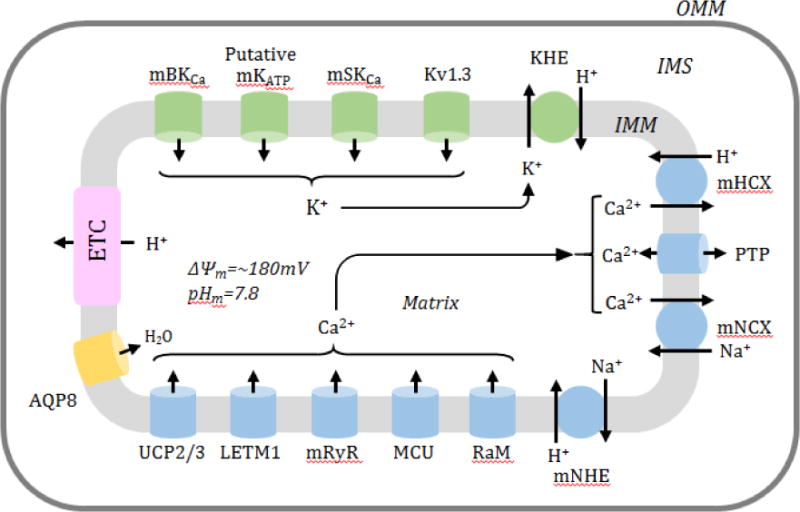
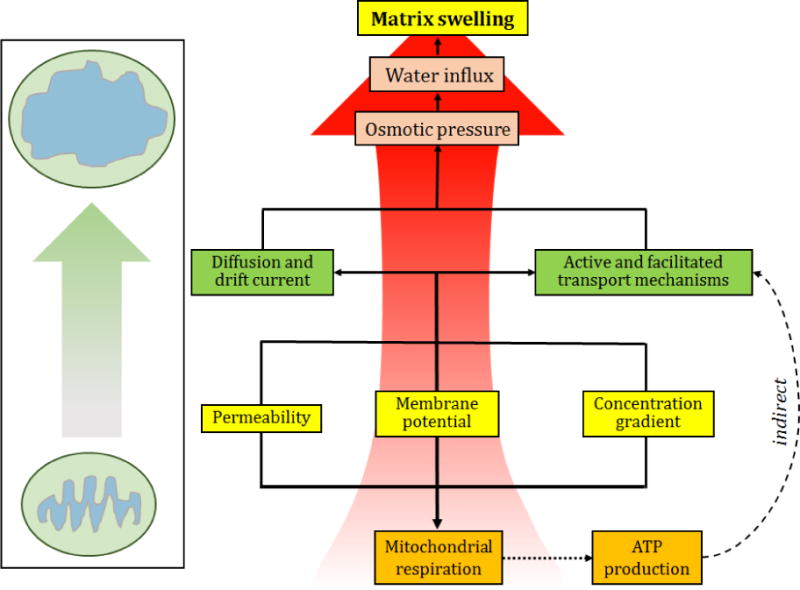
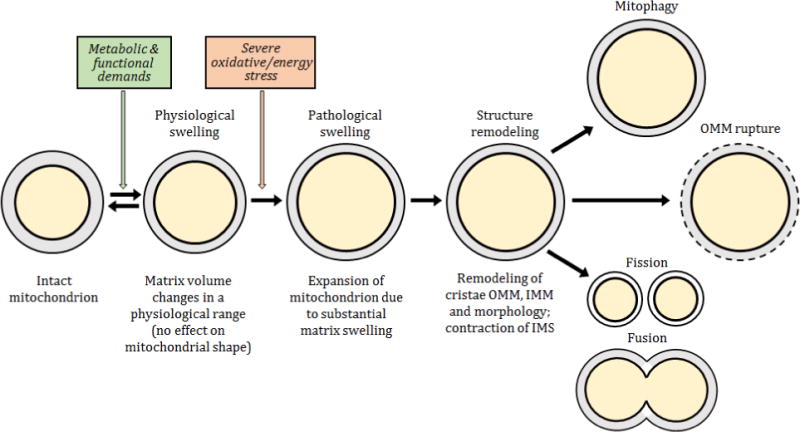
Mitochondria are critical players involved in both cell life and death through multiple pathways. Structural integrity, metabolism and function of mitochondria are regulated by matrix volume due to physiological changes of ion homeostasis in cellular cytoplasm and mitochondria. Ca and K presumably play a critical role in physiological and pathological swelling of mitochondria when increased uptake (influx)/decreased release (efflux) of these ions enhances osmotic pressure accompanied by high water accumulation in the matrix. Changes in the matrix volume in the physiological range have a stimulatory effect on electron transfer chain and oxidative phosphorylation to satisfy metabolic requirements of the cell. However, excessive matrix swelling associated with the sustained opening of mitochondrial permeability transition pores (PTP) and other PTP-independent mechanisms compromises mitochondrial function and integrity leading to cell death. The mechanisms of transition from reversible (physiological) to irreversible (pathological) swelling of mitochondria remain unknown. Mitochondrial swelling is involved in the pathogenesis of many human diseases such as neurodegenerative and cardiovascular diseases. Therefore, modeling analysis of the swelling process is important for understanding the mechanisms of cell dysfunction. This review attempts to describe the role of mitochondrial swelling in cell life and death and the main mechanisms involved in the maintenance of ion homeostasis and swelling. The review also summarizes and discusses different kinetic models and approaches that can be useful for the development of new models for better simulation and prediction of in vivo mitochondrial swelling.
线粒体通过多种途径参与细胞的生与死。由于细胞质和线粒体中离子内稳态的生理变化,线粒体的结构完整性、代谢和功能受到基质体积的调节。当这些离子的摄取(流入)/释放(流出)增加时,渗透压增加,伴随着基质中大量水分的积累,Ca 和 K 可能在正常和病理条件下线粒体肿胀中发挥关键作用。基质体积的变化在生理范围内对电子传递链和氧化磷酸化有刺激作用,以满足细胞的代谢需求。然而,与线粒体通透性转换孔(PTP)持续开放和其他非 PTP 相关机制相关的过度基质肿胀会损害线粒体功能和完整性,导致细胞死亡。从可逆(生理)到不可逆(病理)肿胀的转变机制尚不清楚。线粒体肿胀与许多人类疾病的发病机制有关,如神经退行性疾病和心血管疾病。因此,对肿胀过程的建模分析对于理解细胞功能障碍的机制非常重要。本文综述了线粒体肿胀在细胞生与死中的作用,以及维持离子内稳态和肿胀的主要机制。本文还总结和讨论了不同的动力学模型和方法,这些模型和方法对于开发新的模型以更好地模拟和预测体内线粒体肿胀可能是有用的。