Clinical and Molecular Osteoporosis Research Unit, Department of Clinical Science, Lund University, Malmö University Hospital, SE-20502 Malmö, Sweden.
BMC Musculoskelet Disord. 2010 Mar 11;11:48. doi: 10.1186/1471-2474-11-48.
The number of hip fractures during recent decades has been reported to be increasing, partly because of an increasing proportion of elderly women in the society. However, whether changes in hip fracture annual incidence in women are attributable to secular changes in the prevalence of osteoporosis is unclear.
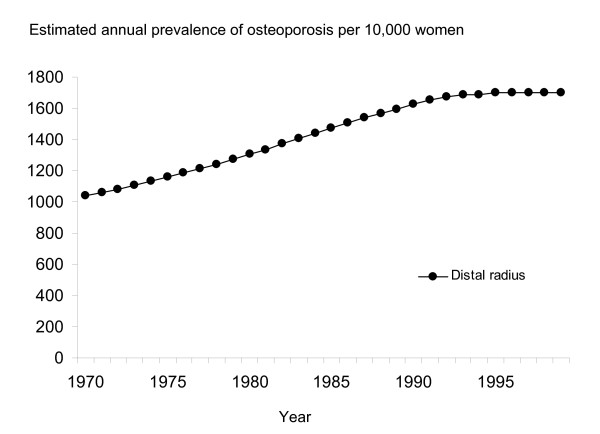
Bone mineral density was evaluated by single-photon absorptiometry at the distal radius in 456 women aged 50 years or above and living in the same city. The measurements were obtained by the same densitometer during three separate time periods: 1970-74 (n = 106), 1987-93 (n = 175) and 1998-1999 (n = 178), and the age-adjusted prevalence of osteoporosis in these three cohorts was calculated. Additionally, all hip fractures sustained in the target population of women aged 50 years or above between 1967 and 2001 were registered, whereupon the crude and the age-adjusted annual incidence of hip fractures were calculated.
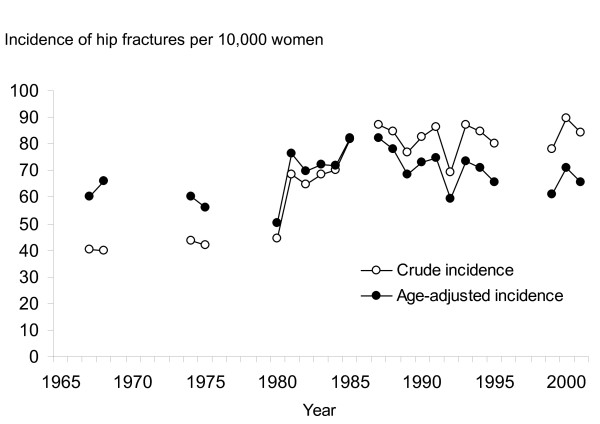
There was no significant difference in the age-adjusted prevalence of osteoporosis when the three cohorts were compared (P = 1.00). The crude annual incidence (per 10,000 women) of hip fracture in the target population increased by 110% from 40 in 1967 to 84 in 2001. The overall trend in the crude incidence between 1967 and 2001 was increasing (1.58 per 10,000 women per year; 95 percent confidence interval, 1.17 to 1.99), whereas the age-adjusted incidence was stable over the same period (0.22 per 10,000 women per year; 95 percent confidence interval, -0.16 to 0.60).
The increased number of hip fracture in elderly women is more likely to be attributable to demographic changes in the population than to secular increase in the prevalence of osteoporosis.
近年来,髋部骨折的数量据报道一直在增加,部分原因是社会中老年女性的比例增加。然而,女性髋部骨折年发病率的变化是否归因于骨质疏松症患病率的长期变化尚不清楚。
对居住在同一城市的 456 名年龄在 50 岁及以上的女性进行单光子吸收法测量桡骨远端骨密度。这些测量值是在三个不同的时间段内由同一台密度计获得的:1970-74 年(n = 106)、1987-93 年(n = 175)和 1998-1999 年(n = 178),并计算了这三组人群的年龄调整后骨质疏松症患病率。此外,还登记了 1967 年至 2001 年期间目标人群中所有年龄在 50 岁及以上的女性发生的所有髋部骨折,计算了髋部骨折的粗发病率和年龄调整后年发病率。
三组人群的年龄调整后骨质疏松症患病率无显著差异(P = 1.00)。目标人群的髋部骨折粗发病率(每 10000 名女性)从 1967 年的 40 例增加到 2001 年的 84 例,增加了 110%。1967 年至 2001 年期间,粗发病率的总体趋势呈上升趋势(每年每 10000 名女性增加 1.58;95%置信区间,1.17 至 1.99),而同期年龄调整后的发病率保持稳定(每年每 10000 名女性增加 0.22;95%置信区间,-0.16 至 0.60)。
老年女性髋部骨折数量的增加更可能归因于人口的人口统计学变化,而不是骨质疏松症患病率的长期增加。