MRC Prion Unit, UCL Institute of Neurology, Queen Square, London WC1N 3BG, UK.
Hum Mol Genet. 2010 Jun 1;19(11):2228-38. doi: 10.1093/hmg/ddq100. Epub 2010 Mar 10.
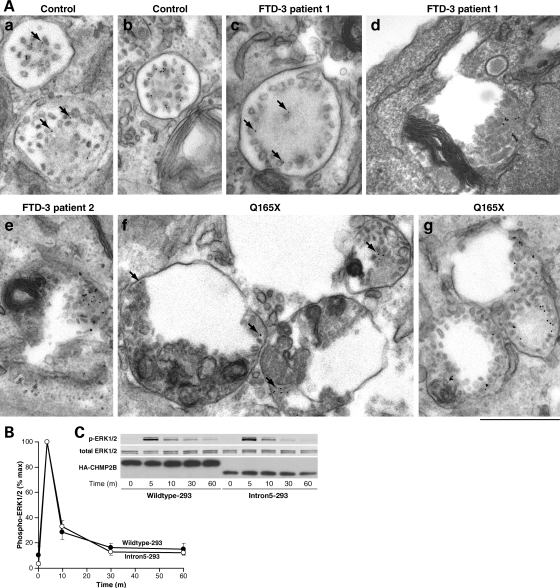
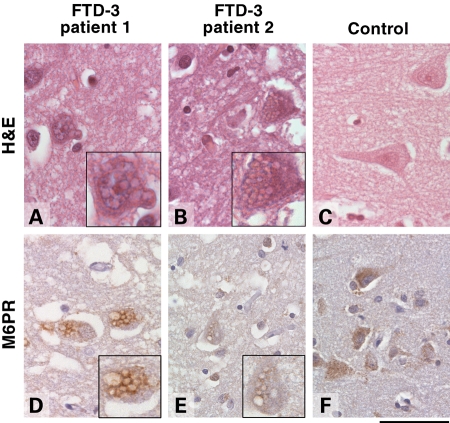
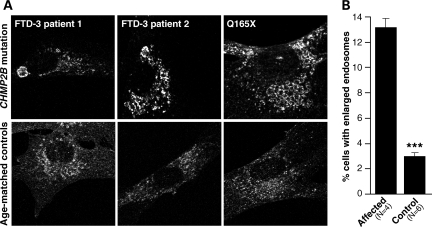
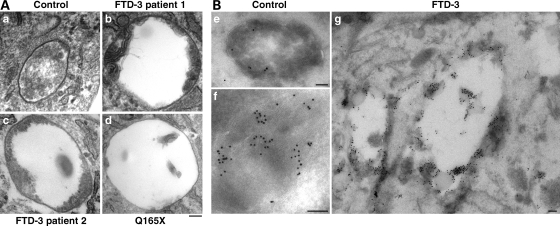
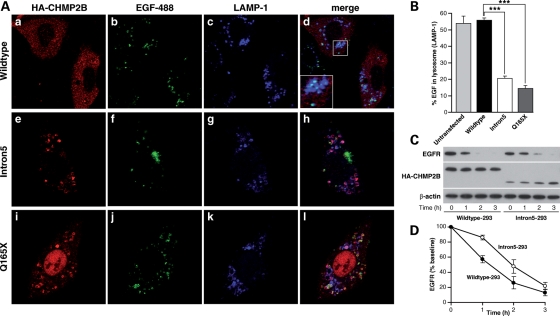
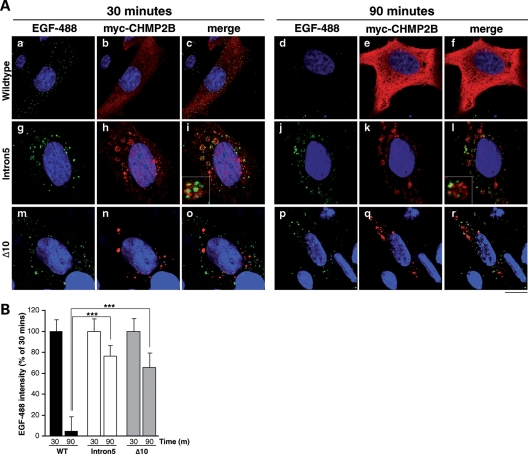
Mutations in CHMP2B cause frontotemporal dementia (FTD) in a large Danish pedigree, which is termed FTD linked to chromosome 3 (FTD-3), and also in an unrelated familial FTD patient. CHMP2B is a component of the ESCRT-III complex, which is required for function of the multivesicular body (MVB), an endosomal structure that fuses with the lysosome to degrade endocytosed proteins. We report a novel endosomal pathology in CHMP2B mutation-positive patient brains and also identify and characterize abnormal endosomes in patient fibroblasts. Functional studies demonstrate a specific disruption of endosome-lysosome fusion but not protein sorting by the MVB. We provide evidence for a mechanism for impaired endosome-lysosome fusion whereby mutant CHMP2B constitutively binds to MVBs and prevents recruitment of proteins necessary for fusion to occur, such as Rab7. The fusion of endosomes with lysosomes is required for neuronal function and the data presented therefore suggest a pathogenic mechanism for FTD caused by CHMP2B mutations.
CHMP2B 基因突变导致一个丹麦大的家系发生额颞叶痴呆(FTD),称为与 3 号染色体相关的 FTD(FTD-3),也导致一个无关联的家族性 FTD 患者发病。CHMP2B 是 ESCRT-III 复合物的一个组成部分,该复合物对于多泡体(MVB)的功能是必需的,MVB 是一种内体结构,与溶酶体融合以降解内吞的蛋白质。我们在 CHMP2B 突变阳性患者大脑中报告了一种新的内体病理学,并且还鉴定和描述了患者成纤维细胞中的异常内体。功能研究表明,特定的内体-溶酶体融合被破坏,但 MVB 中的蛋白质分拣不受影响。我们提供了证据表明,一种内体-溶酶体融合受损的机制是突变型 CHMP2B 与 MVB 持续结合,并阻止了发生融合所必需的蛋白质的募集,如 Rab7。内体与溶酶体的融合对于神经元功能是必需的,因此提出了由 CHMP2B 突变引起的 FTD 的致病机制。