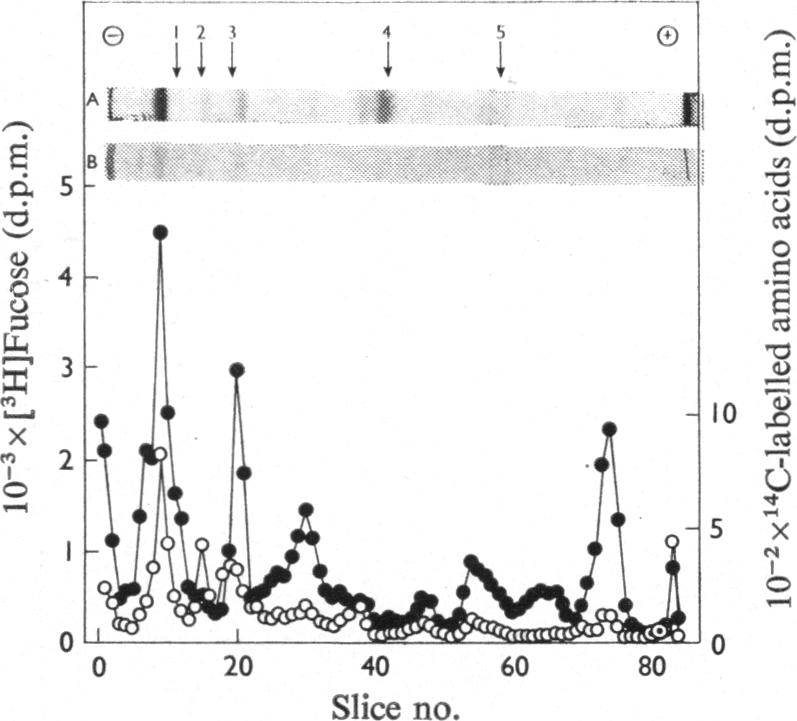
Confluent human skin fibroblasts maintained in a chemically defined medium incorporate l-[1-(3)H]fucose in a linear manner with time into non-diffusible macromolecules for up to 48h. Chromatographic analysis demonstrated that virtually all the macromolecule-associated (3)H was present as [(3)H]fucose. 2. Equilibrium CsCl-density-gradient centrifugation established that [(3)H]fucose-labelled macromolecules released into the medium were predominantly glycoproteins. Confirmation of this finding was provided by molecular-size analyses of the [(3)H]fucose-labelled material before and after trypsin digestion. 3. The [(3)H]fucose-labelled glycoproteins released into fibroblast culture medium were analysed by gel-filtration chromatography and sodium dodecyl sulphate/polyacrylamide-gel electrophoresis. These techniques demonstrated that the major fucosylated glycoprotein had an apparent mol.wt. of 230000-250000; several minor labelled species were also detected. 4. Dual-labelling experiments with [(3)H]fucose and (14)C-labelled amino acids indicated that the major fucosylated glycoprotein was synthesized de novo by cultured fibroblasts. The non-collagenous nature of this glycoprotein was established by three independent methods. 5. Gel-filtration analysis before and after reduction with dithiothreitol showed that the major glycoprotein occurs as a disulphide-bonded dimer when analysed under denaturing conditions. Further experiments demonstrated that this glycoprotein was the predominant labelled species released into the medium when fibroblasts were incubated with [(35)S]cysteine. 6. The relationship between the major fucosylated glycoprotein and a glycoprotein, or group of glycoproteins, variously known as fibronectin, LETS protein, cell-surface protein etc., is discussed.