Nakamura H, Nemenoff R A, Gronich J H, Bonventre J V
Medical Service, Massachusetts General Hospital, Boston 02114.
J Clin Invest. 1991 May;87(5):1810-8. doi: 10.1172/JCI115202.
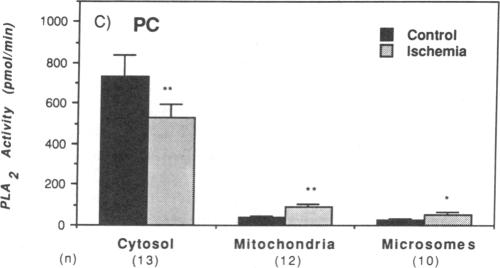
Phospholipase A2 (PLA2) activities in cytosolic, mitochondrial, and microsomal fractions of rat kidneys were characterized under control conditions, after ischemia, and subsequent to ischemia and reperfusion. Two forms of PLA2 activity were present in the cytosolic fraction: a high molecular weight form, active against phosphatidylcholine (PC), and phosphatidylethanolamine (PE), which upon purification has a molecular mass of 110 kD; and smaller form (Mr approximately 14 kD), active against PE. In mitochondrial and microsomal fractions a single form (Mr approximately 14 kD), active against both PC and PE, was dominant. Activities in each fraction were optimal at pH 8.5-9.5. Cytosolic PLA2 activity was enhanced when Ca2+ concentration [( Ca2+]) was increased over the range of 10(-7) to 10(-6) M. Mitochondrial PLA2 activity required higher [Ca2+] for activation (greater than 10(-6) M). After 45 min of ischemia cytosolic PLA2 activity was decreased, whereas mitochondrial and microsomal activities were increased. When ischemia was followed by 1 h of reperfusion, cytosolic, mitochondrial, and microsomal activities were enhanced. Ischemia alone did not change the gel filtration chromatography patterns of PLA2 activity, but ischemia and reperfusion resulted in the appearance of a new peak of activity in cytosolic and mitochondrial fractions (Mr approximately 2-3 kD). Thus, the rat kidney has multiple forms of PLA2 activity, likely representing distinct enzymes, with Ca2+ dependencies suggesting regulation by Ca2+ in vivo. Ischemia and reperfusion result in stable increases of PLA2 activity in each subcellular fraction, perhaps related to covalent modifications of PLA2's, which likely account for membrane phospholipid degradation, and increased tissue levels of unsaturated free fatty acids.
在对照条件下、缺血后以及缺血再灌注后,对大鼠肾脏胞质、线粒体和微粒体部分的磷脂酶A2(PLA2)活性进行了表征。胞质部分存在两种形式的PLA2活性:一种高分子量形式,对磷脂酰胆碱(PC)和磷脂酰乙醇胺(PE)有活性,纯化后分子量为110 kD;另一种较小形式(Mr约为14 kD),对PE有活性。在线粒体和微粒体部分,一种单一形式(Mr约为14 kD),对PC和PE都有活性,占主导地位。各部分的活性在pH 8.5 - 9.5时最佳。当Ca2+浓度[(Ca2+)]在10(-7)至10(-6)M范围内增加时,胞质PLA2活性增强。线粒体PLA2活性需要更高的[Ca2+]来激活(大于10(-6)M)。缺血45分钟后,胞质PLA2活性降低,而线粒体和微粒体活性增加。当缺血后再灌注1小时,胞质、线粒体和微粒体活性增强。单独缺血不会改变PLA2活性的凝胶过滤色谱图谱,但缺血再灌注会导致胞质和线粒体部分出现一个新的活性峰(Mr约为2 - 3 kD)。因此,大鼠肾脏具有多种形式的PLA2活性可能代表不同的酶,其对Ca2+的依赖性表明在体内受Ca2+调节。缺血再灌注导致每个亚细胞部分的PLA2活性稳定增加,这可能与PLA2的共价修饰有关,这可能导致膜磷脂降解以及组织中不饱和游离脂肪酸水平升高。