Department of Surgery , Maastricht University Medical Center+ , 6229 HX Maastricht , The Netherlands.
The Maastricht Multimodal Molecular Imaging Institute (M4I), Division of Imaging Mass Spectrometry , Maastricht University , 6200 MD Maastricht , The Netherlands.
Anal Chem. 2019 Mar 5;91(5):3575-3581. doi: 10.1021/acs.analchem.8b05521. Epub 2019 Feb 15.
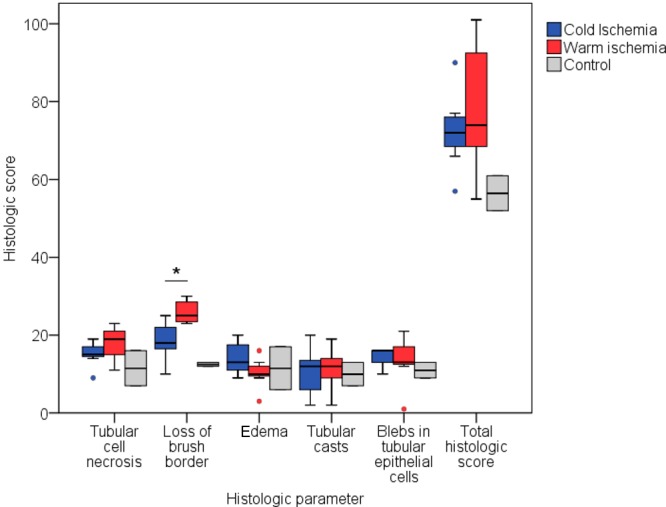
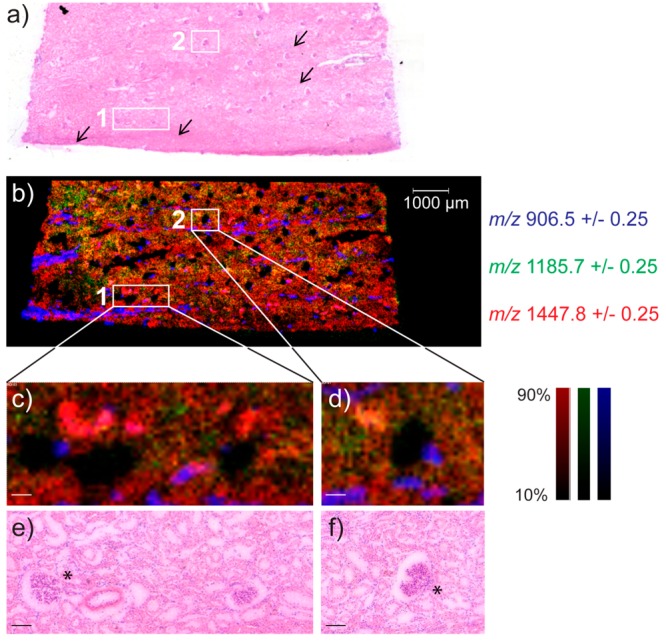
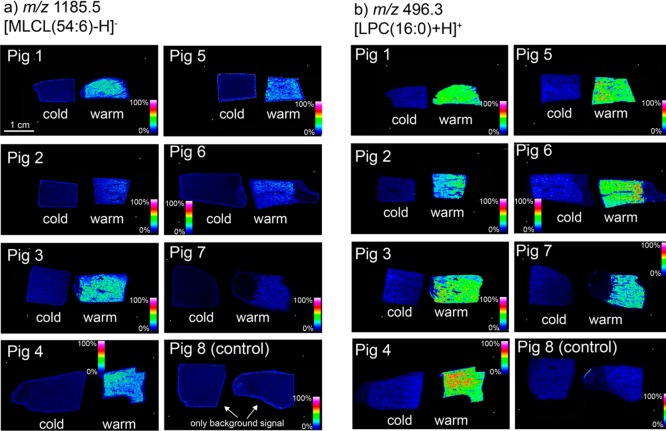
The increasing analytical speed of mass-spectrometry imaging (MSI) has led to growing interest in the medical field. Acute kidney injury is a severe disease with high morbidity and mortality. No reliable cut-offs are known to estimate the severity of acute kidney injury. Thus, there is a need for new tools to rapidly and accurately assess acute ischemia, which is of clinical importance in intensive care and in kidney transplantation. We investigated the value of MSI to assess acute ischemic kidney tissue in a porcine model. A perfusion model was developed where paired kidneys received warm (severe) or cold (minor) ischemia ( n = 8 per group). First, ischemic tissue damage was systematically assessed by two blinded pathologists. Second, MALDI-MSI of kidney tissues was performed to study the spatial distributions and compositions of lipids in the tissues. Histopathological examination revealed no significant difference between kidneys, whereas MALDI-MSI was capable of a detailed discrimination of severe and mild ischemia by differential expression of characteristic lipid-degradation products throughout the tissue within 2 h. In particular, lysolipids, including lysocardiolipins, lysophosphatidylcholines, and lysophosphatidylinositol, were dramatically elevated after severe ischemia. This study demonstrates the significant potential of MSI to differentiate and identify molecular patterns of early ischemic injury in a clinically acceptable time frame. The observed changes highlight the underlying biochemical processes of acute ischemic kidney injury and provide a molecular classification tool that can be deployed in assessment of acute ischemic kidney injury.
质谱成像(MSI)分析速度的提高促使其在医学领域的应用兴趣日益浓厚。急性肾损伤是一种严重的疾病,具有高发病率和高死亡率。目前还没有可靠的截止值来估计急性肾损伤的严重程度。因此,需要新的工具来快速、准确地评估急性缺血,这在重症监护和肾移植中具有重要的临床意义。我们研究了 MSI 在评估猪模型急性缺血性肾组织中的价值。建立了一个灌注模型,其中配对的肾脏接受温热(严重)或寒冷(轻微)缺血(每组 8 个)。首先,由两名盲法病理学家系统地评估缺血性组织损伤。其次,对肾脏组织进行 MALDI-MSI,以研究组织中脂质的空间分布和组成。组织病理学检查显示肾脏之间没有显著差异,而 MALDI-MSI 能够通过在 2 小时内通过整个组织中特征性脂质降解产物的差异表达来详细区分严重和轻微的缺血。特别是,在严重缺血后,溶血磷脂,包括溶血心磷脂、溶血磷脂酰胆碱和溶血磷脂酰肌醇,显著升高。本研究证明了 MSI 在可接受的临床时间范围内区分和识别早期缺血性损伤分子模式的显著潜力。观察到的变化突出了急性缺血性肾损伤的潜在生化过程,并提供了一种可以用于评估急性缺血性肾损伤的分子分类工具。