Division of Diabetes Translation, Centers for Disease Control and Prevention, Atlanta, Georgia, USA.
Diabetes Care. 2010 Jun;33(6):1193-9. doi: 10.2337/dc09-1888. Epub 2010 Mar 23.
To assess the long-term cost-effectiveness of aspirin use among adults aged >or=40 years with newly diagnosed type 2 diabetes.
We used a validated cost-effectiveness model of type 2 diabetes to assess the lifetime health and cost consequences of use or nonuse of aspirin. The model simulates the progression of diabetes and accompanying complications for a cohort of subjects with type 2 diabetes. The model predicts the outcomes of type 2 diabetes along five disease paths (nephropathy, neuropathy, retinopathy, coronary heart disease, and stroke) from the time of diagnosis until age 94 years or until death.
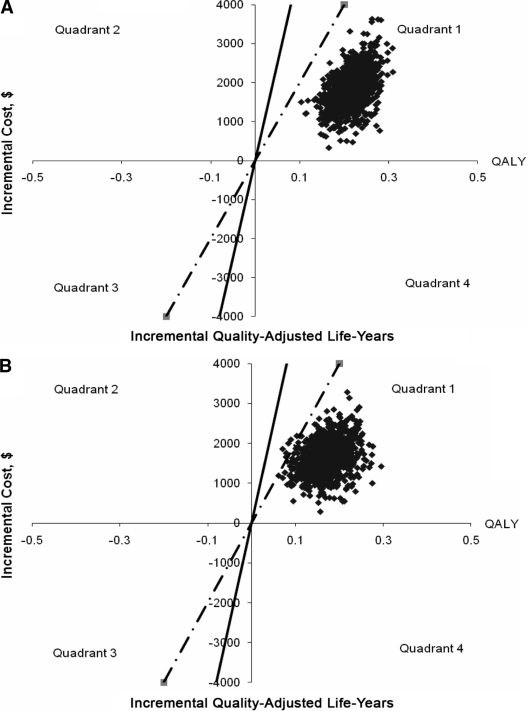
Over a lifetime, aspirin users gained 0.31 life-years (LY) or 0.19 quality-adjusted LYs (QALYs) over nonaspirin users, at an incremental cost of $1,700; the incremental cost-effectiveness ratio (ICER) of aspirin use was $5,428 per LY gained or $8,801 per QALY gained. In probabilistic sensitivity analyses, the ICER was <$30,000 per QALY in all of 2,000 realizations in two scenarios.
Regular use of aspirin among people with newly diagnosed diabetes is cost-effective.
评估新诊断 2 型糖尿病成人患者使用阿司匹林的长期成本效益。
我们使用经过验证的 2 型糖尿病成本效益模型来评估阿司匹林使用或不使用对患者终生健康和成本的影响。该模型模拟了一组 2 型糖尿病患者的糖尿病进展及其伴随并发症。该模型根据五种疾病路径(肾病、神经病变、视网膜病变、冠心病和中风),从诊断时间到 94 岁或死亡,预测 2 型糖尿病的结果。
在一生中,阿司匹林使用者比非阿司匹林使用者多获得 0.31 个生命年(LY)或 0.19 个质量调整生命年(QALY),增量成本为 1700 美元;阿司匹林使用的增量成本效益比(ICER)为每获得 1 LY 增加 5428 美元,每获得 1 QALY 增加 8801 美元。在概率敏感性分析中,在两种情况下的 2000 次实现中,ICER 均<30000 美元/QALY。
在新诊断为糖尿病的人群中,常规使用阿司匹林具有成本效益。