Developmental Biology Group, Department of Genetics, University of Georgia, Athens, Georgia, United States of America.
PLoS One. 2010 Mar 19;5(3):e9758. doi: 10.1371/journal.pone.0009758.
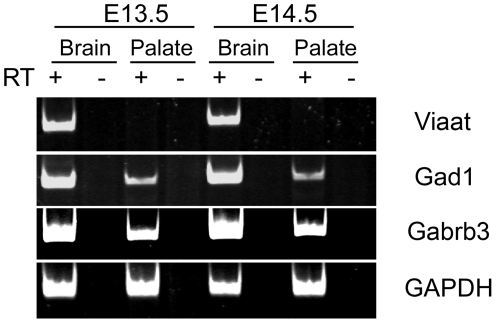
Previous studies have shown that disruption of GABA signaling in mice via mutations in the Gad1, Gabrb3 or Viaat genes leads to the development of non-neural developmental defects such as cleft palate. Studies of the Gabrb3 and Gad1 mutant mice have suggested that GABA function could be required either in the central nervous system or in the palate itself for normal palatogenesis.
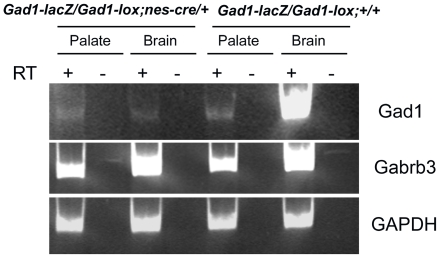
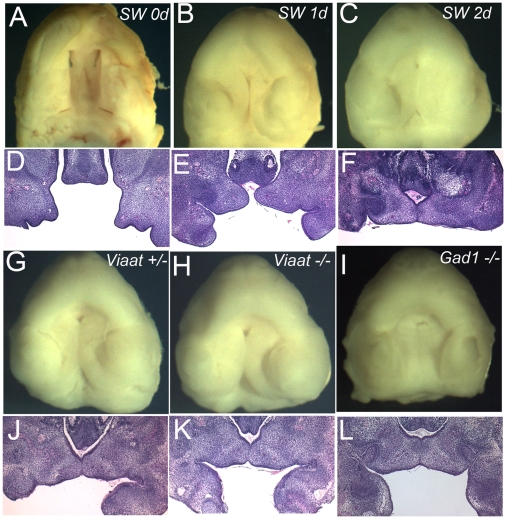
METHODOLOGY/PRINCIPAL FINDINGS: To further examine the role of GABA signaling in palatogenesis we used three independent experimental approaches to test whether Gad1 or Viaat function is required in the fetal CNS for normal palate development. We used oral explant cultures to demonstrate that the Gad1 and Viaat mutant palates were able to undergo palatogenesis in culture, suggesting that there is no defect in the palate tissue itself in these mice. In a second series of experiments we found that the GABA(A) receptor agonist muscimol could rescue the cleft palate phenotype in Gad1 and Viaat mutant embryos. This suggested that normal multimeric GABA(A) receptors in the CNS were necessary for normal palatogenesis. In addition, we showed that CNS-specific inactivation of Gad1 was sufficient to disrupt palate development.
CONCLUSIONS/SIGNIFICANCE: Our results are consistent with a role for Gad1 and Viaat in the central nervous system for normal development of the palate. We suggest that the alterations in GABA signaling lead to non-neural defects such as cleft palate as a secondary effect due to alterations in or elimination of fetal movements.
先前的研究表明,通过 Gad1、Gabrb3 或 Viaat 基因的突变破坏 GABA 信号在小鼠中会导致非神经发育缺陷的发展,如腭裂。对 Gabrb3 和 Gad1 突变小鼠的研究表明,GABA 功能可能需要在中枢神经系统或腭本身中正常发挥作用以进行腭发生。
方法/主要发现:为了进一步研究 GABA 信号在腭发生中的作用,我们使用三种独立的实验方法来测试 Gad1 或 Viaat 功能是否在胎儿中枢神经系统中对于正常腭发育是必需的。我们使用口腔外植体培养来证明 Gad1 和 Viaat 突变体腭能够在培养中经历腭发生,这表明这些小鼠的腭组织本身没有缺陷。在一系列实验中,我们发现 GABA(A)受体激动剂 muscimol 可以挽救 Gad1 和 Viaat 突变体胚胎的腭裂表型。这表明正常的中枢神经系统多聚 GABA(A)受体对于正常的腭发生是必需的。此外,我们表明 CNS 特异性 Gad1 失活足以破坏腭发育。
结论/意义:我们的结果与 Gad1 和 Viaat 在中枢神经系统中对于正常腭发育的作用一致。我们认为 GABA 信号的改变导致非神经缺陷,如腭裂,是由于胎儿运动的改变或消除引起的次要影响。