Key Laboratory of Marine Bio-resources Sustainable Utilization, South China Sea Institute of Oceanology, Chinese Academy of Sciences, Guangzhou 510301, China.
Molecules. 2010 Feb 10;15(2):871-7. doi: 10.3390/molecules15020871.
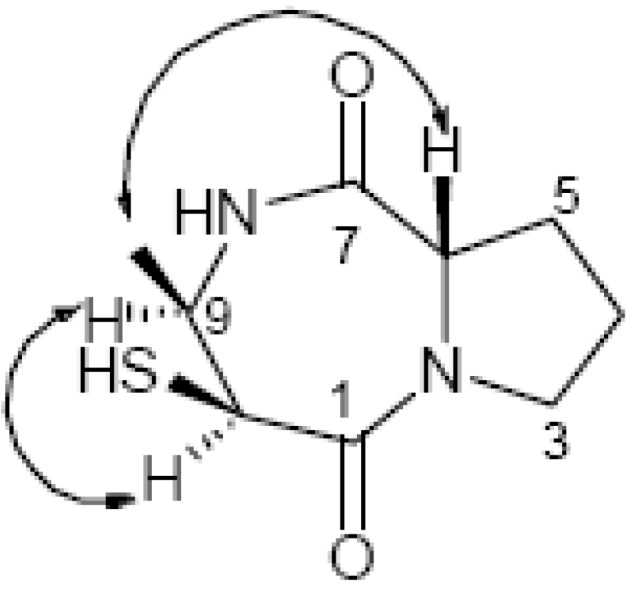
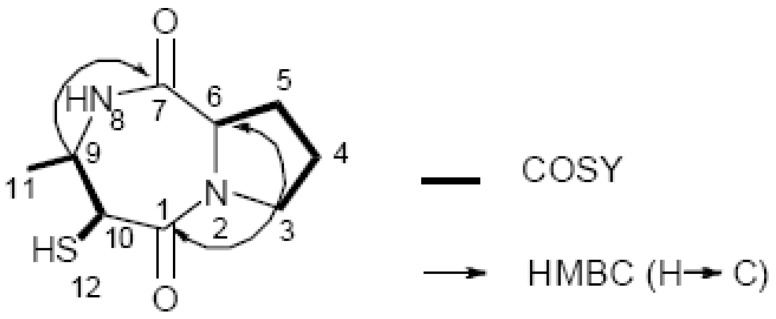
A new 1,4-diazepine, callysponine (1), was isolated from a South China Sea Callyspongia sp. marine sponge, together with four known proline-based diketopiperazines: cyclo-(S-Pro-R-Leu) (2), cyclo-(S-Pro-R-Val) (3), cyclo-(S-Pro-R-Ala) (4), andcyclo-(S-Pro-R-Tyr) (5). The new structure was determined on the basis of NMR and MS analysis, and the absolute stereochemistry was defined by NOESY spectroscopy and optical rotation. The structures of the known compounds were identified by comparison of their spectroscopic data with those reported in the literature. Callysponine (1) did not inhibit the growth of HepG2 (hepatoma carcinoma cell), A549 (lung carcinoma cell), and HeLa (cervical cancer cell) cell lines.
从南海一种海绵 Callyspongia sp. 中分离得到一种新的 1,4-二氮杂卓化合物 callysponine (1),以及四个已知的脯氨酸二酮哌嗪:环-(S-Pro-R-Leu) (2)、环-(S-Pro-R-Val) (3)、环-(S-Pro-R-Ala) (4) 和环-(S-Pro-R-Tyr) (5)。新结构是基于 NMR 和 MS 分析确定的,绝对立体化学是通过 NOESY 光谱和旋光确定的。通过与文献报道的光谱数据进行比较,确定了已知化合物的结构。Callysponine (1) 对 HepG2(肝癌细胞)、A549(肺癌细胞)和 HeLa(宫颈癌细胞)细胞系的生长没有抑制作用。