Department of Chemistry and Centre for Catalysis Research and Innovation, University of Ottawa, Ottawa, Ontario K1N 6N5, Canada.
J Phys Chem A. 2010 Apr 22;114(15):5119-31. doi: 10.1021/jp101416k.
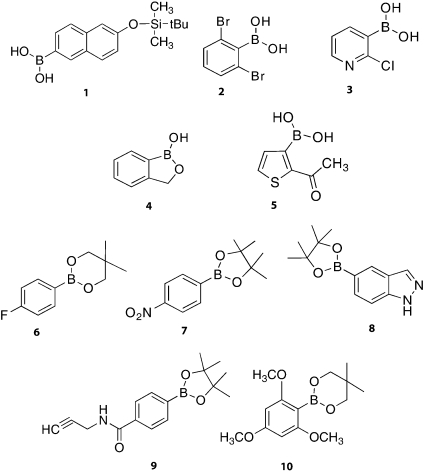
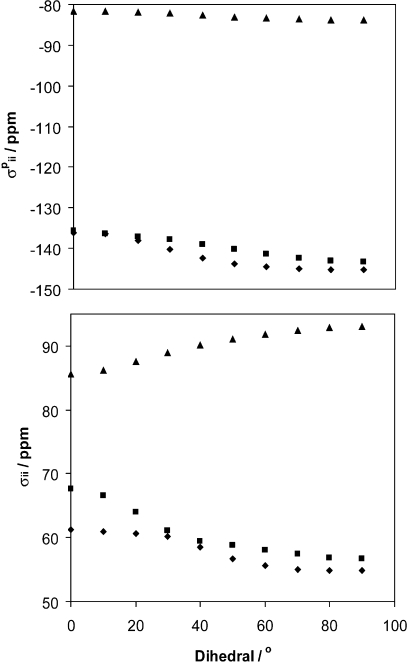
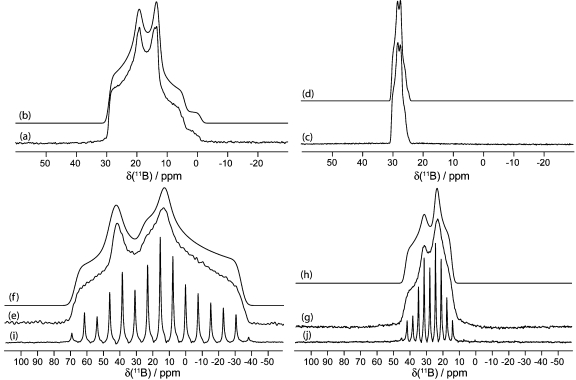
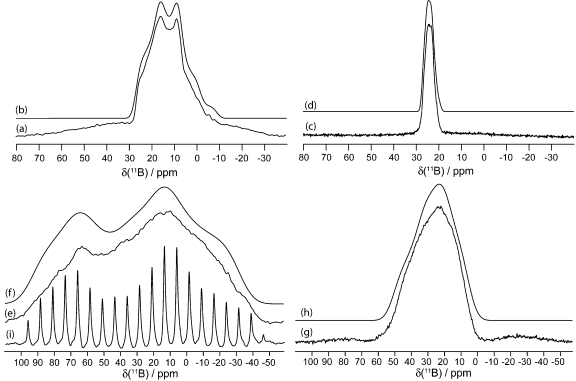
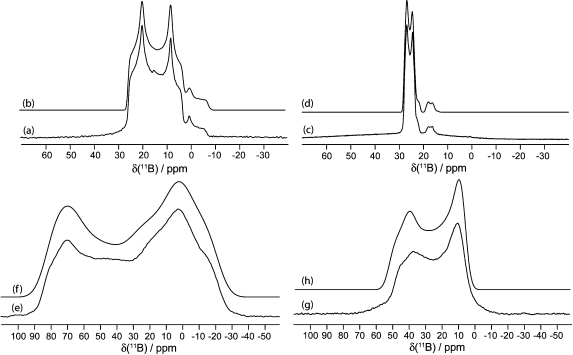
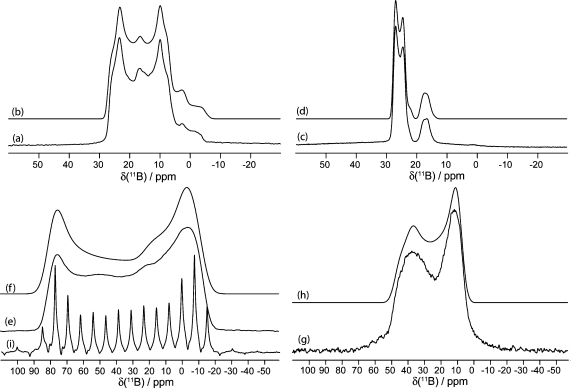
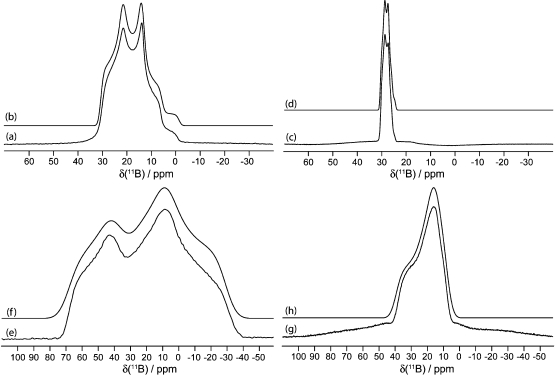
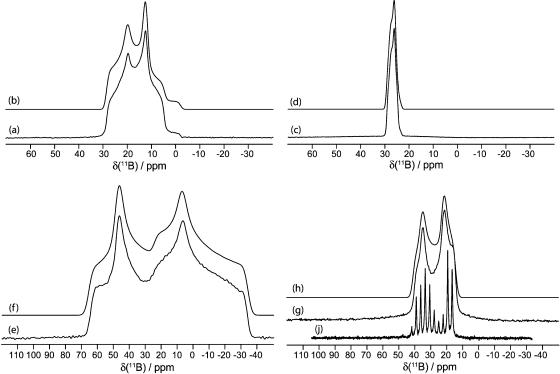
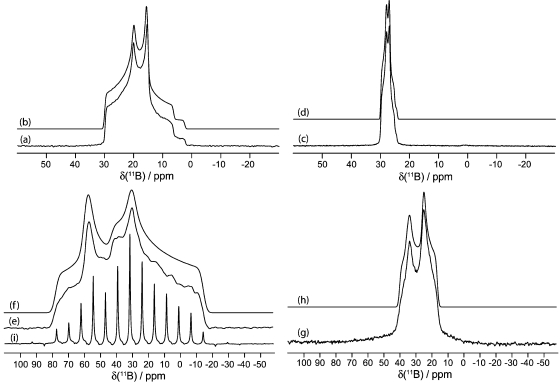
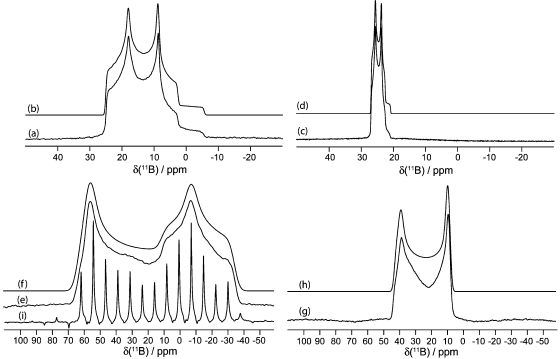
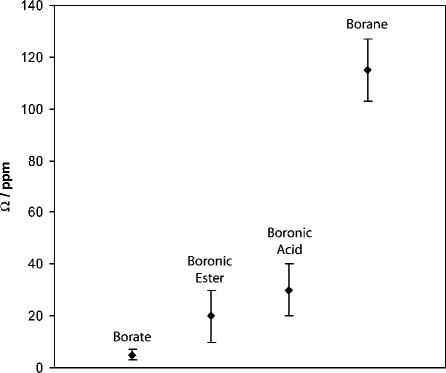
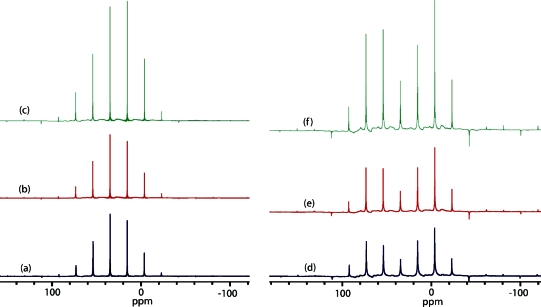
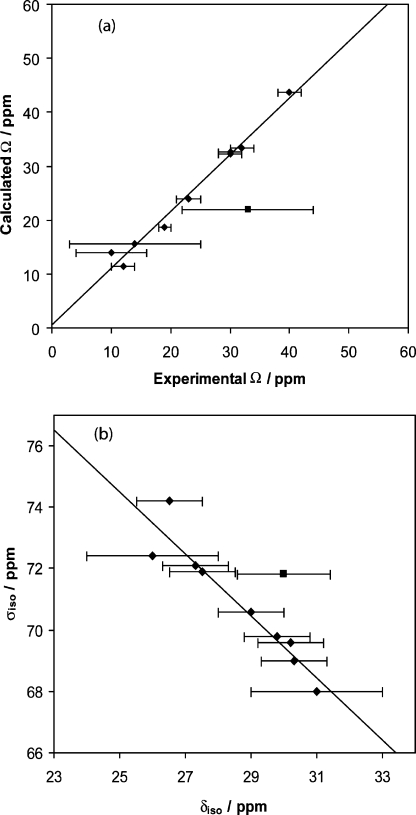
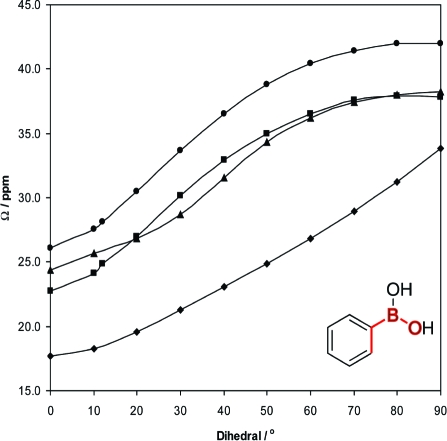
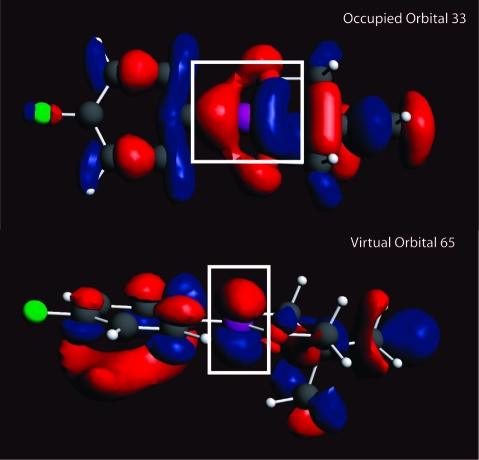
The results of a solid-state (11)B NMR study of a series of 10 boronic acids and boronic esters with aromatic substituents are reported. Boron-11 electric field gradient (EFG) and chemical shift (CS) tensors obtained from analyses of spectra acquired in magnetic fields of 9.4 and 21.1 T are demonstrated to be useful for gaining insight into the molecular and electronic structure about the boron nucleus. Data collected at 21.1 T clearly show the effects of chemical shift anisotropy (CSA), with tensor spans (Omega) on the order of 10-40 ppm. Signal enhancements of up to 2.95 were achieved with a DFS-modified QCPMG pulse sequence. To understand the relationship between the measured tensors and the local structure better, calculations of the (11)B EFG and magnetic shielding tensors for these compounds were conducted. The best agreement was found between experimental results and those obtained from GGA revPBE DFT calculations. A positive correlation was found between Omega and the dihedral angle (phi(CCBO)), which describes the orientation of the boronic acid/ester functional group relative to an aromatic system bound to boron. The small boron CSA is discussed in terms of paramagnetic shielding contributions as well as diamagnetic shielding contributions. Although there is a region of overlap, both Omega and the (11)B quadrupolar coupling constants tend to be larger for boronic acids than for the esters. We conclude that the span is generally the most characteristic boron NMR parameter of the molecular and electronic environment for boronic acids and esters, and show that the values result from a delicate interplay of several competing factors, including hydrogen bonding, the value of phi(CCBO), and the electron-donating or withdrawing substituents bound to the aromatic ring.
报告了一系列带有芳香取代基的 10 个硼酸和硼酸酯的固态(11)B NMR 研究结果。通过在 9.4 和 21.1 T 磁场中获取的光谱分析获得的硼-11 电场梯度(EFG)和化学位移(CS)张量,被证明可用于深入了解硼核的分子和电子结构。在 21.1 T 下收集的数据清楚地显示了化学位移各向异性(CSA)的影响,张量跨度(Omega)约为 10-40 ppm。使用 DFS 修饰的 QCPMG 脉冲序列实现了高达 2.95 的信号增强。为了更好地理解测量张量与局部结构之间的关系,对这些化合物的(11)B EFG 和磁屏蔽张量进行了计算。实验结果与 GGA revPBE DFT 计算结果之间的吻合度最佳。发现 Omega 与二面角(phi(CCBO))之间存在正相关关系,phi(CCBO)描述了硼酸/酯官能团相对于与硼键合的芳香系统的取向。小的硼 CSA 是根据顺磁屏蔽贡献以及抗磁屏蔽贡献来讨论的。尽管有重叠区域,但硼酸的 Omega 和(11)B 四极耦合常数通常比酯大。我们得出的结论是,跨度通常是硼酸和硼酸酯分子和电子环境中最具特征的硼 NMR 参数,并表明该值是几个竞争因素相互作用的结果,包括氢键、phi(CCBO)的值以及与芳香环结合的供电子或吸电子取代基。