Research Center for Advanced Science and Technology, University of Tokyo, Meguro-ku, Tokyo, Japan.
Exp Brain Res. 2010 May;203(1):233-9. doi: 10.1007/s00221-010-2217-3. Epub 2010 Mar 26.
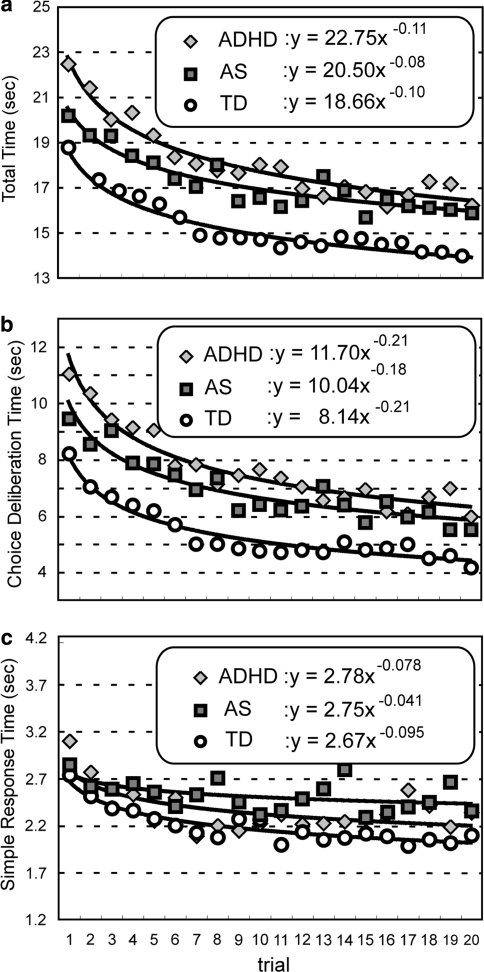
Developmental disorders such as attention-deficit/hyperactivity disorder (ADHD) and Asperger syndrome (AS) are often associated with learning disabilities. This study investigated the explicit learning of visuomotor sequences in 17 ADHD children (mean age 12.1), 21 AS children (mean age 12.7), and 15 typically developing children (mean age: 12.3). The participants were required to explore a hidden sequence of button presses by trial and error and elaborate the learned sequence (2 x 10 task: Hikosaka et al. 1996). The results indicated that although ADHD and AS children had a tendency of repeating the same errors and took longer to complete a sequence, both showed a degree and pattern of improvement in accuracy and speed similar to that of typically developing children. These results suggest that the explicit learning of visuomotor sequence in ADHD and AS patients is largely unimpaired.
发展障碍,如注意力缺陷/多动障碍(ADHD)和阿斯伯格综合征(AS),常与学习障碍相关。本研究调查了 17 名 ADHD 儿童(平均年龄 12.1 岁)、21 名 AS 儿童(平均年龄 12.7 岁)和 15 名正常发育儿童(平均年龄:12.3 岁)对视觉运动序列的外显学习。要求参与者通过试错来探索隐藏的按钮按下序列,并详细说明所学的序列(2 x 10 任务:Hikosaka 等人,1996 年)。结果表明,尽管 ADHD 和 AS 儿童有重复相同错误的倾向,并且完成序列的时间更长,但他们在准确性和速度上的提高程度和模式与正常发育的儿童相似。这些结果表明,ADHD 和 AS 患者的视觉运动序列外显学习在很大程度上未受损害。