Department of Neurology, Division of Neuromuscular Disease, Brigham and Women's Hospital, Boston, MA, USA.
Clin Immunol. 2010 Jul;136(1):130-8. doi: 10.1016/j.clim.2010.02.014. Epub 2010 Mar 25.
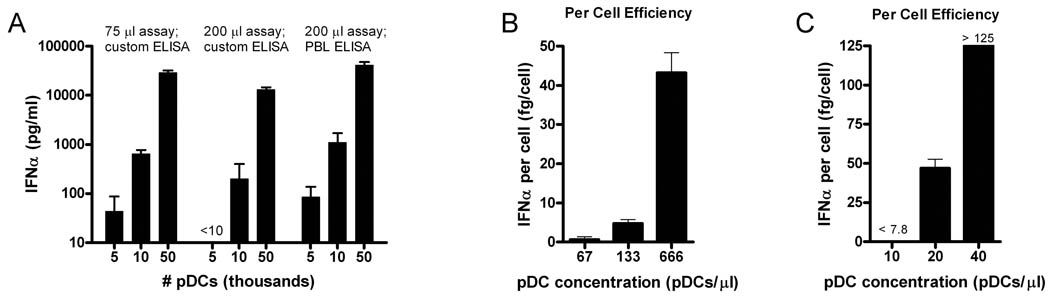
To determine the potential consequences of plasmacytoid dendritic cell (pDC) accumulation in tissue sites observed in several autoimmune diseases, we measured type 1 interferon production from circulating human pDCs as a function of pDC concentration. The effects of interferon-alpha and blockade of the type 1 interferon receptor (IFNAR) on human pDC type 1 interferon and interferon-inducible transcription and protein production were measured. Human pDCs became far more efficient producers of interferon-alpha at concentrations beyond those normally present in blood, through an IFNAR-dependent mechanism. Extracellular interferon-alpha increased pDC production of type 1 interferons. The accumulation of pDCs in diseased tissue sites allows marked non-linear amplification of type 1 interferon production locally. The role of the IFNAR-dependent mechanism of interferon production by human pDCs is greater than previously suggested. IFNAR blockade has potential for diminishing type 1 interferon production by all human cells.
为了确定几种自身免疫性疾病中观察到的组织部位浆细胞样树突状细胞 (pDC) 积累的潜在后果,我们测量了循环人 pDC 中 1 型干扰素的产生,作为 pDC 浓度的函数。测量了干扰素-α和 1 型干扰素受体 (IFNAR) 阻断对人 pDC 1 型干扰素和干扰素诱导的转录和蛋白产生的影响。通过 IFNAR 依赖性机制,人 pDC 在超出正常血液浓度的浓度下,成为干扰素-α的更有效产生者。细胞外干扰素-α增加了 pDC 产生 1 型干扰素。pDC 在疾病组织部位的积累允许局部显著的非线性格式放大 1 型干扰素的产生。人 pDC 产生干扰素的 IFNAR 依赖性机制的作用比以前认为的更大。IFNAR 阻断有可能减少所有人类细胞产生 1 型干扰素。