Wang Zhenlin, Wang Zunyun, Hu Xianyu, Han Qijun, Chen Ke, Pang Gang
Department of General Surgery, The First Affiliated Hospital of Anhui Medical University, Hefei, 230022, Anhui, People's Republic of China.
Department of Human Anatomy, School of Basic Medicine Sciences, Anhui Medical University, Hefei, 230032, Anhui, People's Republic of China.
Int J Gen Med. 2021 Oct 13;14:6725-6739. doi: 10.2147/IJGM.S334245. eCollection 2021.
Gastric cancer (GC) is the third most frequent malignant tumour in the Chinese population, let alone the whole world. Recently, most prognostic models have only focused on the levels of several genes, miRNAs, lncRNAs, gene mutations, or DNA methylation; however, the activation status of biological pathways is more stable and can reflect the comprehensive inner conditions of tumours.
We collected samples from the Cancer Genome Atlas Stomach Adenocarcinoma (TCGA-STAD) cohort and GSE62254 cohort, with a total of 594 patients. We employed GSEA to first compare the diverse activated signalling pathways between dead GC patients and living patients. The least absolute shrinkage and selection operator (LASSO) regression analysis was subsequently performed by the "glmnet" package to generate a prognostic signature.
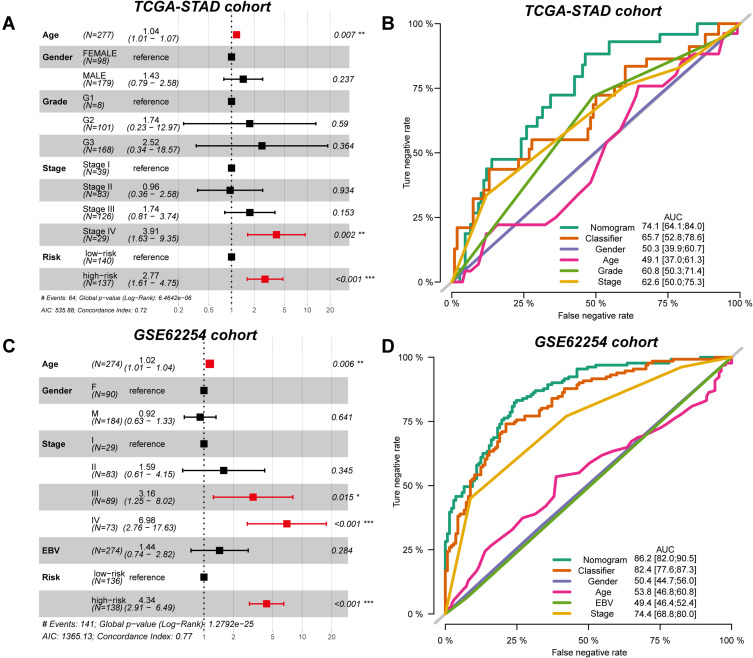
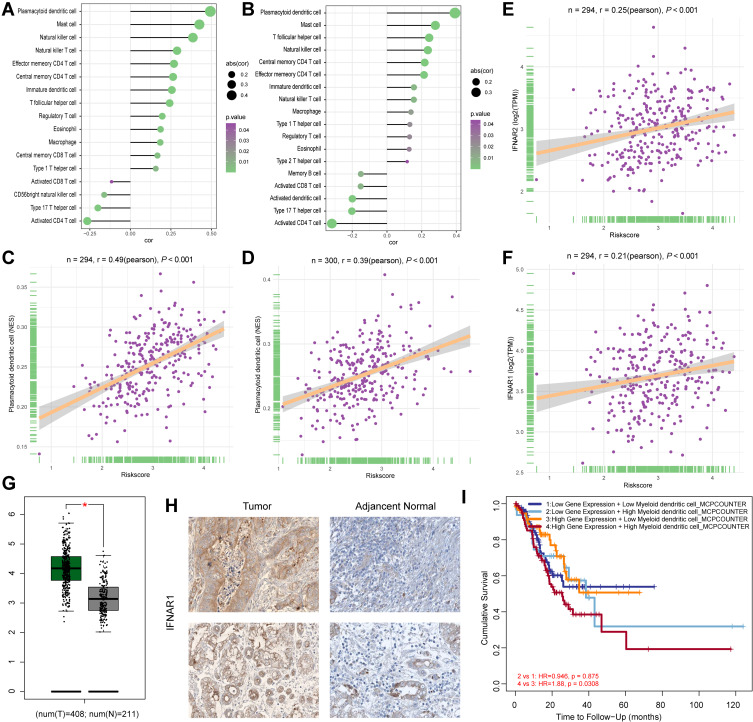
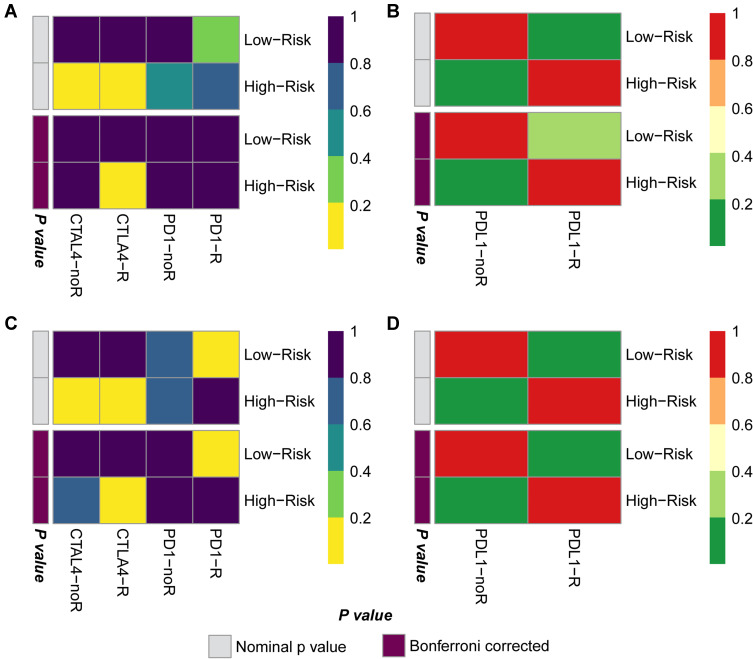
We extracted a total of 218 genes from the KEGG Focal Adhesion and KEGG ECM Receptor Interaction pathways, which showed significant activation in dead GC patients in two enrolled cohorts, for subsequent LASSO analysis. In the TCGA-STAD cohort, patients in the high-risk group faced a significantly poorer prognosis than those in the low-risk group (P < 0.001, HR: 4.62, 95% CI: 3.447-6.183), with an AUC of 0.694. In the GSE62254 cohort, the HR value was 4.94 (95% CI: 3.413-7.165), and the AUC value was as high as 0.834. A high-risk score and poor prognosis correlated with infiltrated dendritic cells, and the receptor of IFN-α was also positively linked with the risk score, as well as poor prognosis. GC patients with high-risk scores were more likely to respond to CTLA4 treatment but not PD1 treatment.
Taken together, we established and verified an extracellular matrix prognostic model of gastric cancer patients. The model can be used to evaluate the risk of death of GC patients, as well as the response to anti-CTLA4 immunotherapy.
胃癌(GC)是中国人群中第三常见的恶性肿瘤,在全球范围内更是如此。最近,大多数预后模型仅关注几个基因、miRNA、lncRNA的水平、基因突变或DNA甲基化;然而,生物通路的激活状态更稳定,能够反映肿瘤的综合内在状况。
我们从癌症基因组图谱胃腺癌(TCGA-STAD)队列和GSE62254队列中收集样本,共594例患者。我们首先使用基因集富集分析(GSEA)比较死亡的GC患者和存活患者之间不同的激活信号通路。随后通过“glmnet”包进行最小绝对收缩和选择算子(LASSO)回归分析,以生成预后特征。
我们从KEGG粘着斑和KEGG细胞外基质受体相互作用通路中总共提取了218个基因,这些基因在两个纳入队列的死亡GC患者中显示出显著激活,用于后续的LASSO分析。在TCGA-STAD队列中,高风险组患者的预后明显比低风险组患者差(P<0.001,HR:4.62,95%CI:3.447-6.183),曲线下面积(AUC)为0.694。在GSE62254队列中,HR值为4.94(95%CI:3.413-7.165),AUC值高达0.834。高风险评分和不良预后与浸润的树突状细胞相关,干扰素-α受体也与风险评分以及不良预后呈正相关。高风险评分的GC患者更可能对CTLA4治疗有反应,但对PD1治疗无反应。
综上所述,我们建立并验证了一个胃癌患者的细胞外基质预后模型。该模型可用于评估GC患者的死亡风险以及对抗CTLA4免疫治疗的反应。