Department of Surgical and Gastroenterological Sciences, University of Padua, Padua, Italy.
BMC Gastroenterol. 2010 Apr 1;10:35. doi: 10.1186/1471-230X-10-35.
Bax inhibitor-1 (BI-1) is an evolutionary conserved endoplasmic reticulum protein that, when overexpressed in mammalian cells, suppresses the apoptosis induced by Bax, a pro-apoptotic member of the Bcl-2 family. The aims of this study were: (1) to clarify the role of intrinsic anti- and pro-apoptotic mediators, evaluating Bax and BI-1 mRNA and protein expressions in liver tissues from patients with different degrees of liver damage; (2) to determine whether HCV and HBV infections modulate said expression.
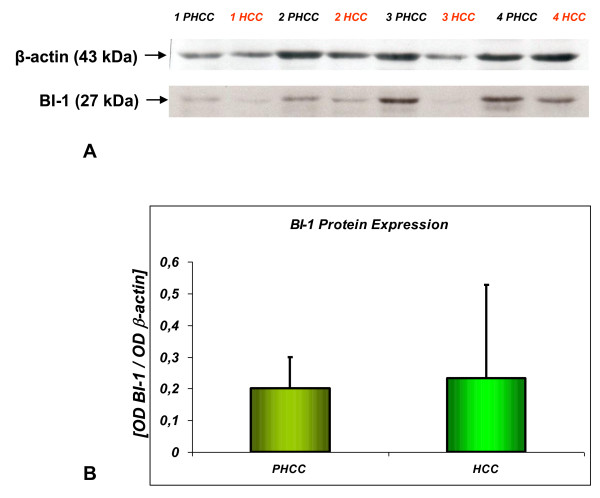
We examined 62 patients: 39 with chronic hepatitis (CH) (31 HCV-related and 8 HBV-related); 7 with cirrhosis (6 HCV-related and 1 HBV-related); 13 with hepatocellular carcinoma (HCC) [7 in viral cirrhosis (6 HCV- and 1 HBV-related), 6 in non-viral cirrhosis]; and 3 controls. Bax and BI-1 mRNAs were quantified by real-time PCR, and BI-1 protein expression by Western blot.
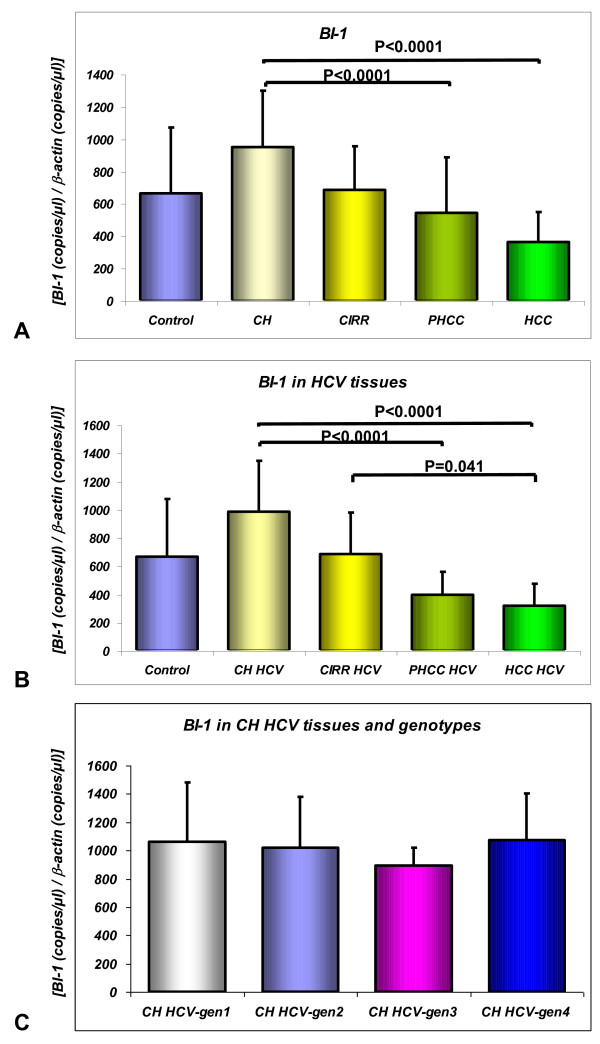
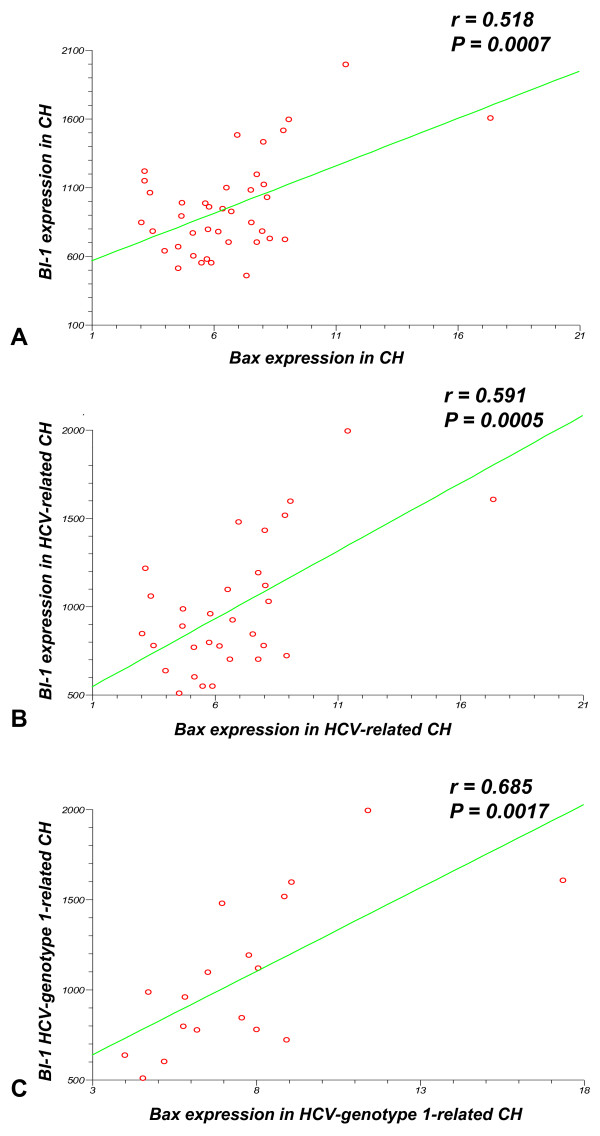
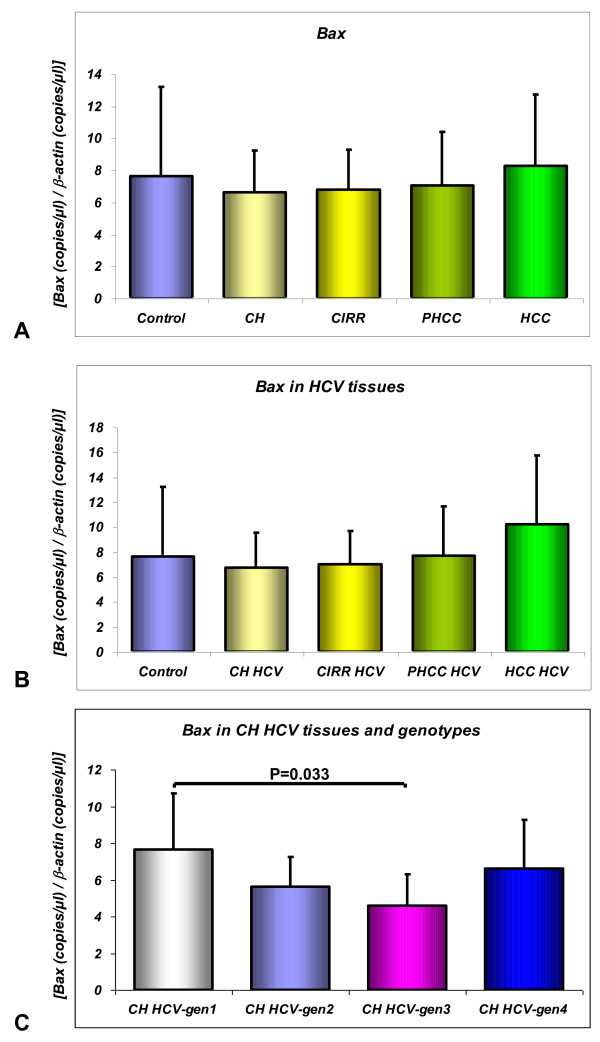
CH tissues expressed significantly higher BI-1 mRNA levels than cirrhotic tissues surrounding HCC (P < 0.0001) or HCC (P < 0.0001). Significantly higher Bax transcripts were observed in HCV-genotype-1-related than in HCV-genotype-3-related CH (P = 0.033). A positive correlation emerged between BI-1 and Bax transcripts in CH tissues, even when HCV-related CH and HCV-genotype-1-related CH were considered alone (P = 0.0007, P = 0.0005 and P = 0.0017, respectively).
BI-1 expression is down-regulated as liver damage progresses. The high BI-1 mRNAs levels observed in early liver disease may protect virus-infected cells against apoptosis, while their progressive downregulation may facilitate hepatocellular carcinogenesis. HCV genotype seems to have a relevant role in Bax transcript expression.
Bax 抑制剂-1(BI-1)是一种进化上保守的内质网蛋白,当其在哺乳动物细胞中过表达时,可抑制 Bax(Bcl-2 家族的促凋亡成员)诱导的细胞凋亡。本研究的目的是:(1)阐明内在抗凋亡和促凋亡介质的作用,评估不同程度肝损伤患者肝组织中的 Bax 和 BI-1 mRNA 和蛋白表达;(2)确定 HCV 和 HBV 感染是否调节所述表达。
我们检查了 62 名患者:39 名慢性肝炎(CH)患者(31 名 HCV 相关,8 名 HBV 相关);7 名肝硬化患者(6 名 HCV 相关,1 名 HBV 相关);13 名肝细胞癌(HCC)患者[7 名在病毒性肝硬化(6 名 HCV-和 1 名 HBV-相关),6 名在非病毒性肝硬化];和 3 名对照。通过实时 PCR 定量 Bax 和 BI-1 mRNA,通过 Western blot 定量 BI-1 蛋白表达。
CH 组织的 BI-1 mRNA 水平明显高于 HCC 周围的肝硬化组织(P < 0.0001)或 HCC(P < 0.0001)。HCV 基因型 1 相关的 CH 组织中 Bax 转录物显著高于 HCV 基因型 3 相关的 CH(P = 0.033)。在 CH 组织中观察到 BI-1 和 Bax 转录物之间呈正相关,即使在单独考虑 HCV 相关 CH 和 HCV 基因型 1 相关 CH 时也是如此(P = 0.0007、P = 0.0005 和 P = 0.0017)。
BI-1 的表达随着肝损伤的进展而下调。在早期肝病中观察到的高 BI-1 mRNA 水平可能使病毒感染的细胞免受凋亡,而其逐渐下调可能促进肝细胞癌的发生。HCV 基因型似乎在 Bax 转录物表达中具有重要作用。