Yüksel Sahru, Ayvazyan Lilit, Gasparyan Armen Yuri
Boğaziçi University, Department of Molecular Biology and Genetics, Istanbul, Turkey.
Open Cardiovasc Med J. 2010 Feb 23;4:51-6. doi: 10.2174/1874192401004020051.
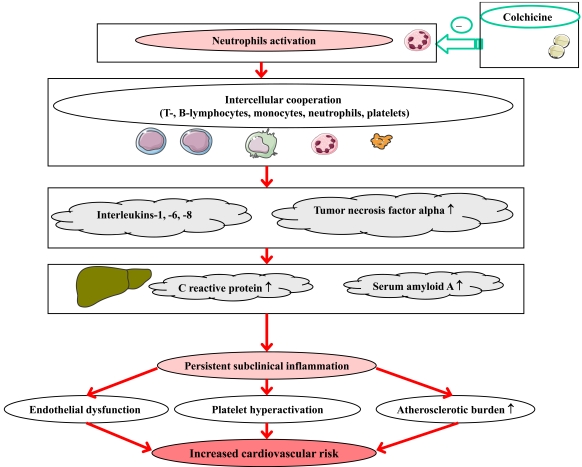
Numerous inflammatory and innate immune pathways are involved in atherogenesis. Elaboration of clinical models of inflammation-induced atherogenesis may further advance our knowledge of multiple inflammatory pathways implicated in atherogenesis and provide a useful tool for cardiovascular prevention. Familial Mediterranean fever (FMF) is a chronic inflammatory disorder with profiles of inflammatory markers close to that seen in the general population. In a few recent studies, it has been shown that endothelial dysfunction, increased atherosclerotic burden and activation of platelets accompany attack-free periods of FMF. Colchicine is proved to be useful in suppression of inflammation in FMF. Preliminary basic and clinical studies suggest that this relatively safe drug may be useful for cardiovascular protection in patients with FMF and in the general population. Multinational prospective studies are warranted to further elaborate clinical model of inflammation-induced atherosclerosis associated with FMF.
许多炎症和固有免疫途径都参与了动脉粥样硬化的发生发展。构建炎症诱导动脉粥样硬化的临床模型可能会进一步增进我们对参与动脉粥样硬化的多种炎症途径的了解,并为心血管疾病预防提供一个有用的工具。家族性地中海热(FMF)是一种慢性炎症性疾病,其炎症标志物谱与普通人群相近。最近的一些研究表明,在FMF的无发作期会出现内皮功能障碍、动脉粥样硬化负担增加和血小板活化。秋水仙碱已被证明对抑制FMF中的炎症有用。初步的基础和临床研究表明,这种相对安全的药物可能对FMF患者和普通人群的心血管保护有益。有必要开展多国前瞻性研究,以进一步完善与FMF相关的炎症诱导动脉粥样硬化的临床模型。