Gasparyan Armen Yuri
Department of Internal Medicine, Krankenhaus der Barmherzigen Brüder, Teaching Hospital of Medical University of Graz, Graz, Austria.
Open Cardiovasc Med J. 2009 Jul 7;3:78-80. doi: 10.2174/1874192400903010078.
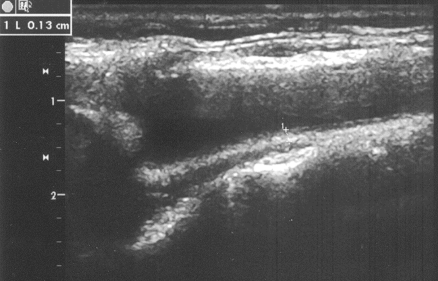
B-mode ultrasonography of the carotid artery is a non-invasive, informative and reproducible technique used for the assessment of prevalence and course of atherosclerosis in a variety of clinical conditions. Visualization of intima-media complex, atherosclerotic plaques, rough arterial wall and calcifications of the carotid artery may be useful for the assessment of atherosclerotic burden. The latter was confirmed in a recent consensus statement of the American Society of Echocardiography. Detection of structural changes, such as Menkeber's sclerosis of the medial layer of the carotid artery, carotid aneurysm may indicate advanced vascular pathology and prompt an appropriate treatment. Ultrasound images of patients with atherosclerotic plaque and Menkeberg's sclerosis are presented and issues related to clinical significance of the common carotid artery intima-media thickness are discussed.
颈动脉B超检查是一种用于评估多种临床情况下动脉粥样硬化的患病率和病程的非侵入性、信息丰富且可重复的技术。颈动脉内膜中层复合体、动脉粥样硬化斑块、动脉壁粗糙及钙化的可视化对于评估动脉粥样硬化负担可能有用。美国超声心动图学会最近的一份共识声明证实了后者。检测结构变化,如颈动脉中层的门克贝格硬化、颈动脉动脉瘤,可能提示晚期血管病变并促使进行适当治疗。本文展示了动脉粥样硬化斑块和门克贝格硬化患者的超声图像,并讨论了与颈总动脉内膜中层厚度临床意义相关的问题。