Department of Immunology, St. Jude Children's Research Hospital, Memphis, TN 38104, USA.
J Immunol. 2010 May 1;184(9):4610-4. doi: 10.4049/jimmunol.1000217. Epub 2010 Apr 5.
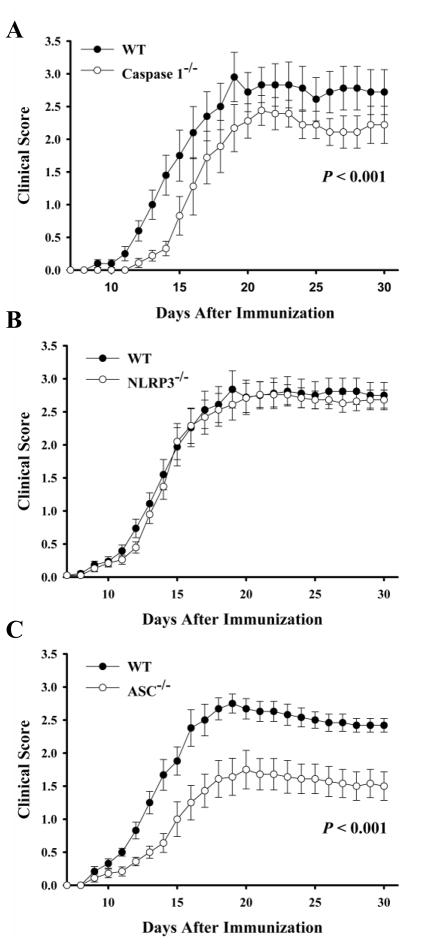
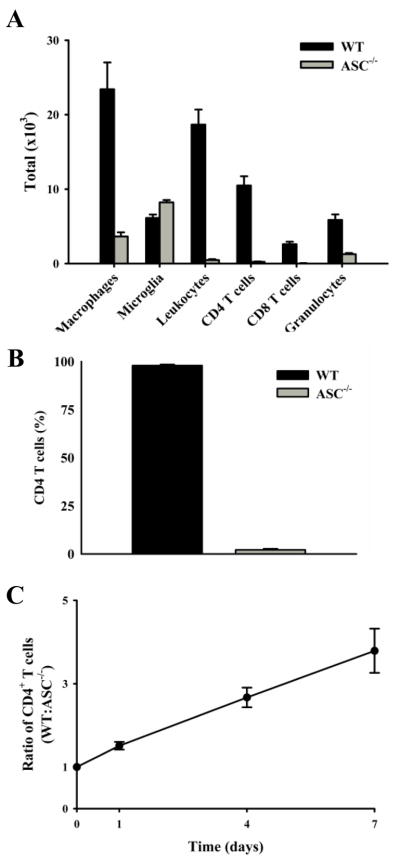
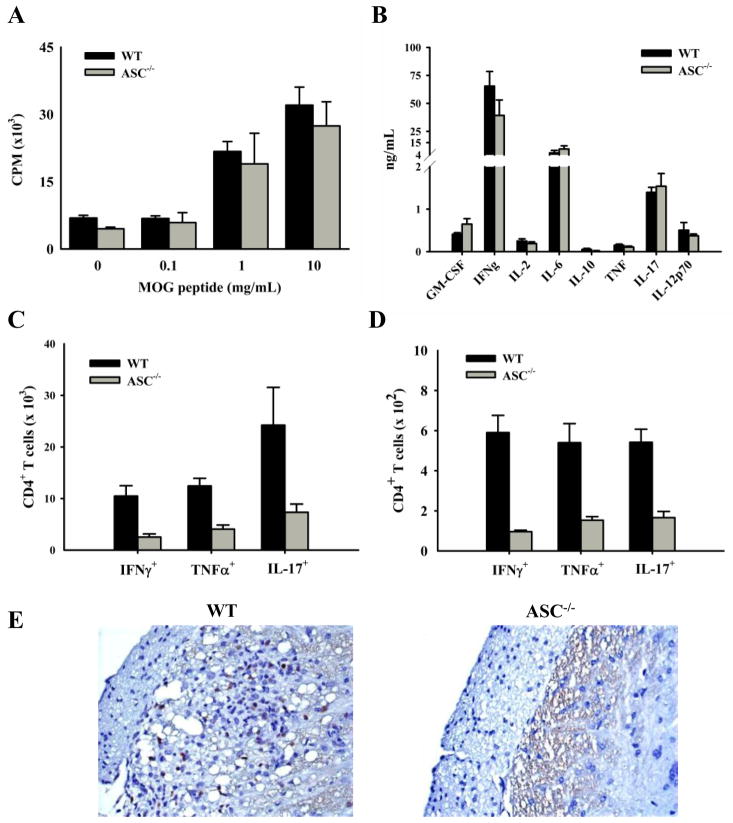
Multiple sclerosis is an autoimmune disease in which self-reactive T cells attack oligodendrocytes that myelinate axons in the CNS. Experimental autoimmune encephalomyelitis (EAE), an animal model of multiple sclerosis, is dependent on caspase-1; however, the role of Nod-like receptors upstream of caspase-1 is unknown. Danger- and pathogen-associated molecular patterns activate Nod-like receptor 3, which activates caspase-1 through the adaptor protein, apoptosis-associated speck-like protein containing CARD (ASC). We report that the progression of EAE is dependent on ASC and caspase-1 but not Nod-like receptor 3. ASC(-/-) mice were even more protected from the progression of EAE than were caspase-1(-/-) mice, suggesting that an inflammasome-independent function of ASC contributes to the progression of EAE. We found that CD4(+) T cells deficient in ASC exhibited impaired survival; accordingly, ASC(-/-) mice had fewer myelin oligodendrocyte glycoprotein-specific T cells in the draining lymph nodes and CNS.
多发性硬化症是一种自身免疫性疾病,其中自身反应性 T 细胞攻击中枢神经系统中髓鞘轴突的少突胶质细胞。实验性自身免疫性脑脊髓炎(EAE)是多发性硬化症的动物模型,依赖于半胱天冬酶-1;然而,半胱天冬酶-1 上游的 Nod 样受体的作用尚不清楚。危险和病原体相关的分子模式激活 Nod 样受体 3,其通过衔接蛋白凋亡相关斑点样蛋白含有 CARD(ASC)激活半胱天冬酶-1。我们报告 EAE 的进展依赖于 ASC 和半胱天冬酶-1,但不依赖于 Nod 样受体 3。ASC(-/-)小鼠比 caspase-1(-/-)小鼠更能防止 EAE 的进展,这表明 ASC 的炎症小体非依赖性功能有助于 EAE 的进展。我们发现缺乏 ASC 的 CD4(+)T 细胞表现出存活能力受损;因此,ASC(-/-)小鼠在引流淋巴结和中枢神经系统中具有较少的髓鞘少突胶质糖蛋白特异性 T 细胞。