Mata-Martínez Esperanza, Díaz-Muñoz Mauricio, Vázquez-Cuevas Francisco G
Laboratorio de Fisiología Celular, Departamento de Neurobiología Celular y Molecular, Instituto de Neurobiología, Universidad Nacional Autónoma de México, Juriquilla, Mexico.
Front Cell Neurosci. 2022 Jun 16;16:929529. doi: 10.3389/fncel.2022.929529. eCollection 2022.
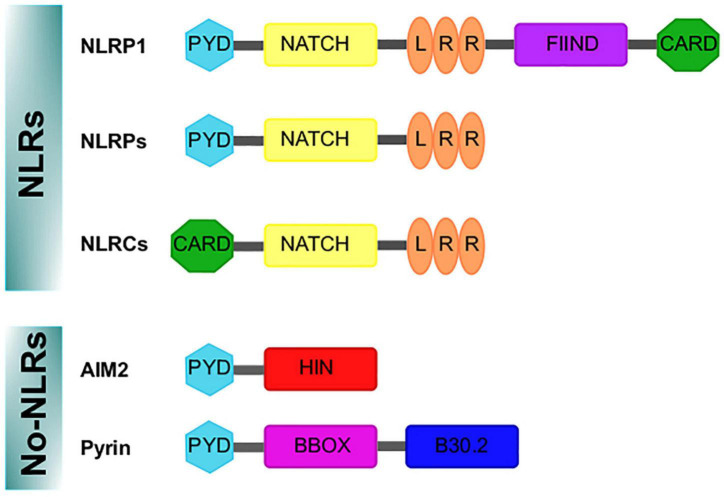
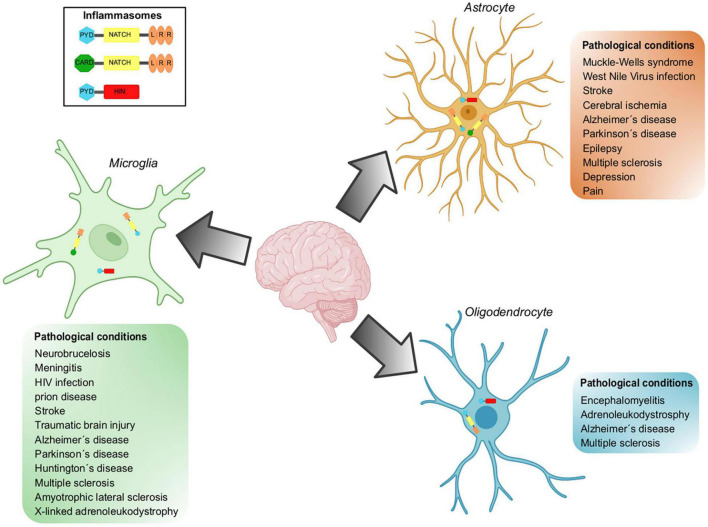
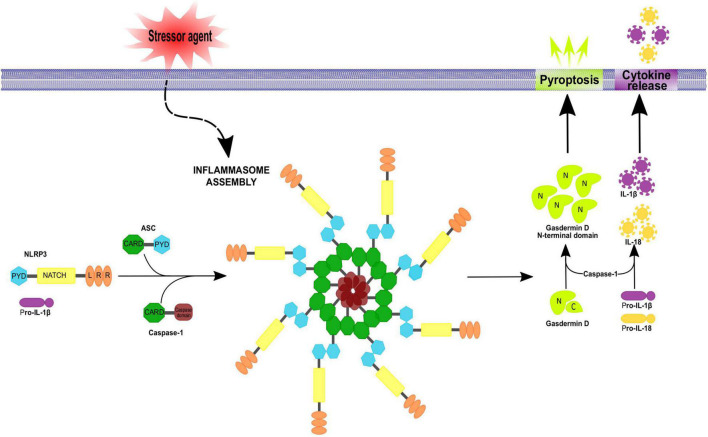
Inflammation mediated by the innate immune system is a physiopathological response to diverse detrimental circumstances such as microbe infections or tissular damage. The molecular events that underlie this response involve the assembly of multiprotein complexes known as inflammasomes. These assemblages are essentially formed by a stressor-sensing protein, an adapter protein and a non-apoptotic caspase (1 or 11). The coordinated aggregation of these components mediates the processing and release of pro-inflammatory interleukins (IL-β and IL-18) and cellular death by pyroptosis induction. The inflammatory response is essential for the defense of the organism; for example, it triggers tissue repair and the destruction of pathogen microbe infections. However, when inflammation is activated chronically, it promotes diverse pathologies in the lung, liver, brain and other organs. The nervous system is one of the main tissues where the inflammatory process has been characterized, and its implications in health and disease are starting to be understood. Thus, the regulation of inflammasomes in specific cellular types of the central nervous system needs to be thoroughly understood to innovate treatments for diverse pathologies. In this review, the presence and participation of inflammasomes in pathological conditions in different types of glial cells will be discussed.
由先天免疫系统介导的炎症是对多种有害情况(如微生物感染或组织损伤)的生理病理反应。构成这种反应基础的分子事件涉及被称为炎性小体的多蛋白复合物的组装。这些组装体主要由应激源感应蛋白、衔接蛋白和非凋亡性半胱天冬酶(1或11)组成。这些成分的协同聚集介导促炎白细胞介素(IL-β和IL-18)的加工和释放以及通过焦亡诱导导致细胞死亡。炎症反应对于机体防御至关重要;例如,它触发组织修复和病原体微生物感染的破坏。然而,当炎症被慢性激活时,它会在肺、肝、脑和其他器官中引发多种病症。神经系统是已对炎症过程进行特征描述的主要组织之一,其在健康和疾病中的影响也开始被理解。因此,需要深入了解中枢神经系统特定细胞类型中炎性小体的调节,以便为多种病症创新治疗方法。在这篇综述中,将讨论炎性小体在不同类型神经胶质细胞病理状况中的存在和作用。