Division of Adult and Community Health, National Center for Chronic Disease Prevention and Health Promotion, Centers for Disease Control and Prevention, Atlanta, Georgia, USA.
Diabetes Care. 2010 Jul;33(7):1618-24. doi: 10.2337/dc09-1788. Epub 2010 Apr 5.
We sought to assess the associations of testosterones and sex hormone-binding globulin (SHBG) with metabolic syndrome and insulin resistance in men.
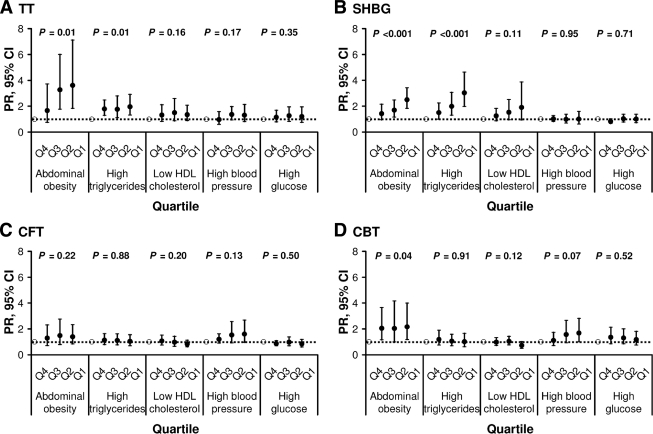
We defined metabolic syndrome according to the National Cholesterol Education Program Expert Panel on Detection, Evaluation, and Treatment of High Blood Cholesterol in Adults. Among men aged >or=20 years who participated in the Third National Health and Nutrition Examination Survey (n = 1,226), the Cox proportional hazards model was used to estimate the prevalence ratio and 95% CI of metabolic syndrome according to circulating concentrations of testosterones and SHBG.
After adjustment for age, race/ethnicity, smoking status, alcohol intake, physical activity level, LDL cholesterol, C-reactive protein, and insulin resistance, men in the first quartile (lowest) (prevalence ratio 2.16 [95% CI 1.53-3.06]) and second quartile of total testosterone (2.51 [1.86-3.37]) were more likely to have metabolic syndrome than men in the fourth quartile (highest, referent group) (P < 0.001 for linear trend). Similarly, men in the first quartile of SHBG (2.17 [1.32-3.56]) were more likely to have metabolic syndrome than men in the fourth quartile (P = 0.02 for linear trend). No significant associations of calculated free testosterone (P = 0.31 for linear trend) and bioavailable testosterone (P = 0.11 for linear trend) with metabolic syndrome were detected after adjustment for all possible confounders.
Low concentrations of total testosterone and SHBG were strongly associated with increased likelihood of having metabolic syndrome, independent of traditional cardiovascular risk factors and insulin resistance.
我们旨在评估男性体内睾酮和性激素结合球蛋白(SHBG)与代谢综合征和胰岛素抵抗的相关性。
我们根据美国国家胆固醇教育计划专家小组(NCEP)提出的成人高胆固醇血症检测、评估与治疗标准来定义代谢综合征。在参与第三次全国健康和营养调查(NHANES III)的年龄≥20 岁的男性(n=1226)中,我们采用 Cox 比例风险模型,根据循环睾酮和 SHBG 浓度来估计代谢综合征的患病率比和 95%可信区间。
在调整年龄、种族/民族、吸烟状态、饮酒量、体力活动水平、LDL 胆固醇、C-反应蛋白和胰岛素抵抗后,总睾酮第一四分位数(最低)(患病率比 2.16 [95%可信区间 1.53-3.06])和第二四分位数(2.51 [1.86-3.37])的男性比第四四分位数(最高,参照组)的男性更易发生代谢综合征(P<0.001,线性趋势)。同样,SHBG 第一四分位数(2.17 [1.32-3.56])的男性比第四四分位数的男性更易发生代谢综合征(P=0.02,线性趋势)。在调整所有可能的混杂因素后,计算得出的游离睾酮(P=0.31,线性趋势)和生物可利用睾酮(P=0.11,线性趋势)与代谢综合征之间无显著相关性。
总睾酮和 SHBG 浓度较低与代谢综合征的发生几率增加密切相关,这独立于传统心血管危险因素和胰岛素抵抗。