• 文献检索
  • 文档翻译
  • 深度研究
  • 学术资讯
  • Suppr Zotero 插件Zotero 插件
  • 邀请有礼
  • 套餐&价格
  • 历史记录
应用&插件
Suppr Zotero 插件Zotero 插件浏览器插件Mac 客户端Windows 客户端微信小程序
定价
高级版会员购买积分包购买API积分包
服务
文献检索文档翻译深度研究API 文档MCP 服务
关于我们
关于 Suppr公司介绍联系我们用户协议隐私条款
关注我们

Suppr 超能文献

核心技术专利:CN118964589B侵权必究
粤ICP备2023148730 号-1Suppr @ 2026

文献检索

告别复杂PubMed语法,用中文像聊天一样搜索,搜遍4000万医学文献。AI智能推荐,让科研检索更轻松。

立即免费搜索

文件翻译

保留排版,准确专业,支持PDF/Word/PPT等文件格式,支持 12+语言互译。

免费翻译文档

深度研究

AI帮你快速写综述,25分钟生成高质量综述,智能提取关键信息,辅助科研写作。

立即免费体验

双相障碍中 MRI 高信号病变:一项荟萃分析和综述。

Hyperintense MRI lesions in bipolar disorder: A meta-analysis and review.

机构信息

Department of Psychiatry, Duke University Medical Center, Durham, North Carolina, USA.

出版信息

Int Rev Psychiatry. 2009;21(4):394-409. doi: 10.1080/09540260902962198.

DOI:10.1080/09540260902962198
PMID:20374153
原文链接:https://pmc.ncbi.nlm.nih.gov/articles/PMC4098150/
Abstract

BACKGROUND

Cortical and subcortical hyperintensities in magnetic resonance imaging (MRI) scans are thought to represent areas of ischemic damage to brain tissue. Researchers have focused on the possible role these lesions may have in psychiatric disorders, including bipolar disorder. In 1997, the proposed 'vascular mania' diagnosis suggested utilizing not only the presence of strokes, but also confluent hyperintensities in its diagnostic criteria. This study was conducted to use meta-analytic techniques to investigate the association of hyperintensities and bipolar illness and to evaluate the current state of the literature.

METHODS

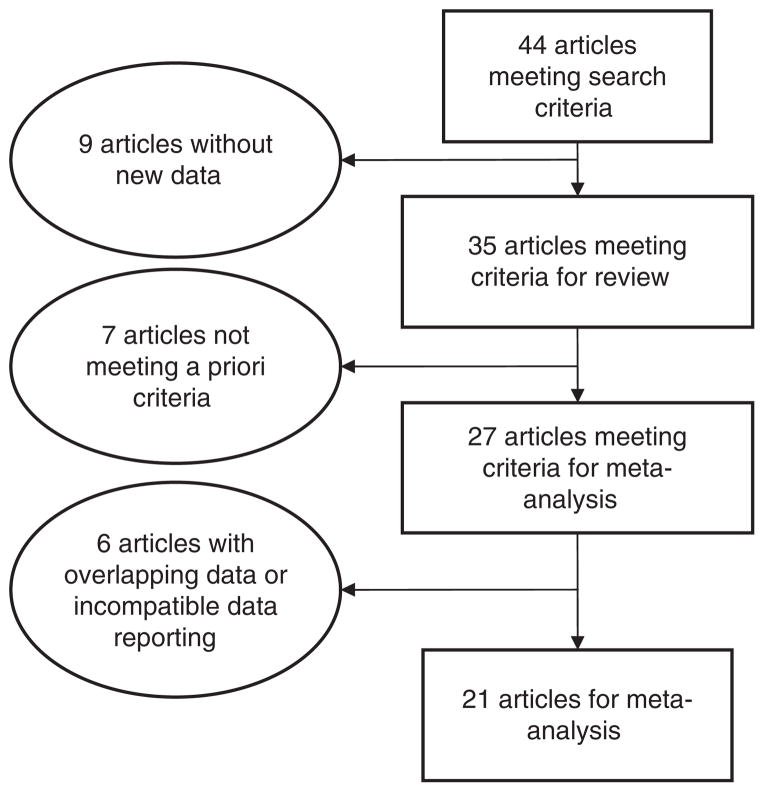
Using the PubMed and MEDLINE databases, we conducted a systematic literature search of studies investigating hyperintensities in subjects with bipolar disorder and controls or other psychiatric illnesses. We identified 44 publications from which 35 studies were included for review and 27 were selected for meta-analysis. Summary statistics of the prevalence were estimated through odds-ratios and confidence interval. Heterogeneity of the results across studies was tested using Q-statistics.

RESULTS

Meta-analysis identified an odds ratio of 2.5 (95% CI 1.9, 3.3) for hyperintensities in bipolar subjects compared to controls; however, there was significant heterogeneity among the studies (Q-statistics = 32; p = 0.04). This finding was most prominent for adolescents and children where the odds ratio was 5.7 (95% CI 2.3, 13.7). Deep white matter hyperintensities (odd ratio 3.2; 95% CI 2.2, 4.5) and subcortical grey matter hyperintensities (odds ratio 2.7; 95% CI 1.3, 2.9) were more strongly associated with bipolar subjects. There were no differences between bipolar subjects and controls for perivascular hyperintensities (odds ratio 1.3; 95% CI 0.8, 1.9). Though hyperintensities were numerically greater in bipolar subjects, meta-analysis did not demonstrate any significant differences between bipolar subjects and unipolar depression subjects (OR 1.6; 95% CI 0.9, 2.7) nor subjects with schizophrenia (OR 1.5; 95% CI 0.9, 2.7).

CONCLUSIONS

This meta-analysis continues to support the association of bipolar disorder and hyperintensities, especially in the deep white matter and subcortical grey matter. It also highlights the increased incidence in children and adolescence with bipolar disorder. However, hyperintensities are not specific to bipolar disorder, but appear at similar rates in unipolar depression and schizophrenia. Thus, the role of hyperintensities in the pathogenesis, pathophysiology, and treatment of bipolar disorder remains unclear. Further studies are required that are large enough to decrease the heterogeneity of the samples and MRI techniques, assess size and location of hyperintensities, and the impact on treatment response. Coordination with newer imaging techniques, such as diffusion tensor imaging (DTI) may be especially helpful in understanding the pathology of these lesions.
https://cdn.ncbi.nlm.nih.gov/pmc/blobs/f5fe/4098150/c620ef764ee2/nihms597520f2.jpg
https://cdn.ncbi.nlm.nih.gov/pmc/blobs/f5fe/4098150/1162a44cde8f/nihms597520f1.jpg
https://cdn.ncbi.nlm.nih.gov/pmc/blobs/f5fe/4098150/c620ef764ee2/nihms597520f2.jpg
https://cdn.ncbi.nlm.nih.gov/pmc/blobs/f5fe/4098150/1162a44cde8f/nihms597520f1.jpg
https://cdn.ncbi.nlm.nih.gov/pmc/blobs/f5fe/4098150/c620ef764ee2/nihms597520f2.jpg
摘要

背景

磁共振成像 (MRI) 扫描中的皮质和皮质下高信号被认为代表脑组织的缺血性损伤区域。研究人员专注于这些病变在包括双相情感障碍在内的精神疾病中的可能作用。1997 年,提出的“血管性躁狂”诊断建议不仅利用中风的存在,还利用其诊断标准中的融合性高信号。本研究旨在使用荟萃分析技术研究高信号与双相情感障碍之间的关联,并评估文献现状。

方法

我们使用 PubMed 和 MEDLINE 数据库,对研究双相情感障碍患者和对照组或其他精神疾病患者高信号的文献进行了系统的文献检索。我们从 44 篇出版物中确定了 35 项研究进行综述,其中 27 项研究进行了荟萃分析。通过优势比和置信区间估计患病率的汇总统计数据。使用 Q 统计量测试研究之间的异质性。

结果

荟萃分析确定,与对照组相比,双相情感障碍患者的高信号优势比为 2.5(95%置信区间 1.9, 3.3);然而,研究之间存在显著的异质性(Q 统计量=32;p=0.04)。这一发现在青少年和儿童中最为明显,优势比为 5.7(95%置信区间 2.3, 13.7)。深部白质高信号(优势比 3.2;95%置信区间 2.2, 4.5)和皮质下灰质高信号(优势比 2.7;95%置信区间 1.3, 2.9)与双相情感障碍患者的相关性更强。双相情感障碍患者和对照组之间的血管周围高信号无差异(优势比 1.3;95%置信区间 0.8, 1.9)。尽管双相情感障碍患者的高信号数值更大,但荟萃分析并未显示双相情感障碍患者与单相抑郁症患者(OR 1.6;95%置信区间 0.9, 2.7)或精神分裂症患者(OR 1.5;95%置信区间 0.9, 2.7)之间存在任何显著差异。

结论

本荟萃分析继续支持双相情感障碍与高信号之间的关联,尤其是在深部白质和皮质下灰质中。它还突出了双相情感障碍在儿童和青少年中的发病率增加。然而,高信号并非双相情感障碍所特有,在单相抑郁症和精神分裂症中也以相似的比率出现。因此,高信号在双相情感障碍的发病机制、病理生理学和治疗中的作用仍不清楚。需要进一步的研究,这些研究的样本和 MRI 技术足够大,可以降低样本的异质性,评估高信号的大小和位置,以及对治疗反应的影响。与新的成像技术(如弥散张量成像 (DTI))的协调可能有助于理解这些病变的病理学。

相似文献

1
Hyperintense MRI lesions in bipolar disorder: A meta-analysis and review.双相障碍中 MRI 高信号病变:一项荟萃分析和综述。
Int Rev Psychiatry. 2009;21(4):394-409. doi: 10.1080/09540260902962198.
2
T2 hyperintensities in bipolar disorder: magnetic resonance imaging comparison and literature meta-analysis.双相情感障碍中的T2高信号:磁共振成像比较与文献荟萃分析
Am J Psychiatry. 1995 Aug;152(8):1139-44. doi: 10.1176/ajp.152.8.1139.
3
White matter hyperintensities in subjects with bipolar disorder.双相情感障碍患者的白质高信号
Psychiatry Clin Neurosci. 2004 Oct;58(5):516-21. doi: 10.1111/j.1440-1819.2004.01294.x.
4
Combined analyses of gray matter voxel-based morphometry and white matter tract-based spatial statistics in pediatric bipolar mania.儿科双相情感障碍躁狂症的灰质体素形态计量学和白质束空间统计学的联合分析。
J Affect Disord. 2013 Aug 15;150(1):70-6. doi: 10.1016/j.jad.2013.02.021. Epub 2013 Mar 7.
5
Preliminary study of magnetic resonance imaging characteristics in 8- to 16-year-olds with mania.8至16岁躁狂症患儿磁共振成像特征的初步研究。
J Am Acad Child Adolesc Psychiatry. 1995 Jun;34(6):742-9. doi: 10.1097/00004583-199506000-00014.
6
White matter hyperintensities in bipolar and unipolar patients with relatively mild-to-moderate illness severity.病情相对轻至中度的双相情感障碍和单相情感障碍患者的白质高信号。
J Affect Disord. 2003 Dec;77(3):237-45. doi: 10.1016/s0165-0327(02)00170-2.
7
Assessment of white matter abnormalities in paranoid schizophrenia and bipolar mania patients.评估偏执型精神分裂症和双相情感障碍躁狂患者的脑白质异常。
Psychiatry Res. 2011 Dec 30;194(3):347-353. doi: 10.1016/j.pscychresns.2011.03.010. Epub 2011 Nov 12.
8
White matter hyperintensities in young individuals with bipolar disorder or at high genetic risk.双相障碍或遗传风险较高的年轻个体中的脑白质高信号。
J Affect Disord. 2019 Feb 15;245:228-236. doi: 10.1016/j.jad.2018.10.368. Epub 2018 Nov 2.
9
Late onset bipolar disorder associated with white matter hyperintensities: a pathophysiological hypothesis.与白质高信号相关的迟发性双相情感障碍:一种病理生理学假说。
Prog Neuropsychopharmacol Biol Psychiatry. 2007 Mar 30;31(2):551-6. doi: 10.1016/j.pnpbp.2006.10.004. Epub 2006 Nov 14.
10
Myelin staining of deep white matter in the dorsolateral prefrontal cortex in schizophrenia, bipolar disorder, and unipolar major depression.精神分裂症、双相情感障碍和单相重度抑郁症患者背外侧前额叶皮质深层白质的髓鞘染色
Psychiatry Res. 2007 Jun 30;151(3):179-88. doi: 10.1016/j.psychres.2006.12.019. Epub 2007 Apr 11.

引用本文的文献

1
Argyria and Neuropsychiatric Disorders: When not only the Matter is Gray. A Literature Review and a Case Report.银质沉着症与神经精神疾病:当不仅仅是皮肤变灰时。文献综述与病例报告
Curr Med Chem. 2025;32(19):3748-3758. doi: 10.2174/0109298673313180240625070037.
2
Leukoaraiosis: Epidemiology, Imaging, Risk Factors, and Management of Age-Related Cerebral White Matter Hyperintensities.脑白质疏松症:与年龄相关的脑白质高信号的流行病学、影像学、危险因素及管理
J Stroke. 2024 May;26(2):131-163. doi: 10.5853/jos.2023.02719. Epub 2024 May 30.
3
White matter hyperintensities in bipolar disorder: systematic review and meta-analysis.

本文引用的文献

1
Incidental findings on brain MRI in the general population.普通人群脑磁共振成像的偶然发现。
N Engl J Med. 2007 Nov 1;357(18):1821-8. doi: 10.1056/NEJMoa070972.
2
White matter hyperintensities and their associations with suicidality in patients with major affective disorders.重度情感障碍患者的白质高信号及其与自杀倾向的关联。
Eur Arch Psychiatry Clin Neurosci. 2007 Dec;257(8):494-9. doi: 10.1007/s00406-007-0755-x. Epub 2007 Sep 27.
3
Medical comorbidity in bipolar disorder: re-prioritizing unmet needs.双相情感障碍中的医学共病:重新确定未满足需求的优先级。
双相情感障碍中的白质高信号:系统评价与荟萃分析。
Front Psychiatry. 2024 Jan 26;15:1343463. doi: 10.3389/fpsyt.2024.1343463. eCollection 2024.
4
The Immunoseasonal Theory of Psychiatric Disorders.精神疾病的免疫季节性理论。
J Clin Med. 2023 Jul 11;12(14):4615. doi: 10.3390/jcm12144615.
5
Reduced Cortical Thicknesses of Adolescents with Bipolar Disorder and Relationship with Brain-derived Neurotrophic Factor.双相情感障碍青少年的皮质厚度降低及其与脑源性神经营养因子的关系
Scand J Child Adolesc Psychiatr Psychol. 2023 Jun 26;11(1):78-86. doi: 10.2478/sjcapp-2023-0008. eCollection 2023 Jan.
6
The non-linear correlation between the volume of cerebral white matter lesions and incidence of bipolar disorder: A secondary analysis of data from a cross-sectional study.脑白质病变体积与双相情感障碍发病率之间的非线性相关性:一项横断面研究数据的二次分析
Front Psychiatry. 2023 Mar 16;14:1149663. doi: 10.3389/fpsyt.2023.1149663. eCollection 2023.
7
Research Status in Clinical Practice Regarding Pediatric and Adolescent Bipolar Disorders.儿童和青少年双相情感障碍的临床实践研究现状
Front Psychiatry. 2022 May 27;13:882616. doi: 10.3389/fpsyt.2022.882616. eCollection 2022.
8
Insights into myelin dysfunction in schizophrenia and bipolar disorder.对精神分裂症和双相情感障碍中髓鞘功能障碍的见解。
World J Psychiatry. 2022 Feb 19;12(2):264-285. doi: 10.5498/wjp.v12.i2.264.
9
The additive impact of cardio-metabolic disorders and psychiatric illnesses on accelerated brain aging.心-代谢障碍和精神疾病对加速大脑老化的附加影响。
Hum Brain Mapp. 2022 Apr 15;43(6):1997-2010. doi: 10.1002/hbm.25769. Epub 2022 Feb 3.
10
Evaluating endophenotypes for bipolar disorder.评估双相情感障碍的内表型
Int J Bipolar Disord. 2021 May 27;9(1):17. doi: 10.1186/s40345-021-00220-w.
Curr Opin Psychiatry. 2007 Jul;20(4):406-16. doi: 10.1097/YCO.0b013e3281938102.
4
Progression of white matter hyperintensities in elderly individuals over 3 years.3年内老年个体脑白质高信号的进展情况。
Neurology. 2007 Jan 16;68(3):214-22. doi: 10.1212/01.wnl.0000251302.55202.73.
5
Late onset bipolar disorder associated with white matter hyperintensities: a pathophysiological hypothesis.与白质高信号相关的迟发性双相情感障碍:一种病理生理学假说。
Prog Neuropsychopharmacol Biol Psychiatry. 2007 Mar 30;31(2):551-6. doi: 10.1016/j.pnpbp.2006.10.004. Epub 2006 Nov 14.
6
Development and validation of MIX: comprehensive free software for meta-analysis of causal research data.MIX的开发与验证:用于因果研究数据荟萃分析的综合免费软件
BMC Med Res Methodol. 2006 Oct 13;6:50. doi: 10.1186/1471-2288-6-50.
7
Not all age-related white matter hyperintensities are the same: a magnetization transfer imaging study.并非所有与年龄相关的脑白质高信号都相同:一项磁化传递成像研究。
AJNR Am J Neuroradiol. 2006 Oct;27(9):1964-8.
8
Frontal signal hyperintensities in mania in old age.老年躁狂症中的额叶信号高强化
Am J Geriatr Psychiatry. 2006 Jul;14(7):598-604. doi: 10.1097/01.JGP.0000200603.70504.d5.
9
Advances in magnetic resonance imaging methods for the evaluation of bipolar disorder.用于评估双相情感障碍的磁共振成像方法的进展。
CNS Spectr. 2006 Apr;11(4):269-80. doi: 10.1017/s1092852900020770.
10
Association of Jacobsen syndrome and bipolar affective disorder in a patient with a de novo 11q terminal deletion.一名新发11q末端缺失患者的雅各布森综合征与双相情感障碍的关联
Am J Med Genet A. 2006 Feb 15;140(4):378-82. doi: 10.1002/ajmg.a.31088.