Bernhardt M, Pennell D R, Almer L S, Schell R F
Wisconsin State Laboratory of Hygiene, Madison.
J Clin Microbiol. 1991 Mar;29(3):422-5. doi: 10.1128/jcm.29.3.422-425.1991.
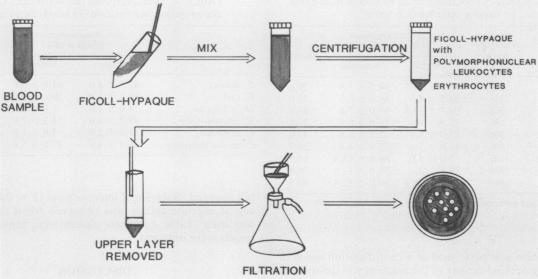
Culture of blood is the most frequent means of diagnosing bacteremia. However, conventional blood culturing methods are slow in isolating bacteria. We developed a method for isolation of bacteria by centrifugation and filtration. Fresh human whole blood was inoculated with facultatively anaerobic and aerobic microorganisms (3 to 172 microorganisms per 5 ml). Seeded blood was then mixed with Ficoll-Hypaque (density, 1.149 +/- 0.002 g/ml) and centrifuged (386 x g) for 30 min at ambient temperature. The entire gradient (plasma, leukocytes, and Ficoll-Hypaque) was removed and filtered through a 0.22-micron membrane filter (Millipore). The filters were then placed on chocolate agar plates and incubated at 35 degrees C in a humidified atmosphere containing 5% CO2. For each bacterium tested, approximately 35 to 100% of the viable microorganisms were recovered when compared with control cultures (pour plates of seeded blood). All bacteria produced isolated colonies on filters after overnight incubation (18 h). This procedure may prove to be a more rapid method for isolating bacteria from clinical blood samples than the blood culture bottle technique.
血液培养是诊断菌血症最常用的方法。然而,传统的血液培养方法在分离细菌方面速度较慢。我们开发了一种通过离心和过滤分离细菌的方法。将新鲜人全血接种兼性厌氧和需氧微生物(每5毫升3至172个微生物)。然后将接种的血液与Ficoll-Hypaque(密度,1.149 +/- 0.002克/毫升)混合,并在室温下以386 x g离心30分钟。去除整个梯度(血浆、白细胞和Ficoll-Hypaque)并通过0.22微米的膜过滤器(密理博)过滤。然后将过滤器放置在巧克力琼脂平板上,并在含5%二氧化碳的潮湿气氛中于35摄氏度孵育。与对照培养物(接种血液的倾注平板)相比,对于每种测试的细菌,约35%至100%的活微生物被回收。过夜孵育(18小时)后,所有细菌在过滤器上产生分离的菌落。与血培养瓶技术相比,该程序可能被证明是一种从临床血液样本中分离细菌的更快方法。