Department of Emergency Medicine, Tri-Service General Hospital, National Defense Medical Center, Neihu 114, Taipei, Taiwan.
Yonsei Med J. 2010 May;51(3):367-74. doi: 10.3349/ymj.2010.51.3.367.
Severe hypoglycemia can result in neural damage, impaired cognitive function, coma, seizures, or death. The decision to admit diabetic patients after initial treatment in the emergency department remains unclear. Our purpose is to identify risk factors for developing recurrent hypoglycemia in diabetic patients admitted for severe hypoglycemia.
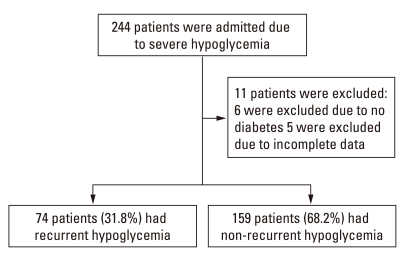
We reviewed the records of 233 subjects (92 males, 141 females; mean age, 74.1 +/- 9.8 years) with type 2 diabetes treated at a tertiary care teaching hospital and hospitalized for severe hypoglycemia.
Seventy-four (31.8%) patients were categorized with recurrent hypoglycemia and 159 (68.2%) with non-recurrent. Multivariate logistic regression analysis revealed that patients with loss of a recent meal, coronary artery disease, infection, and poor renal function (lower estimated glomerular filtration rate) were at risk for recurrent hypoglycemia. The use of calcium-channel blockers appeared to be a protective factor for the development of recurrent hypoglycemia.
There may be a subset of patients with severe hypoglycemia and certain risk factors for recurrent hypoglycemia that should be admitted.
严重低血糖可导致神经损伤、认知功能障碍、昏迷、癫痫发作,甚至死亡。对于在急诊科接受初始治疗后是否需要收治糖尿病患者,目前仍不明确。本研究旨在确定因严重低血糖而住院的糖尿病患者发生复发性低血糖的风险因素。
我们回顾了在一所三级教学医院接受治疗的 233 例(男性 92 例,女性 141 例;平均年龄 74.1 +/- 9.8 岁)2 型糖尿病患者的记录,这些患者因严重低血糖住院。
74 例(31.8%)患者被归类为复发性低血糖,159 例(68.2%)患者为非复发性低血糖。多变量逻辑回归分析显示,近期未进食、冠状动脉疾病、感染和肾功能不良(估算肾小球滤过率较低)的患者发生复发性低血糖的风险较高。钙通道阻滞剂的使用似乎是复发性低血糖发展的保护因素。
对于有严重低血糖和某些复发性低血糖风险因素的患者,可能需要收治入院。