Department of Psychology, University of Michigan, Ann Arbor, MI, USA.
Brain Res. 2010 Sep 2;1350:43-64. doi: 10.1016/j.brainres.2010.04.003. Epub 2010 Apr 11.
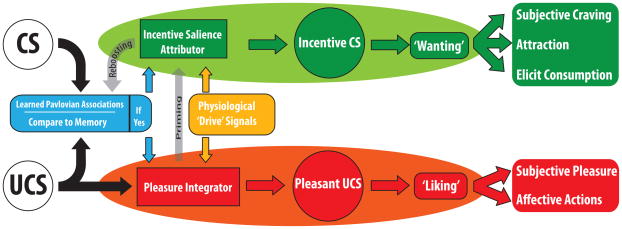
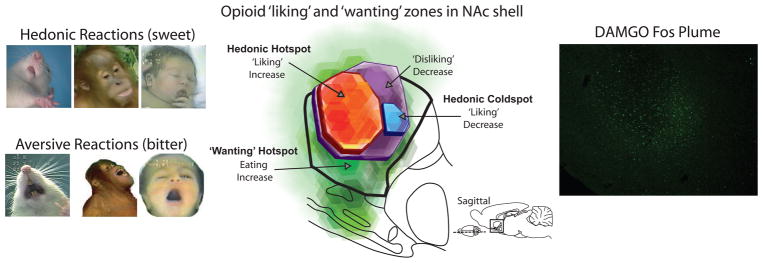
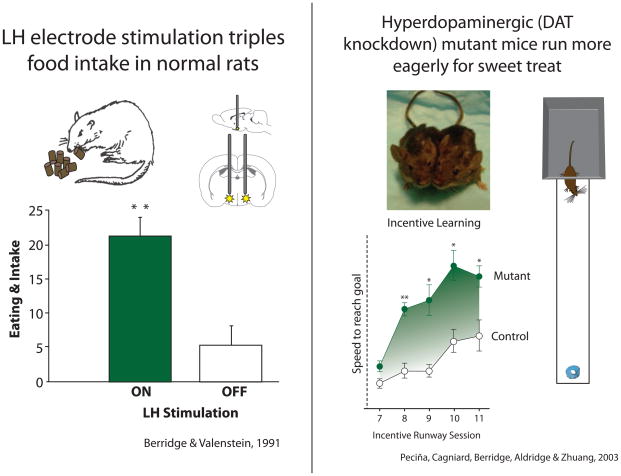
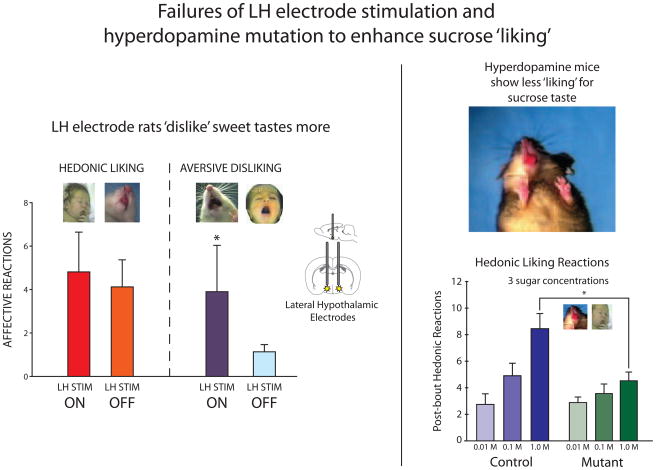
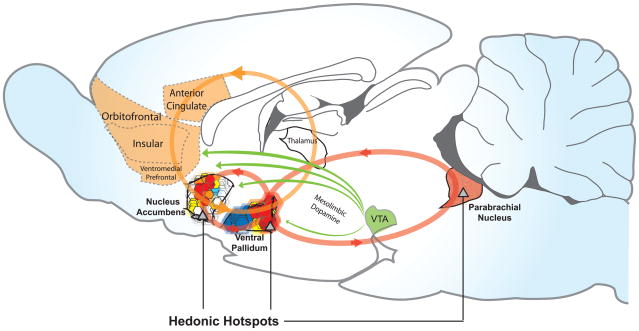
What we eat, when and how much, all are influenced by brain reward mechanisms that generate "liking" and "wanting" for foods. As a corollary, dysfunction in reward circuits might contribute to the recent rise of obesity and eating disorders. Here we assess brain mechanisms known to generate "liking" and "wanting" for foods and evaluate their interaction with regulatory mechanisms of hunger and satiety, relevant to clinical issues. "Liking" mechanisms include hedonic circuits that connect together cubic-millimeter hotspots in forebrain limbic structures such as nucleus accumbens and ventral pallidum (where opioid/endocannabinoid/orexin signals can amplify sensory pleasure). "Wanting" mechanisms include larger opioid networks in nucleus accumbens, striatum, and amygdala that extend beyond the hedonic hotspots, as well as mesolimbic dopamine systems, and corticolimbic glutamate signals that interact with those systems. We focus on ways in which these brain reward circuits might participate in obesity or in eating disorders.
我们所吃的食物、进食的时间和进食量,都受到大脑奖赏机制的影响,而这些机制会产生我们对食物的“喜好”和“欲求”。相应地,奖赏回路的功能障碍可能导致肥胖和饮食失调的发病率上升。在这里,我们评估了已知会产生对食物的“喜好”和“欲求”的大脑机制,并评估了它们与饥饿和饱腹感的调节机制的相互作用,这些作用与临床问题有关。“喜好”机制包括连接大脑边缘结构(如伏隔核和腹侧苍白球)中立方毫米热点的享乐回路(阿片类物质/内源性大麻素/食欲素信号可以放大感官愉悦)。“欲求”机制包括伏隔核、纹状体和杏仁核中更大的阿片类物质网络,这些网络超出了享乐热点的范围,还包括中边缘多巴胺系统以及皮质边缘谷氨酸信号,这些信号与这些系统相互作用。我们专注于这些大脑奖赏回路可能参与肥胖或饮食失调的方式。