Research Group Global Health: Ethics, economics and culture, Centre for International Health and Department of Public Health, University of Bergen, Norway.
Cost Eff Resour Alloc. 2010 Apr 16;8:5. doi: 10.1186/1478-7547-8-5.
While health outcomes of HIV/AIDS treatments in terms of increased longevity has been the subject of much research, there appears to be very limited research on the improved health related quality of life (HRQL) that can be applied in cost-utility analyses in Africa south of the Sahara (SSA). Most of the literature that does exist present HRQL measured by disease specific instruments, but such data is of little use as input to economic evaluations.
A systematic review of the literature on HRQL weights for people living with HIV/AIDS in Africa was performed, and the findings are presented and interpreted. We also use focus group discussions in panels of clinical AIDS experts to test the preference based on a generic descriptive system EQ-5D. We contrast quality of life with and without antiretroviral treatment (ART), and with and without treatment failure.
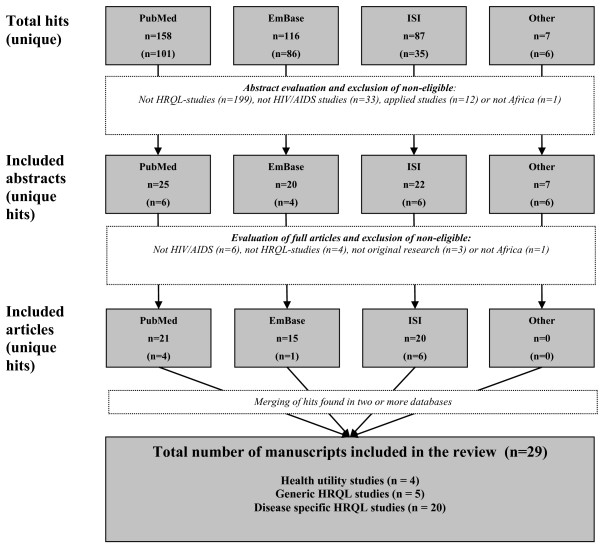
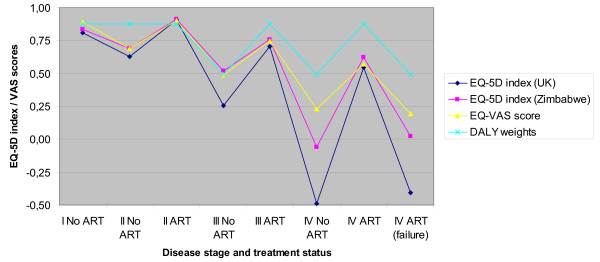
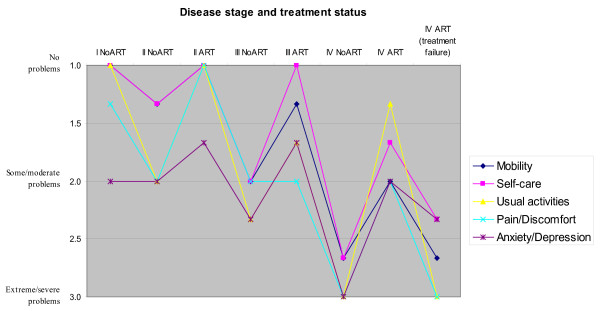
In only four papers were the HRQL weights for HIV/AIDS in sub-Saharan Africa estimated with generic preference based methodologies that can be directly applied in economic evaluation. A total of eight studies were based on generic health profiles. While such 'health profiles' are not preference based, the scores could potentially be transformed into health state utilities. Most of the available literature (20 papers) utilized disease specific instrument, which are not applicable for economic evaluation.The focus group discussions revealed that HRQL weights are strongly correlated to disease stage. Furthermore, clinical experts consistently report that ART has a strong positive impact on the HRQL of patients, although this effect appears to rebound in cases of drug resistance.
EQ-5D appears to be an appropriate tool for measuring and valuing HRQL of HIV/AIDS in Africa. More empirical research is needed on various methodological aspects in order to obtain valid and reliable HRQL weights in economic evaluations of HIV/AIDS prevention and treatment interventions.
尽管有关 HIV/AIDS 治疗在延长寿命方面的健康结果已经成为许多研究的主题,但在撒哈拉以南非洲(SSA)的成本效益分析中,似乎很少有研究关注改善与健康相关的生活质量(HRQL)。大多数现有的文献都通过疾病特异性工具来衡量 HRQL,但这些数据作为经济评估的输入几乎没有用处。
对撒哈拉以南非洲地区 HIV/AIDS 患者的 HRQL 权重的文献进行了系统回顾,并对发现进行了呈现和解释。我们还使用了临床艾滋病专家小组的焦点小组讨论来测试基于通用描述性系统 EQ-5D 的偏好。我们对比了有和没有抗逆转录病毒治疗(ART)以及有和没有治疗失败的情况下的生活质量。
只有四份论文使用了可以直接应用于经济评估的基于通用偏好的方法来估计撒哈拉以南非洲的 HIV/AIDS 的 HRQL 权重。总共进行了八项基于通用健康概况的研究。虽然这些“健康概况”不是基于偏好的,但分数有可能转化为健康状态效用。大多数现有文献(20 篇)都使用了疾病特异性工具,这些工具不适用于经济评估。焦点小组讨论表明,HRQL 权重与疾病阶段密切相关。此外,临床专家一致报告称,ART 对患者的 HRQL 有很强的积极影响,尽管在耐药的情况下这种影响似乎会反弹。
EQ-5D 似乎是衡量和评估非洲 HIV/AIDS 患者 HRQL 的合适工具。需要对各种方法学方面进行更多的实证研究,以在 HIV/AIDS 预防和治疗干预的经济评估中获得有效和可靠的 HRQL 权重。