Jerene Degu, Endale Aschalew, Hailu Yewubnesh, Lindtjørn Bernt
Centre for International Health, University of Bergen, Bergen, Norway.
BMC Infect Dis. 2006 Sep 1;6:136. doi: 10.1186/1471-2334-6-136.
HAART has improved the survival of HIV infected patients. However, compared to patients in high-income countries, patients in resource-poor countries have higher mortality rates. Our objective was to identify independent risk factors for death in Ethiopian patients treated with HAART.
In a district hospital in Ethiopia, we treated adult HIV infected patients with HAART based on clinical and total lymphocyte count (TLC) criteria. We measured body weight and complete blood cell count at baseline, 4 weeks later, then repeated weight every month and complete blood cell count every 12 weeks. Time to death was the main outcome variable. We used the Kaplan Meier and Cox regression survival analyses to identify prognostic markers. Also, we calculated mortality rates for the different phases of the follow-up.
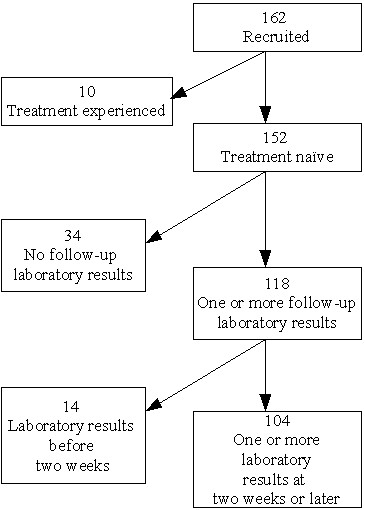
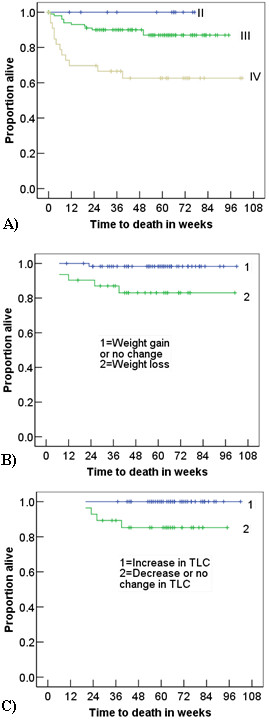
Out of 162 recruited, 152 treatment-naïve patients contributed 144.1 person-years of observation (PYO). 86 (57%) of them were men and their median age was 32 years. 24 patients died, making the overall mortality rate 16.7 per 100 PYO. The highest death rate occurred in the first month of treatment. Compared to the first month, mortality declined by 9-fold after the 18th week of follow-up. Being in WHO clinical stage IV and having TLC< or = 750/mcL were independent predictors of death. Haemoglobin (HGB) < or = 10 g/dl and TLC<= 1200/mcL at baseline were not associated with increased mortality. Body mass index (BMI) < or = 18.5 kg/m2 at baseline was associated with death in univariate analysis. Weight loss was seen in about a third of patients who survived up to the fourth week, and it was associated with increased death. Decline in TLC, HGB and BMI was associated with death in univariate analysis only.
The high mortality rate seen in this cohort was associated with advanced disease stage and very low TLC at presentation. Patients should be identified and treated before they progress to advanced stages. The underlying causes for early death in patients presenting at late stages should be investigated.
高效抗逆转录病毒治疗(HAART)提高了HIV感染患者的生存率。然而,与高收入国家的患者相比,资源匮乏国家的患者死亡率更高。我们的目标是确定接受HAART治疗的埃塞俄比亚患者死亡的独立危险因素。
在埃塞俄比亚的一家区级医院,我们根据临床和总淋巴细胞计数(TLC)标准对成年HIV感染患者进行HAART治疗。我们在基线、4周后测量体重和全血细胞计数,然后每月重复测量体重,每12周重复测量全血细胞计数。死亡时间是主要结局变量。我们使用Kaplan Meier和Cox回归生存分析来确定预后标志物。此外,我们计算了随访不同阶段的死亡率。
在招募的162名患者中,152名初治患者提供了144.1人年的观察期(PYO)。其中86名(57%)为男性,中位年龄为32岁。24名患者死亡,总死亡率为每100人年16.7例。最高死亡率发生在治疗的第一个月。与第一个月相比,随访第18周后死亡率下降了9倍。处于世界卫生组织临床IV期和TLC≤750/μL是死亡的独立预测因素。基线时血红蛋白(HGB)≤10 g/dL和TLC≤1200/μL与死亡率增加无关。基线时体重指数(BMI)≤18.5 kg/m²在单因素分析中与死亡有关。在存活至第四周的患者中,约三分之一出现体重减轻,且与死亡增加有关。TLC、HGB和BMI的下降仅在单因素分析中与死亡有关。
该队列中观察到的高死亡率与疾病晚期和就诊时极低的TLC有关。应在患者进展到晚期之前进行识别和治疗。应调查晚期就诊患者早期死亡的潜在原因。