Department of Psychiatry, Washington University in St. Louis, St. Louis, MO 63110-1093, USA.
Bipolar Disord. 2010 Mar;12(2):164-71. doi: 10.1111/j.1399-5618.2010.00791.x.
The Phenomenology and Course of Pediatric Bipolar Disorders study, a National Institute of Mental Health-funded study of child bipolar I disorder (BP-I) begun in 1995, is a prospective follow-up study that included collecting pharmacological and non-drug treatment data.
There were 115 first-episode subjects who fit full DSM-IV criteria for BP-I, mixed or manic phase, with severity scores in the clinically impaired range, ascertained by consecutive new case ascertainment. Subjects were assessed with the Washington University in St. Louis Kiddie Schedule for Affective Disorders and Schizophrenia (WASH-U-KSADS), given separately to parents about their children and to children about themselves. All treatment was provided by the subjects' own community practitioners, exactly as if they had not been in the research study. Thus, families were only seen for research assessments, and research staff were not at all involved in their treatment. Data on type, dose, and duration of pharmacological and non-drug treatment were collected. During follow-up, 93.9% (n = 108) were assessed at each of the nine assessment times.
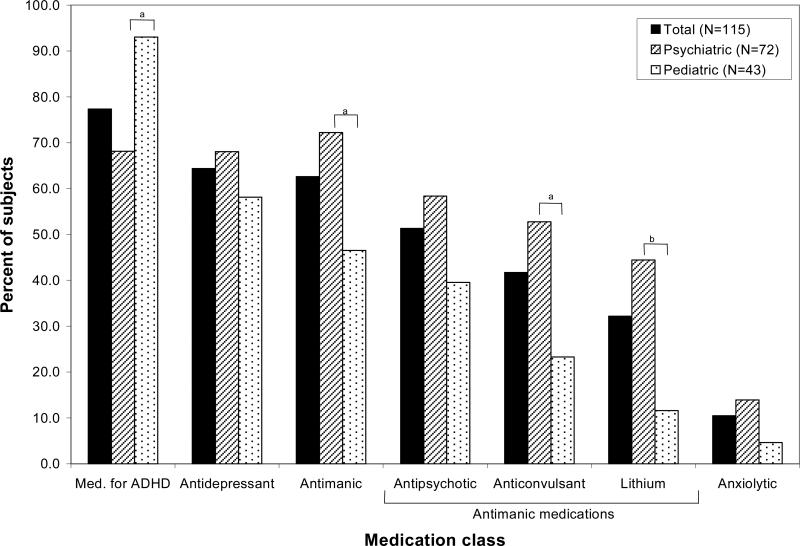
During the eight years, only 62.6% received any antimanic medication (antipsychotic, anticonvulsant, lithium) at any time. Percents who received non-antimanic medication included 77.4% medication for attention-deficit hyperactivity disorder and 64.3% antidepressants. A total of 67.8% of subjects were taking two or more concurrent medication classes. Subjects ascertained from psychiatric versus pediatric sites received antimanics significantly more frequently (p = 0.006). Earlier recovery during eight-year follow-up was predicted by greater percent of weeks on lithium (p = 0.017).
Given these findings, and the poor prognosis from prospective follow-up of this sample reported elsewhere, there is a need for further research that informs the development of effective treatment strategies.
儿童双相障碍现象学和病程研究是一项由美国国立精神卫生研究所资助的研究,始于 1995 年,对儿童 I 型双相障碍(BP-I)进行前瞻性随访研究,包括收集药理学和非药物治疗数据。
共有 115 名首发符合 DSM-IV 标准的 BP-I、混合或躁狂相、严重程度评分处于临床受损范围的患者被连续新病例发现确定。通过圣路易斯华盛顿大学儿童心境障碍和精神分裂症评定量表(WASH-U-KSADS)对患者进行评估,分别由父母和孩子自己报告。所有治疗均由患者所在社区医生提供,完全按照他们未参加研究的情况进行。因此,家庭仅接受研究评估,研究人员完全不参与他们的治疗。收集了药理学和非药物治疗的类型、剂量和持续时间的数据。在随访期间,93.9%(n=108)在九次评估时间中的每次都接受了评估。
在八年期间,只有 62.6%(n=108)的患者在任何时候都接受了任何抗躁狂药物(抗精神病药、抗惊厥药、锂盐)治疗。接受非抗躁狂药物治疗的患者百分比包括 77.4%的注意力缺陷多动障碍药物和 64.3%的抗抑郁药。共有 67.8%的患者同时服用两种或两种以上药物。从精神病科和儿科诊所发现的患者接受抗躁狂药物的频率显著更高(p=0.006)。在八年的随访期间,锂盐使用周数百分比越高,恢复时间越早(p=0.017)。
鉴于这些发现,以及从本样本的前瞻性随访中报告的不良预后,有必要进一步研究,为制定有效的治疗策略提供信息。