Centre for Mathematical Medicine and Biology, School of Mathematical Sciences, University of Nottingham, Nottingham, UK.
Biol Direct. 2010 Apr 20;5:27. doi: 10.1186/1745-6150-5-27.
Investigations of solid tumours suggest that vessel occlusion may occur when increased pressure from the tumour mass is exerted on the vessel walls. Since immature vessels are frequently found in tumours and may be particularly sensitive, such occlusion may impair tumour blood flow and have a negative impact on therapeutic outcome. In order to study the effects that occlusion may have on tumour growth patterns and therapeutic response, in this paper we develop and investigate a continuum model of vascular tumour growth.
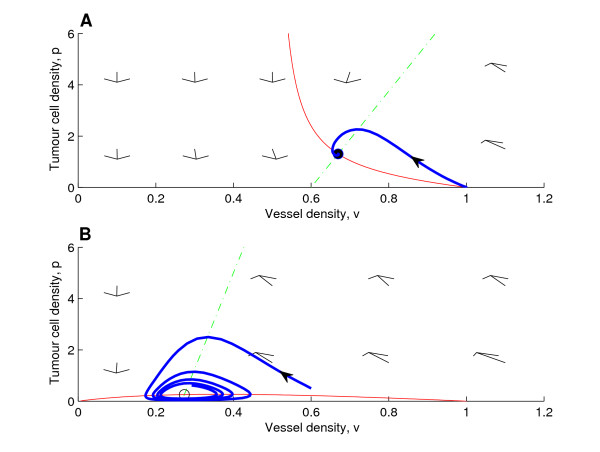
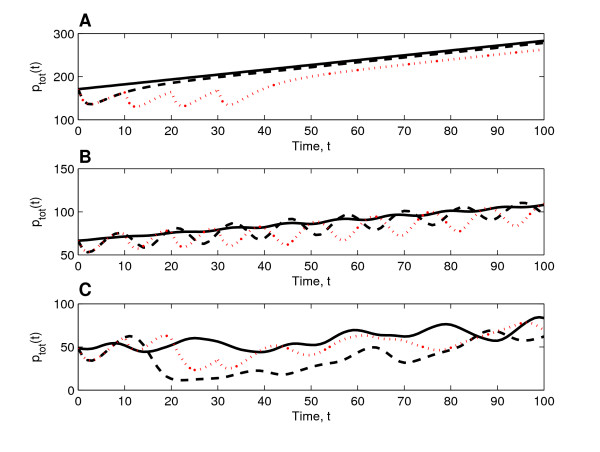
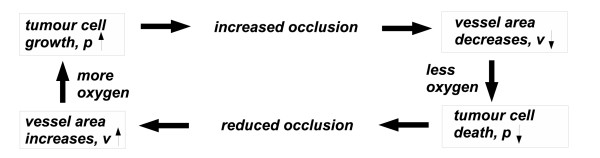
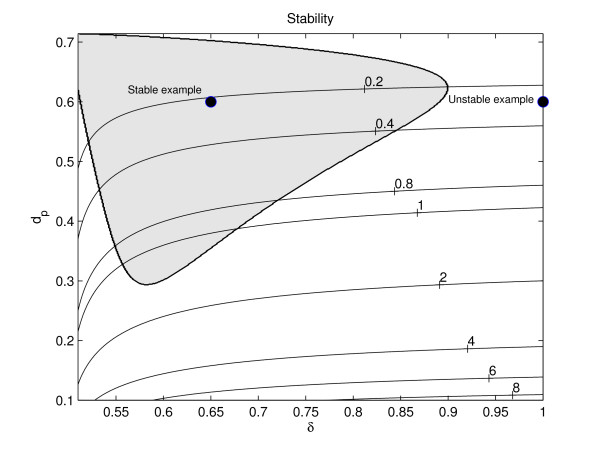
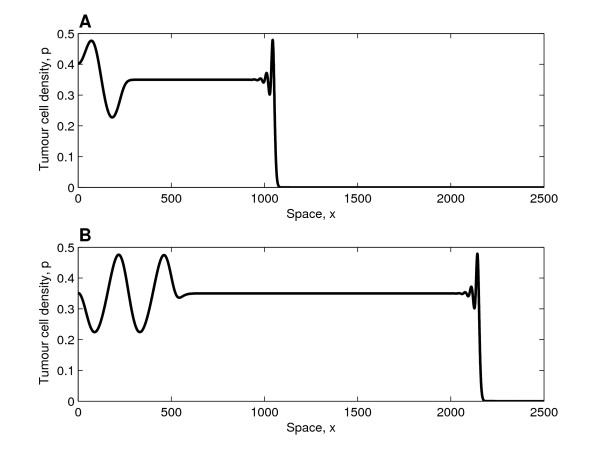
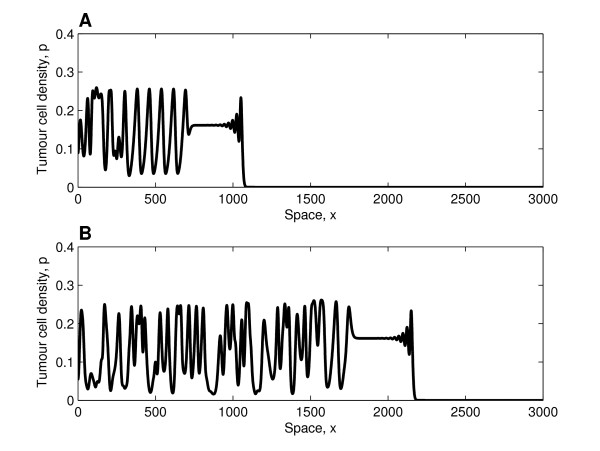
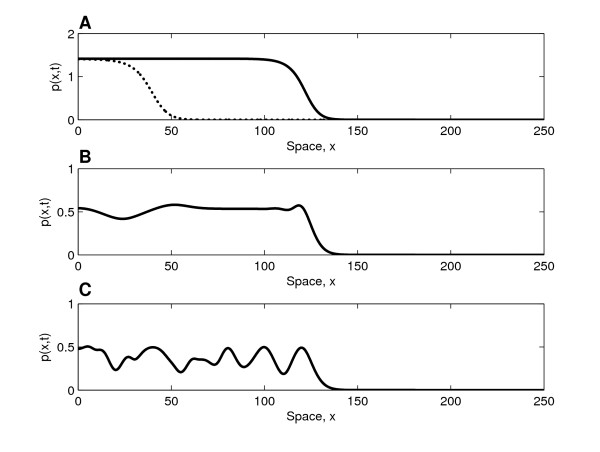
By analysing a spatially uniform submodel, we identify regions of parameter space in which the combination of tumour cell proliferation and vessel occlusion give rise to sustained temporal oscillations in the tumour cell population and in the vessel density. Alternatively, if the vessels are assumed to be less prone to collapse, stable steady state solutions are observed. When spatial effects are considered, the pattern of tumour invasion depends on the dynamics of the spatially uniform submodel. If the submodel predicts a stable steady state, then steady travelling waves are observed in the full model, and the system evolves to the same stable steady state behind the invading front. When the submodel yields oscillatory behaviour, the full model produces periodic travelling waves. The stability of the waves (which can be predicted by approximating the system as one of lambda-omega type) dictates whether the waves develop into regular or irregular spatio-temporal oscillations. Simulations of chemotherapy reveal that treatment outcome depends crucially on the underlying tumour growth dynamics. In particular, if the dynamics are oscillatory, then therapeutic efficacy is difficult to assess since the fluctuations in the size of the tumour cell population are enhanced, compared to untreated controls.
We have developed a mathematical model of vascular tumour growth formulated as a system of partial differential equations (PDEs). Employing a combination of numerical and analytical techniques, we demonstrate how the spatio-temporal dynamics of the untreated tumour may influence its response to chemotherapy.
This manuscript was reviewed by Professor Zvia Agur and Professor Marek Kimmel.
对实体肿瘤的研究表明,当肿瘤块产生的压力施加于血管壁时,可能会发生血管阻塞。由于肿瘤中经常存在不成熟的血管,并且这些血管可能特别敏感,因此这种阻塞可能会损害肿瘤血流,并对治疗结果产生负面影响。为了研究阻塞可能对肿瘤生长模式和治疗反应的影响,本文我们开发并研究了一个血管肿瘤生长的连续统模型。
通过分析一个空间均匀的子模型,我们确定了参数空间的区域,在这些区域中,肿瘤细胞增殖和血管阻塞的组合会导致肿瘤细胞群体和血管密度的持续时间振荡。或者,如果假设血管不易塌陷,则会观察到稳定的稳态解。当考虑空间效应时,肿瘤入侵的模式取决于空间均匀子模型的动力学。如果子模型预测稳定的稳态,则在全模型中观察到稳定的 travelling 波,并且系统在入侵前沿后面演化到相同的稳定稳态。当子模型产生振荡行为时,全模型会产生周期性的 travelling 波。波的稳定性(可以通过将系统近似为 lambda-omega 类型之一来预测)决定了波是否发展为规则或不规则的时空振荡。化疗的模拟表明,治疗结果取决于潜在的肿瘤生长动力学。特别是,如果动力学是振荡的,那么治疗效果很难评估,因为与未治疗的对照相比,肿瘤细胞群体的大小波动会增强。
我们开发了一个血管肿瘤生长的数学模型,该模型表示为一个偏微分方程(PDE)系统。我们结合使用数值和分析技术,展示了未治疗肿瘤的时空动力学如何影响其对化疗的反应。
这篇手稿由 Zvia Agur 教授和 Marek Kimmel 教授评审。