• 文献检索
  • 文档翻译
  • 深度研究
  • 学术资讯
  • Suppr Zotero 插件Zotero 插件
  • 邀请有礼
  • 套餐&价格
  • 历史记录
应用&插件
Suppr Zotero 插件Zotero 插件浏览器插件Mac 客户端Windows 客户端微信小程序
定价
高级版会员购买积分包购买API积分包
服务
文献检索文档翻译深度研究API 文档MCP 服务
关于我们
关于 Suppr公司介绍联系我们用户协议隐私条款
关注我们

Suppr 超能文献

核心技术专利:CN118964589B侵权必究
粤ICP备2023148730 号-1Suppr @ 2026

文献检索

告别复杂PubMed语法,用中文像聊天一样搜索,搜遍4000万医学文献。AI智能推荐,让科研检索更轻松。

立即免费搜索

文件翻译

保留排版,准确专业,支持PDF/Word/PPT等文件格式,支持 12+语言互译。

免费翻译文档

深度研究

AI帮你快速写综述,25分钟生成高质量综述,智能提取关键信息,辅助科研写作。

立即免费体验

胫骨后肌疲劳对行走时足部运动学的影响。

The role of tibialis posterior fatigue on foot kinematics during walking.

机构信息

Running Injury Clinic, Faculty of Kinesiology, University of Calgary, Calgary, AB, Canada.

出版信息

J Foot Ankle Res. 2010 Apr 20;3:6. doi: 10.1186/1757-1146-3-6.

DOI:10.1186/1757-1146-3-6
PMID:20406465
原文链接:https://pmc.ncbi.nlm.nih.gov/articles/PMC2864206/
Abstract

BACKGROUND

The purpose of this study was to investigate the effect of localised tibialis posterior muscle fatigue on foot kinematics during walking. It was hypothesised that following fatigue, subjects would demonstrate greater forefoot and rearfoot motion during walking. It was also postulated that the magnitude of the change in rearfoot motion would be associated with standing anatomical rearfoot posture.

METHODS

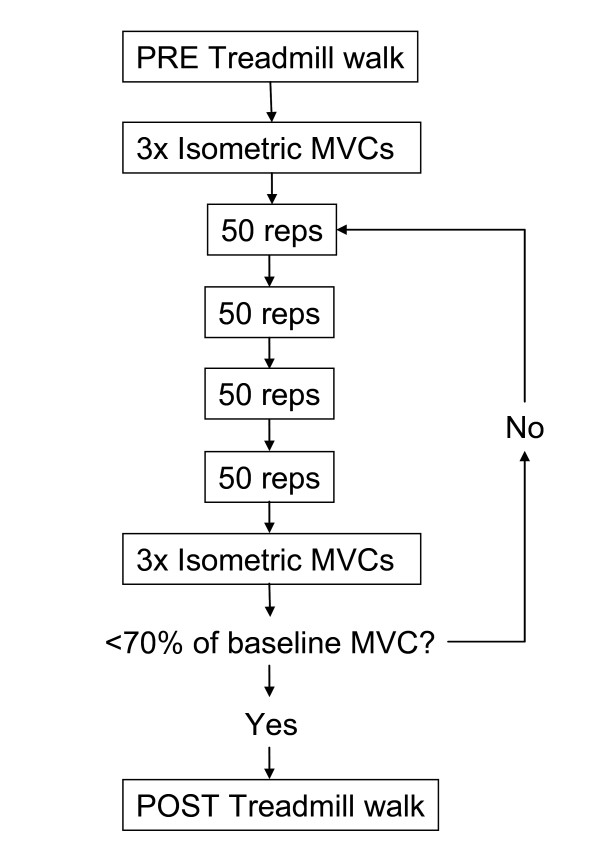
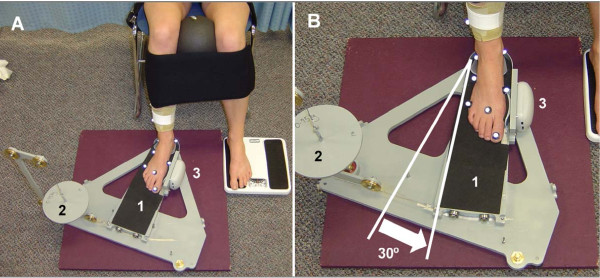
Twenty-nine subjects underwent an exercise fatigue protocol aimed at reducing the force output of tibialis posterior. An eight camera motion analysis system was used to evaluate 3D foot kinematics during treadmill walking both pre- and post-fatigue. The anatomical rearfoot angle was measured during standing prior to the fatigue protocol using a goniometer.

RESULTS

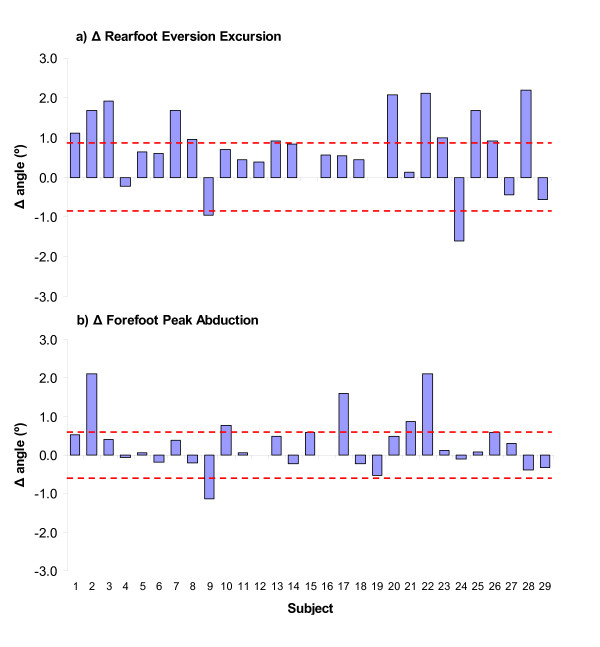
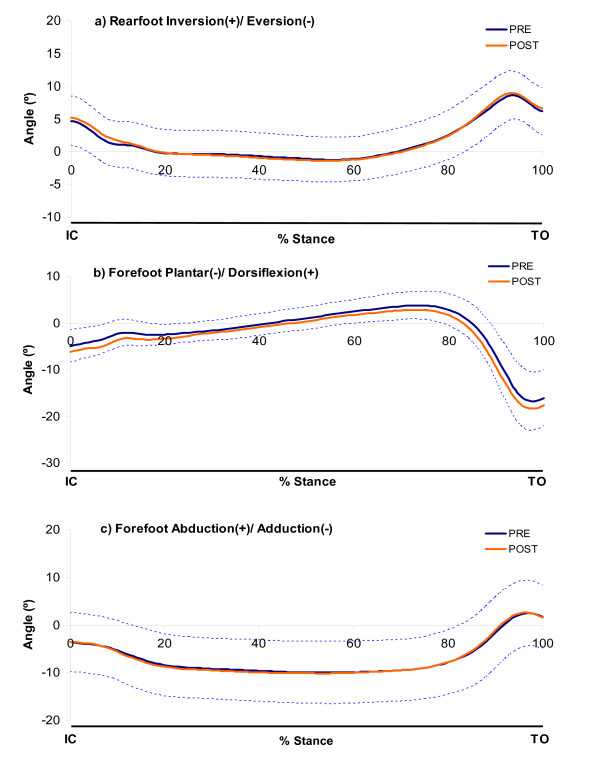
Peak rearfoot eversion remained unchanged following the fatigue protocol. Although increases in rearfoot eversion excursion were observed following fatigue, these changes were of a magnitude of questionable clinical significance (<1.0 degrees ). The magnitude of the change in rearfoot eversion due to fatigue was not associated with the anatomical measurement of standing rearfoot angle. No substantial changes in forefoot kinematics were observed following the fatigue protocol.

CONCLUSIONS

These data indicate that reduced force output of the tibialis posterior muscle did not alter rearfoot and forefoot motion during gait. The anatomical structure of the rearfoot was not associated with the dependence of muscular activity that an individual requires to maintain normal rearfoot kinematics during gait.

摘要

背景

本研究旨在探讨局部胫后肌疲劳对行走时足部运动学的影响。假设疲劳后,受试者在行走时前足和后足的运动幅度会更大。还假设后足运动变化的幅度与站立时解剖后足姿势有关。

方法

29 名受试者接受了一项旨在降低胫后肌力输出的运动疲劳方案。使用八摄像机运动分析系统在跑步机行走时评估疲劳前后的 3D 足部运动学。在疲劳方案之前,使用量角器在站立时测量解剖后足角度。

结果

疲劳方案后,后足外翻峰值保持不变。尽管疲劳后观察到后足外翻幅度增加,但这些变化的幅度具有临床意义(<1.0 度)。由于疲劳导致的后足外翻变化的幅度与站立时后足角度的解剖测量值无关。疲劳方案后,前足运动学没有明显变化。

结论

这些数据表明,胫后肌力输出减少不会改变步态中的后足和前足运动。后足的解剖结构与个体在行走时维持正常后足运动学所需的肌肉活动的依赖性无关。
https://cdn.ncbi.nlm.nih.gov/pmc/blobs/47a9/2864206/d9147d61006d/1757-1146-3-6-4.jpg
https://cdn.ncbi.nlm.nih.gov/pmc/blobs/47a9/2864206/701158eedc44/1757-1146-3-6-1.jpg
https://cdn.ncbi.nlm.nih.gov/pmc/blobs/47a9/2864206/fec44278a03b/1757-1146-3-6-2.jpg
https://cdn.ncbi.nlm.nih.gov/pmc/blobs/47a9/2864206/d632d75cc74a/1757-1146-3-6-3.jpg
https://cdn.ncbi.nlm.nih.gov/pmc/blobs/47a9/2864206/d9147d61006d/1757-1146-3-6-4.jpg
https://cdn.ncbi.nlm.nih.gov/pmc/blobs/47a9/2864206/701158eedc44/1757-1146-3-6-1.jpg
https://cdn.ncbi.nlm.nih.gov/pmc/blobs/47a9/2864206/fec44278a03b/1757-1146-3-6-2.jpg
https://cdn.ncbi.nlm.nih.gov/pmc/blobs/47a9/2864206/d632d75cc74a/1757-1146-3-6-3.jpg
https://cdn.ncbi.nlm.nih.gov/pmc/blobs/47a9/2864206/d9147d61006d/1757-1146-3-6-4.jpg

相似文献

1
The role of tibialis posterior fatigue on foot kinematics during walking.胫骨后肌疲劳对行走时足部运动学的影响。
J Foot Ankle Res. 2010 Apr 20;3:6. doi: 10.1186/1757-1146-3-6.
2
Changes in joint coupling and variability during walking following tibialis posterior muscle fatigue.胫后肌疲劳后步行时关节耦合和可变性的变化。
J Foot Ankle Res. 2011 Feb 4;4:6. doi: 10.1186/1757-1146-4-6.
3
Three-dimensional kinematics of the forefoot, rearfoot, and leg without the function of tibialis posterior in comparison with normals during stance phase of walking.在步行站立期,与正常人相比,后胫骨肌功能缺失时前足、后足和小腿的三维运动学。
Clin Biomech (Bristol). 1999 Jan;14(1):14-23. doi: 10.1016/s0268-0033(98)00034-5.
4
Comparison of foot kinematics between subjects with posterior tibialis tendon dysfunction and healthy controls.患有胫后肌腱功能障碍的受试者与健康对照组之间足部运动学的比较。
J Orthop Sports Phys Ther. 2006 Sep;36(9):635-44. doi: 10.2519/jospt.2006.2293.
5
Clinical measures of hip and foot-ankle mechanics as predictors of rearfoot motion and posture.髋部和足踝力学的临床测量作为后足运动和姿势的预测指标。
Man Ther. 2014 Oct;19(5):379-85. doi: 10.1016/j.math.2013.10.003. Epub 2013 Oct 29.
6
Forefoot midsole stiffness affects forefoot and rearfoot kinematics during the stance phase of gait.前脚掌中底刚度会影响步态站立期的前脚掌和后脚掌运动学。
J Am Podiatr Med Assoc. 2014 Mar;104(2):183-90. doi: 10.7547/0003-0538-104.2.183.
7
The effect of changing mediolateral center of pressure on rearfoot eversion during treadmill running.改变跑步机跑步时中足压力中心内外侧对后足外翻的影响。
Gait Posture. 2021 Jan;83:201-209. doi: 10.1016/j.gaitpost.2020.10.032. Epub 2020 Nov 3.
8
Forefoot angle determines duration and amplitude of pronation during walking.前足角度决定了步行时的旋前持续时间和幅度。
Gait Posture. 2013 May;38(1):8-13. doi: 10.1016/j.gaitpost.2012.10.003. Epub 2012 Oct 30.
9
Changes in Kinematic Coupling Among the Rearfoot, Midfoot, and Forefoot Segments During Running and Walking.跑步和行走过程中后足、中足和前足节段之间运动耦合的变化。
J Am Podiatr Med Assoc. 2018 Jan;108(1):45-51. doi: 10.7547/16-024.
10
Fore- and rearfoot kinematics in high- and low-arched individuals during running.跑步时高足弓和低足弓个体的前足和后足运动学。
Foot Ankle Int. 2011 Jul;32(7):710-6. doi: 10.3113/FAI.2011.0710.

引用本文的文献

1
Running intralimb coordination patterns after a foot core exercise program in recreational runners.在休闲跑者中进行足底核心训练计划后,进行肢体协调模式的训练。
Braz J Med Biol Res. 2024 Jan 22;57:e13124. doi: 10.1590/1414-431X2023e13124. eCollection 2024.
2
The Influence of General and Local Muscle Fatigue on Kinematics and Plantar Pressure Distribution during Running: A Systematic Review and Meta-Analysis.全身及局部肌肉疲劳对跑步时运动学及足底压力分布的影响:一项系统评价与Meta分析
Sports (Basel). 2023 Dec 6;11(12):241. doi: 10.3390/sports11120241.
3
Does the weakening of intrinsic foot muscles cause the decrease of medial longitudinal arch height?

本文引用的文献

1
Foot posture influences the electromyographic activity of selected lower limb muscles during gait.足部姿势会影响步态中选定下肢肌肉的肌电图活动。
J Foot Ankle Res. 2009 Nov 26;2:35. doi: 10.1186/1757-1146-2-35.
2
Nonsurgical management of posterior tibial tendon dysfunction with orthoses and resistive exercise: a randomized controlled trial.使用矫形器和抗阻运动对胫后肌腱功能障碍进行非手术治疗:一项随机对照试验。
Phys Ther. 2009 Jan;89(1):26-37. doi: 10.2522/ptj.20070242. Epub 2008 Nov 20.
3
The effects of sectioning the spring ligament on rearfoot stability and posterior tibial tendon efficiency.
足部内在肌的弱化会导致内侧纵弓高度降低吗?
J Phys Ther Sci. 2017 Jun;29(6):1001-1005. doi: 10.1589/jpts.29.1001. Epub 2017 Jun 7.
4
The Effect of Fatigue on Electromyographic Characteristics during Obstacle Crossing of Different Heights in Young Adults.年轻人跨越不同高度障碍时疲劳对肌电图特征的影响。
J Sports Sci Med. 2014 Dec 1;13(4):724-30. eCollection 2014 Dec.
5
Risk factors associated with medial tibial stress syndrome in runners: a systematic review and meta-analysis.跑步者胫骨内侧应力综合征的相关危险因素:一项系统评价和荟萃分析。
Open Access J Sports Med. 2013 Nov 13;4:229-41. doi: 10.2147/OAJSM.S39331.
6
Biomechanical overload syndrome: defining a new diagnosis.生物力学过载综合征:定义一种新的诊断方法。
Br J Sports Med. 2014 Mar;48(6):415-6. doi: 10.1136/bjsports-2012-091241. Epub 2012 Sep 14.
7
Changes in multi-segment foot biomechanics with a heat-mouldable semi-custom foot orthotic device.多节段足部生物力学在热塑型半定制足部矫形器作用下的变化。
J Foot Ankle Res. 2011 Jun 21;4(1):18. doi: 10.1186/1757-1146-4-18.
8
Changes in joint coupling and variability during walking following tibialis posterior muscle fatigue.胫后肌疲劳后步行时关节耦合和可变性的变化。
J Foot Ankle Res. 2011 Feb 4;4:6. doi: 10.1186/1757-1146-4-6.
9
A comparison of foot arch measurement reliability using both digital photography and calliper methods.足部足弓测量的数字摄影法与量角器法测量可靠性的比较。
J Foot Ankle Res. 2010 Jul 14;3:14. doi: 10.1186/1757-1146-3-14.
切断弹簧韧带对后足稳定性和胫后肌腱效率的影响。
J Foot Ankle Surg. 2008 May-Jun;47(3):219-24. doi: 10.1053/j.jfas.2008.02.002. Epub 2008 Mar 28.
4
Two simple methods for determining gait events during treadmill and overground walking using kinematic data.两种利用运动学数据确定跑步机行走和地面行走过程中步态事件的简单方法。
Gait Posture. 2008 May;27(4):710-4. doi: 10.1016/j.gaitpost.2007.07.007. Epub 2007 Aug 27.
5
Foot and ankle kinematics in patients with posterior tibial tendon dysfunction.胫后肌腱功能障碍患者的足踝关节运动学
Gait Posture. 2008 Feb;27(2):331-9. doi: 10.1016/j.gaitpost.2007.04.014. Epub 2007 Jun 20.
6
Fatigue of the plantar intrinsic foot muscles increases navicular drop.足底固有肌疲劳会增加舟骨下降。
J Electromyogr Kinesiol. 2008 Jun;18(3):420-5. doi: 10.1016/j.jelekin.2006.11.004. Epub 2007 Jan 8.
7
Comparison of foot kinematics between subjects with posterior tibialis tendon dysfunction and healthy controls.患有胫后肌腱功能障碍的受试者与健康对照组之间足部运动学的比较。
J Orthop Sports Phys Ther. 2006 Sep;36(9):635-44. doi: 10.2519/jospt.2006.2293.
8
Changes in gait associated with acute stage II posterior tibial tendon dysfunction.与急性II期胫后肌腱功能障碍相关的步态变化。
Gait Posture. 2007 Apr;25(4):555-64. doi: 10.1016/j.gaitpost.2006.06.008. Epub 2006 Jul 28.
9
Forefoot, rearfoot and shank coupling: effect of variations in speed and mode of gait.前足、后足和小腿的耦合:速度和步态模式变化的影响。
Gait Posture. 2007 Feb;25(2):295-302. doi: 10.1016/j.gaitpost.2006.04.012. Epub 2006 Jun 6.
10
Changes in foot and lower limb coupling due to systematic variations in step width.由于步幅宽度的系统性变化导致的足部与下肢耦合的变化。
Clin Biomech (Bristol). 2006 Feb;21(2):175-83. doi: 10.1016/j.clinbiomech.2005.09.005. Epub 2005 Nov 2.