Institut de Recherche pour le Développement (IRD); UMR 216: Mother and Child face to tropical infections, Paris, France.
Malar J. 2010 Apr 21;9:104. doi: 10.1186/1475-2875-9-104.
Applying the switch from presumptive treatment of malaria to new policies of anti-malarial prescriptions restricted to parasitologically-confirmed cases is a still unsolved challenge. Pragmatic studies can provide data on consequences of such a switch. In order to assess whether restricting anti-malarials to rapid diagnostic test (RDT)-confirmed cases in children of between five and 15 years of age is consistent with an adequate management of fevers, a school-based study was performed in Allada, Benin.
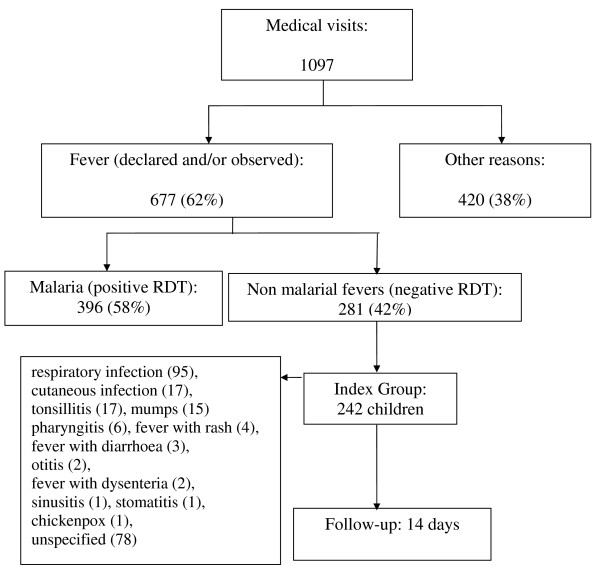
Children in the index group (with fever and a negative RDT) and the matched control group (without fever and a negative RDT) were not prescribed anti-malarials and actively followed-up during 14 days. Blood smears were collected at each assessment. Self-medication with chloroquine and quinine was assessed with blood spots. Malaria attacks during the follow-up were defined by persistent or recurrent fever concomitant to a positive malaria test.
484 children were followed-up (242 in each group). At day 3, fever had disappeared in 94% of children from the index group. The incidence of malaria was similar (five cases in the index group and seven cases in the control group) between groups. Self-medication with chloroquine and quinine in this cohort was uncommon.
Applying a policy of restricting anti-malarials to RDT-confirmed cases is consistent with an adequate management of fevers in this population. Further studies on the management of fever in younger children are of upmost importance.
将疟疾的经验性治疗转变为仅针对寄生虫学确诊病例开具抗疟药物的新政策,这仍然是一个尚未解决的挑战。实用研究可以提供有关这种转变后果的数据。为了评估将抗疟药物仅限于 5 至 15 岁儿童的快速诊断检测(RDT)确诊病例是否符合发热的充分管理,在贝宁的阿洛达进行了一项基于学校的研究。
指数组(发热且 RDT 阴性)和匹配的对照组(无发热且 RDT 阴性)中的儿童未开具抗疟药物,并在 14 天内进行积极随访。每次评估时采集血涂片。通过血斑评估自我使用氯喹和奎宁的情况。在随访期间,持续或反复发热伴疟疾检测阳性定义为疟疾发作。
484 名儿童接受了随访(每组 242 名)。第 3 天,指数组中 94%的儿童发热已消失。两组之间的疟疾发病率相似(指数组有 5 例,对照组有 7 例)。该队列中自我使用氯喹和奎宁的情况并不常见。
在该人群中,实施将抗疟药物仅限于 RDT 确诊病例的政策符合发热的充分管理。进一步研究更年轻儿童的发热管理至关重要。