Evolutionary Biology & Ecology, Free University of Brussels/Université Libre de Bruxelles, B-1050 Brussels, Belgium.
BMC Evol Biol. 2010 Apr 21;10:103. doi: 10.1186/1471-2148-10-103.
Sexually deceptive orchids of the genus Ophrys attract their pollinators, male insects, on a highly specific basis through the emission of odour blends that mimic the female sex pheromone of the targeted species. In this study, we have investigated a contact site between Ophrys arachnitiformis and O. lupercalis, two sympatric orchid species that are usually reproductively isolated via the exploitation of different pollinator "niches", but occasionally hybridise despite their apparent combination of ethological and mechanical isolation barriers. In particular, we have investigated the extent to which these Ophrys hybrids generate "emergent" combinations (i.e. novel and unpredictable from the parents' phenotypes) of floral traits, and how these phenotypic novelties, particularly the odour blends emitted by the flower, could facilitate the invasion of a novel pollinator "niche" and induce the rapid formation of reproductive isolation, a prerequisite for adaptive evolutionary divergence.
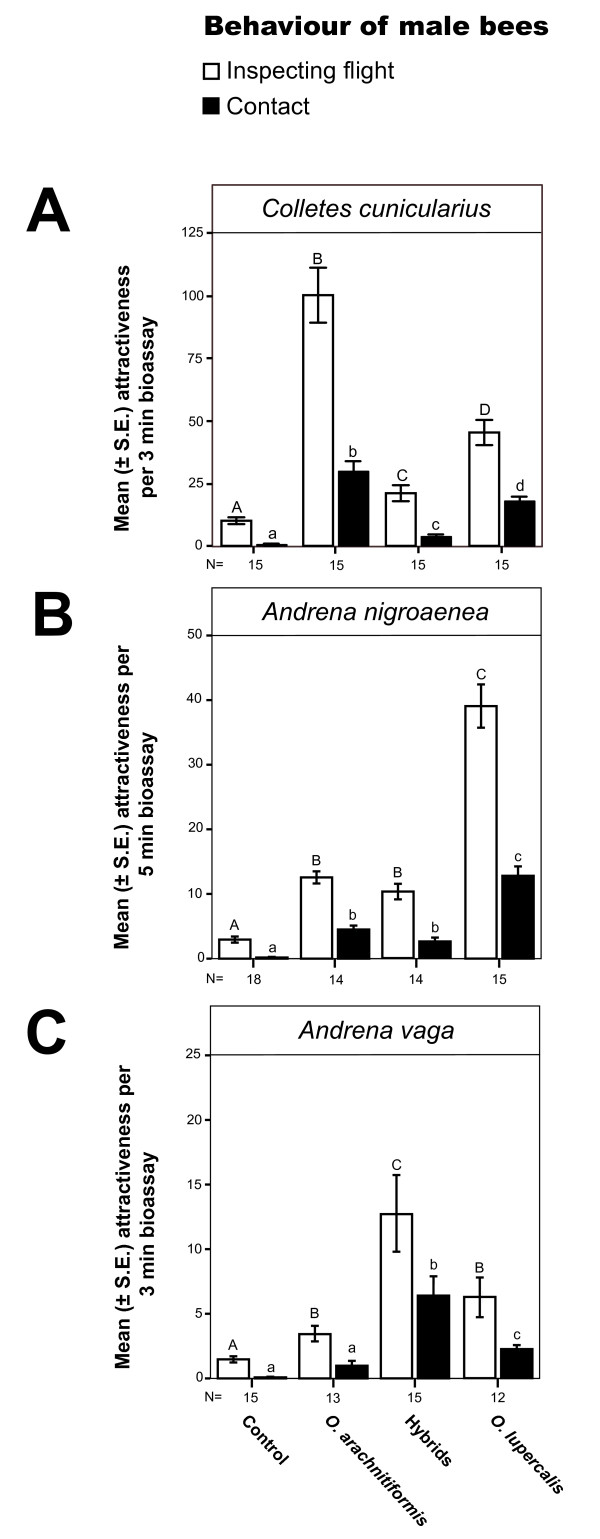
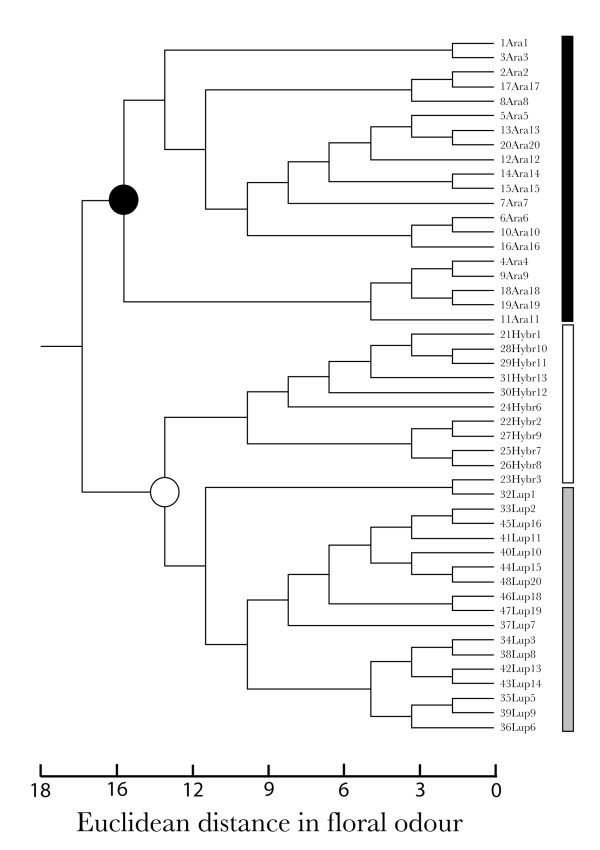
Our chemical analyses of floral scents show that the Ophrys F1 hybrids investigated here produce more compounds, significantly different ratios (% of odour compounds in the total blend), as well as new compounds in their floral odour compared to their progenitors. When tested for their attractiveness to the pollinator of each parent orchid species, we found that floral scent extracts of the hybrids triggered less inspecting flights and contacts by the male bees with the scented dummy than those of the parental orchid species. However, a series of additional behavioural bioassays revealed that the novel floral scent of the hybrids was significantly more attractive than either of the two parents to a pollinator species not initially involved in the pollination of any of the parent Ophrys species.
Collectively, our results illustrate that the process of hybridisation can lead to the generation of evolutionary novelties, and that novel combinations of floral traits can drive pollinator shifts and rapid reproductive isolation in highly specific plant-pollinator interactions.
雄性昆虫通过对气味混合物的感知来识别和定位雌性昆虫,而 Ophrys 属的性欺骗兰花则会根据特定的信息基础,通过释放与目标物种的雌性性信息素相似的气味混合物来吸引其传粉者,即雄性昆虫。在这项研究中,我们调查了 Ophrys arachnitiformis 和 O. lupercalis 之间的一个接触点,这两个近缘兰花物种通常通过利用不同的传粉者“生态位”来实现生殖隔离,但它们偶尔也会发生杂交,尽管它们存在行为和机械隔离障碍。具体而言,我们研究了这些 Ophrys 杂种在多大程度上产生了“新兴”的花部特征组合(即从父母的表型来看是新颖的、不可预测的),以及这些表型新颖性,特别是花所散发的气味混合物,如何促进新的传粉者“生态位”的入侵,并诱导生殖隔离的快速形成,这是适应进化分歧的前提。
我们对花香味的化学分析表明,与亲本相比,这里研究的 Ophrys F1 杂种在其花香中产生了更多的化合物,显著不同的比例(气味化合物在总混合物中的百分比),以及新的化合物。当它们对每个亲本兰花物种的传粉者的吸引力进行测试时,我们发现与亲本兰花物种相比,杂种的花香提取物对雄性蜜蜂的诱虫飞行和接触次数更少。然而,一系列额外的行为生物测定表明,与两种亲本之一相比,杂种的新花香对一种原本不参与任何亲本 Ophrys 物种授粉的传粉者物种更具吸引力。
总的来说,我们的研究结果表明,杂交过程可以产生进化创新,花部特征的新组合可以促进高度特定的植物-传粉者相互作用中的传粉者转移和快速生殖隔离。