Neuroimaging Research Unit, Institute of Experimental Neurology, Division of Neuroscience, Scientific Institute and University Hospital San Raffaele, Milan, Italy.
PLoS One. 2010 Apr 15;5(4):e10198. doi: 10.1371/journal.pone.0010198.
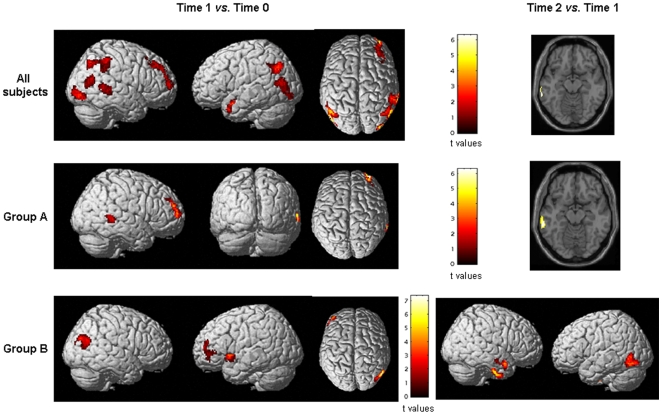
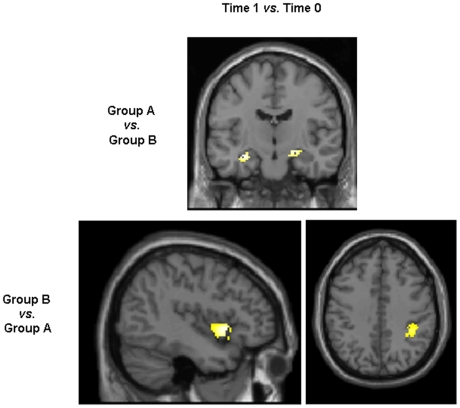
We used tensor-based morphometry (TBM) to: 1) map gray matter (GM) volume changes associated with motor learning in young healthy individuals; 2) evaluate if GM changes persist three months after cessation of motor training; and 3) assess whether the use of different schemes of motor training during the learning phase could lead to volume modifications of specific GM structures. From 31 healthy subjects, motor functional assessment and brain 3D T1-weighted sequence were obtained: before motor training (time 0), at the end of training (two weeks) (time 2), and three months later (time 3). Fifteen subjects (group A) were trained with goal-directed motor sequences, and 16 (group B) with non purposeful motor actions of the right hand. At time 1 vs. time 0, the whole sample of subjects had GM volume increase in regions of the temporo-occipital lobes, inferior parietal lobule (IPL) and middle frontal gyrus, while at time 2 vs. time 1, an increased GM volume in the middle temporal gyrus was seen. At time 1 vs. time 0, compared to group B, group A had a GM volume increase of the hippocampi, while the opposite comparison showed greater GM volume increase in the IPL and insula in group B vs. group A. Motor learning results in structural GM changes of different brain areas which are part of specific neuronal networks and tend to persist after training is stopped. The scheme applied during the learning phase influences the pattern of such structural changes.
我们采用张量形态测量学(TBM)来:1)绘制与年轻健康个体运动学习相关的灰质(GM)体积变化图;2)评估运动训练停止三个月后 GM 变化是否持续;3)评估在学习阶段使用不同的运动训练方案是否会导致特定 GM 结构的体积改变。从 31 名健康受试者中,获得了运动功能评估和大脑 3D T1 加权序列:在运动训练前(时间 0)、训练结束时(两周)(时间 2)和三个月后(时间 3)。15 名受试者(A 组)接受了目标导向的运动序列训练,16 名受试者(B 组)接受了右手非目的性运动动作训练。与时间 0 相比,在时间 1,所有受试者的 GM 体积都增加了颞叶-枕叶、下顶叶(IPL)和中额回的区域,而与时间 1 相比,在时间 2 ,中颞叶的 GM 体积增加了。与 B 组相比,A 组在时间 1 与时间 0 相比,GM 体积增加了海马体,而相反的比较显示 B 组与 A 组相比,GM 体积增加了 IPL 和脑岛。运动学习导致不同脑区 GM 结构发生变化,这些变化是特定神经元网络的一部分,并且在训练停止后仍有持续的趋势。在学习阶段应用的方案影响了这些结构变化的模式。