Department of Public Health, Section of Environment Health, University of Copenhagen, Copenhagen, Denmark.
Environ Health Perspect. 2010 Aug;118(8):1126-36. doi: 10.1289/ehp.0901725. Epub 2010 Apr 27.
Air pollution is thought to exert health effects through oxidative stress, which causes damage to DNA and lipids.
We determined whether levels of oxidatively damaged DNA and lipid peroxidation products in cells or bodily fluids from humans are useful biomarkers of biologically effective dose in studies of the health effects of exposure to particulate matter (PM) from combustion processes.
We identified publications that reported estimated associations between environmental exposure to PM and oxidative damage to DNA and lipids in PubMed and EMBASE. We also identified publications from reference lists and articles cited in the Web of Science.
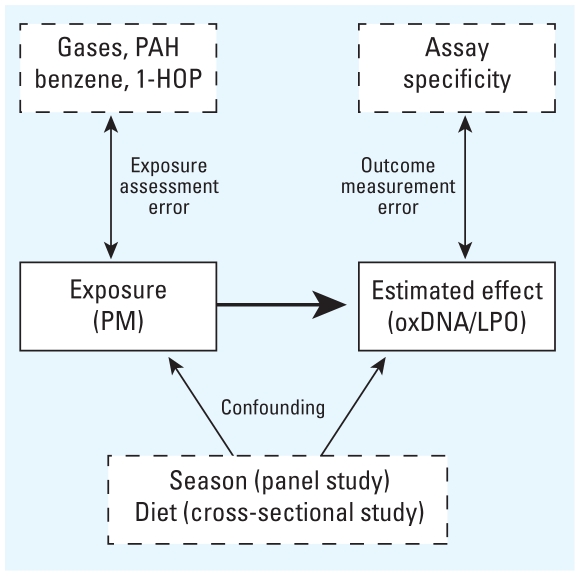
For each study, we obtained information on the estimated effect size to calculate the standardized mean difference (unitless) and determined the potential for errors in exposure assessment and analysis of each of the biomarkers, for total and stratified formal meta-analyses.
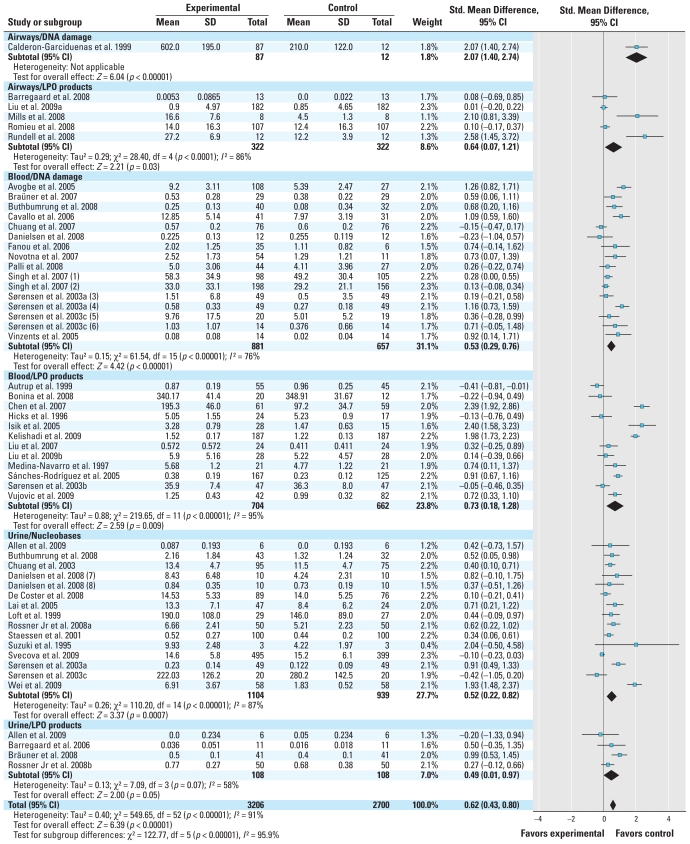
In the meta-analysis, the standardized mean differences (95% confidence interval) between exposed and unexposed subjects for oxidized DNA and lipids were 0.53 (0.29-0.76) and 0.73 (0.18-1.28) in blood and 0.52 (0.22-0.82) and 0.49 (0.01-0.97) in urine, respectively. The standardized mean difference for oxidized lipids was 0.64 (0.07-1.21) in the airways. Restricting analyses to studies unlikely to have substantial biomarker or exposure measurement error, studies likely to have biomarker and/or exposure error, or studies likely to have both sources of error resulted in standardized mean differences of 0.55 (0.19-0.90), 0.66 (0.37-0.95), and 0.65 (0.34-0.96), respectively.
Exposure to combustion particles is consistenly associated with oxidatively damaged DNA and lipids in humans, suggesting that it is possible to use these measurements as biomarkers of biologically effective dose.
空气污染被认为通过氧化应激对健康产生影响,这种应激会导致 DNA 和脂质受损。
我们旨在确定人体细胞或体液中氧化损伤的 DNA 和脂质过氧化产物水平是否可作为评估暴露于燃烧过程产生的颗粒物(PM)对健康影响的生物有效剂量的生物标志物。
我们在 PubMed 和 EMBASE 中检索报告环境 PM 暴露与 DNA 和脂质氧化损伤之间相关性的研究,确定了相关出版物,并从 Web of Science 中的参考文献和引用文章中进行了补充。
对于每项研究,我们获取了关于估计效应量的信息,以计算标准化均数差(无量纲),并确定了暴露评估和分析每个生物标志物的潜在误差,以进行总分析和分层荟萃分析。
在荟萃分析中,暴露组与未暴露组的血液中氧化 DNA 和脂质以及尿液中氧化 DNA 和脂质的标准化均数差(95%置信区间)分别为 0.53(0.29-0.76)和 0.73(0.18-1.28)、0.52(0.22-0.82)和 0.49(0.01-0.97);气道中氧化脂质的标准化均数差为 0.64(0.07-1.21)。将分析限制在生物标志物和/或暴露测量误差较小、可能存在生物标志物和/或暴露误差或两者都可能存在的研究中,结果分别为标准化均数差 0.55(0.19-0.90)、0.66(0.37-0.95)和 0.65(0.34-0.96)。
暴露于燃烧颗粒与人体中的氧化损伤 DNA 和脂质持续相关,这表明这些测量值有可能作为生物有效剂量的生物标志物。