Department of Pharmacology, University of Washington School of Medicine, Seattle, Washington, United States of America.
PLoS One. 2010 Apr 23;5(4):e10325. doi: 10.1371/journal.pone.0010325.
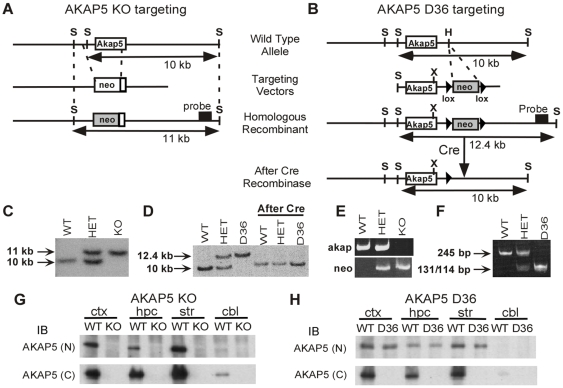
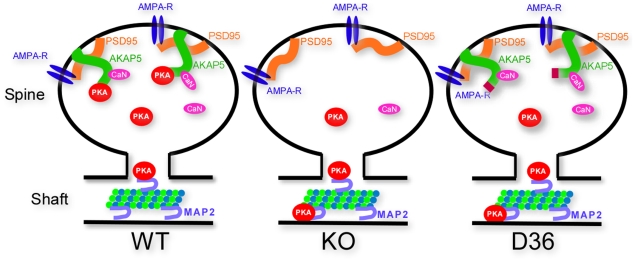
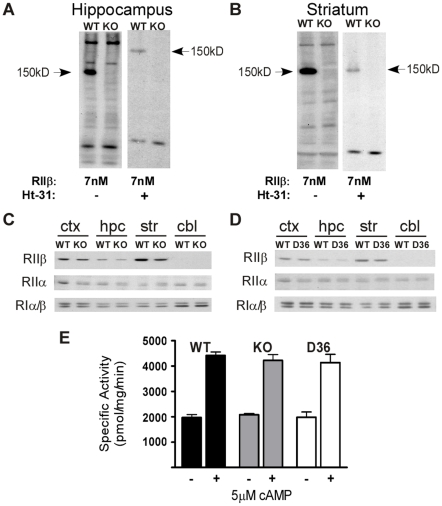
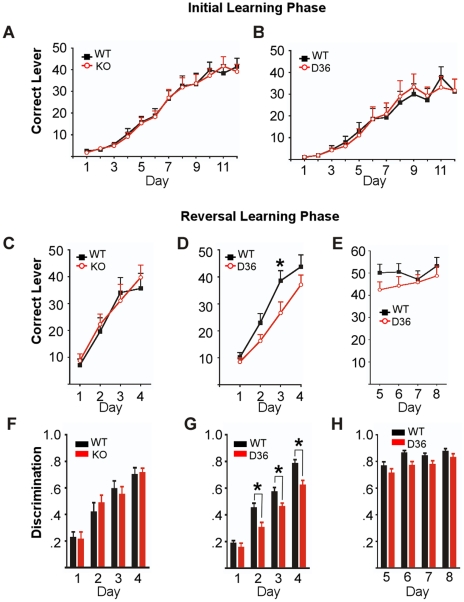
AKAP5 (also referred to as AKAP150 in rodents and AKAP79 in humans) is a scaffolding protein that is highly expressed in neurons and targets a variety of signaling molecules to dendritic membranes. AKAP5 interacts with PKA holoenzymes containing RIIalpha or RIIbeta as well as calcineurin (PP2B), PKC, calmodulin, adenylyl cyclase type V/VI, L-type calcium channels, and beta-adrenergic receptors. AKAP5 has also been shown to interact with members of the MAGUK family of PSD-scaffolding proteins including PSD95 and SAP97 and target signaling molecules to receptors and ion channels in the postsynaptic density (PSD). We created two lines of AKAP5 mutant mice: a knockout of AKAP5 (KO) and a mutant that lacks the PKA binding domain of AKAP5 (D36). We find that PKA is delocalized in both the hippocampus and striatum of KO and D36 mice indicating that other neural AKAPs cannot compensate for the loss of PKA binding to AKAP5. In AKAP5 mutant mice, a significant fraction of PKA becomes localized to dendritic shafts and this correlates with increased binding to microtubule associated protein-2 (MAP2). Electrophysiological and behavioral analysis demonstrated more severe deficits in both synaptic plasticity and operant learning in the D36 mice compared with the complete KO animals. Our results indicate that the targeting of calcineurin or other binding partners of AKAP5 in the absence of the balancing kinase, PKA, leads to a disruption of synaptic plasticity and results in learning and memory defects.
AKAP5(在啮齿动物中也称为 AKAP150,在人类中称为 AKAP79)是一种支架蛋白,在神经元中高度表达,将各种信号分子靶向树突膜。AKAP5 与包含 RIIalpha 或 RIIbeta 以及钙调蛋白磷酸酶(PP2B)、PKC、钙调蛋白、腺苷酸环化酶 V/VI 型、L 型钙通道和β肾上腺素能受体的 PKA 全酶相互作用。AKAP5 还被证明与 PSD 支架蛋白 MAGUK 家族的成员相互作用,包括 PSD95 和 SAP97,并将信号分子靶向突触后密度(PSD)中的受体和离子通道。我们创建了两条 AKAP5 突变小鼠:AKAP5 敲除(KO)和缺乏 AKAP5 PKA 结合域的突变体(D36)。我们发现 PKA 在 KO 和 D36 小鼠的海马体和纹状体中均发生了定位改变,表明其他神经 AKAP 无法补偿 PKA 与 AKAP5 结合的缺失。在 AKAP5 突变小鼠中,PKA 的很大一部分定位于树突干,这与与微管相关蛋白-2(MAP2)的结合增加相关。电生理和行为分析表明,与完全 KO 动物相比,D36 小鼠的突触可塑性和操作性学习缺陷更为严重。我们的结果表明,在缺乏平衡激酶 PKA 的情况下,钙调蛋白或 AKAP5 的其他结合伴侣的靶向会导致突触可塑性的破坏,并导致学习和记忆缺陷。