Edo Solsona María Dolores, Monte Boquet Emilio, Casanova Estruch Bonaventura, Poveda Andrés José Luis
Department of Pharmacy.
Department of Neurology, Hospital Universitari i Politècnic La Fe, Valencia, Spain.
Patient Prefer Adherence. 2017 Mar 2;11:415-421. doi: 10.2147/PPA.S127508. eCollection 2017.
Adherence to disease-modifying drugs (DMDs) is one of the key factors for achieving optimal clinical outcomes. Rebismart is an injection device for subcutaneous administration of interferon beta-1a (INF β-1a) that is also able to monitor adherence objectively. The aim of this study was to describe adherence to INF β-1a using the said electronic autoinjection device and to explore the relationship between adherence and relapses in a Spanish cohort.
This is a retrospective observational study in which 110 Spanish patients self-administered INF β-1a subcutaneously using an electronic autoinjection device between June 2010 and June 2015. The primary end point was the percentage of adherence measured by Rebismart to subcutaneous INF β-1a injections calculated as number of injections received in time period versus number of injections scheduled in time period. Other variables recorded were demographic and clinical data. Statistical analysis was performed using SPSS 19.0 software.
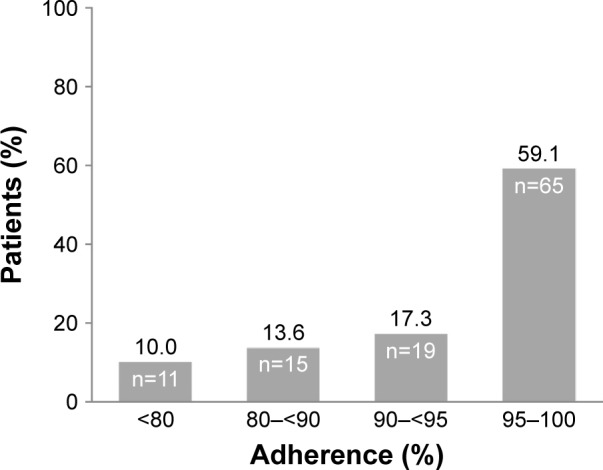
Median adherence for the total study period was 96.5% (interquartile range [IQR]: 91.1-99.1). Similar values were observed during the first 6 months: 98.7% (IQR: 91.3-100), and the last 6 months: 97.6% (IQR: 91.1-99.8). Median duration of treatment was 979 days (IQR: 613.8-1,266.8). During the entire treatment period, 77.3% of patients were relapse free and mean annualized relapse rate was 0.14 (standard deviation: 0.33). Increased adherence was associated with better clinical outcomes, leading to lower relapse risk (odds ratio: 0.953; 95% confidence interval: 0.912-0.995). Specifically, every percentage unit increase in adherence resulted in a 4.7% decrease in relapse.
Patients with multiple sclerosis who self-injected INF β-1a with Rebismart had excellent adherence, correlating with a high proportion of relapse-free patients and very low annualized relapse rate.
坚持使用疾病修正药物(DMDs)是实现最佳临床疗效的关键因素之一。Rebismart是一种用于皮下注射干扰素β-1a(INFβ-1a)的注射装置,它还能够客观监测用药依从性。本研究的目的是描述使用上述电子自动注射装置时对INFβ-1a的依从性,并探讨西班牙队列中依从性与复发之间的关系。
这是一项回顾性观察研究,110名西班牙患者在2010年6月至2015年6月期间使用电子自动注射装置皮下自我注射INFβ-1a。主要终点是Rebismart测量的皮下注射INFβ-1a的依从性百分比,计算方法为某时间段内实际接受的注射次数与该时间段内计划注射次数之比。记录的其他变量包括人口统计学和临床数据。使用SPSS 19.0软件进行统计分析。
整个研究期间的中位依从性为96.5%(四分位间距[IQR]:91.1 - 99.1)。在前6个月观察到类似的值:98.7%(IQR:91.3 - 100),以及后6个月:97.6%(IQR:91.1 - 99.8)。中位治疗持续时间为979天(IQR:613.8 - 1266.8)。在整个治疗期间,77.3%的患者无复发,平均年化复发率为0.14(标准差:0.33)。依从性增加与更好的临床结果相关,导致复发风险降低(比值比:0.953;95%置信区间:0.912 - 0.995)。具体而言,依从性每增加一个百分点,复发率就降低4.7%。
使用Rebismart自我注射INFβ-1a的多发性硬化症患者具有出色的依从性,这与高比例的无复发患者和极低的年化复发率相关。