Department of Cell and Molecular Physiology, University of North Carolina, Chapel Hill, North Carolina, USA.
PLoS One. 2010 Apr 26;5(4):e10347. doi: 10.1371/journal.pone.0010347.
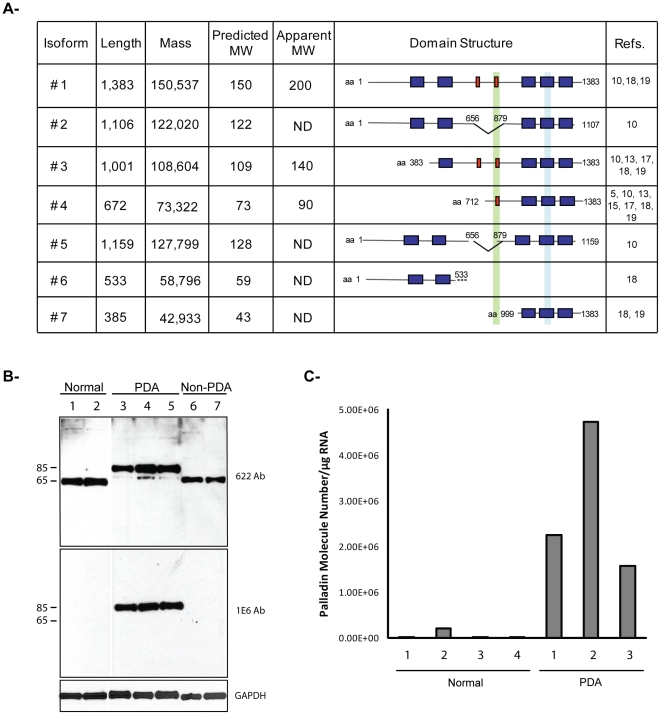
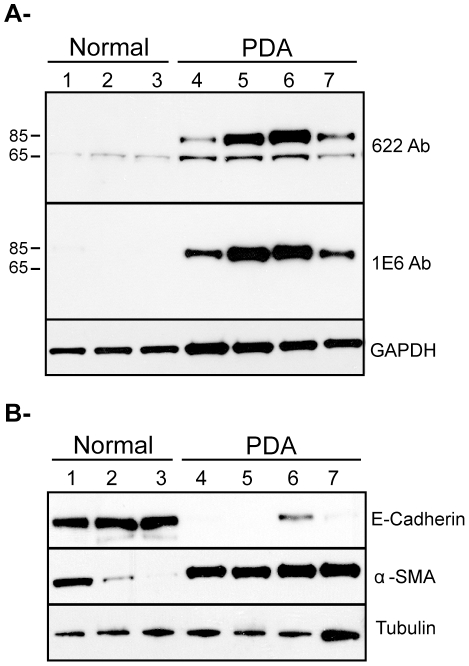
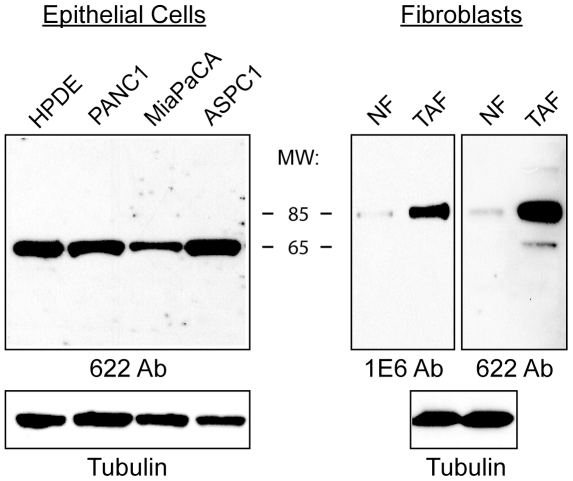
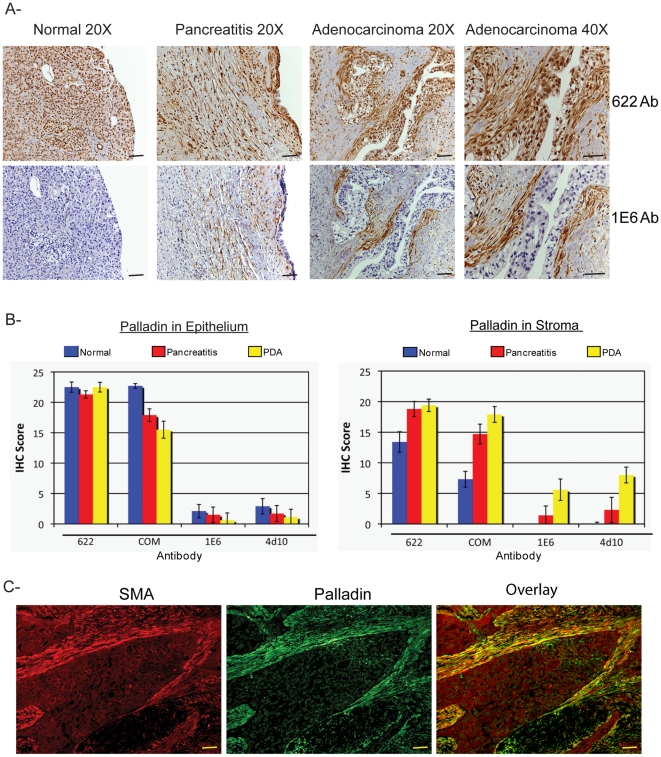
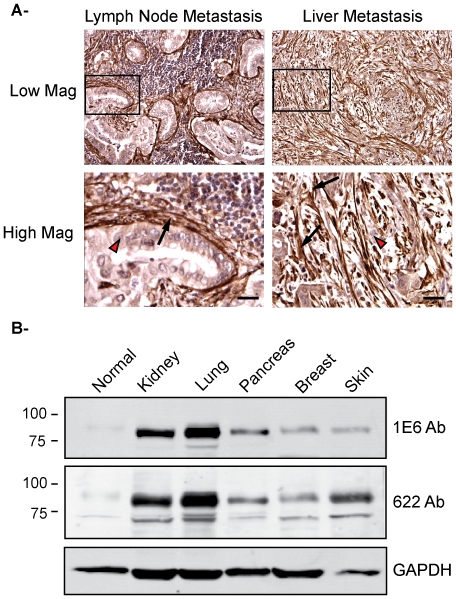
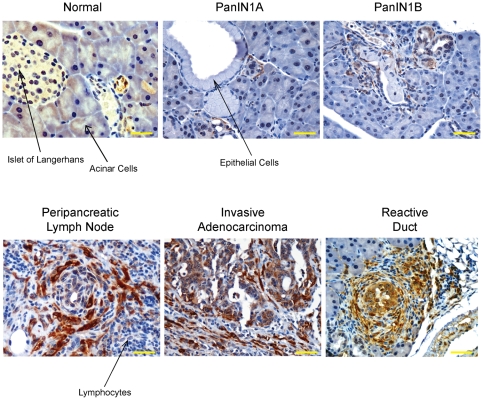
Pancreatic ductal adenocarcinoma (PDA) is a lethal disease with a characteristic pattern of early metastasis, which is driving a search for biomarkers that can be used to detect the cancer at an early stage. Recently, the actin-associated protein palladin was identified as a candidate biomarker when it was shown that palladin is mutated in a rare inherited form of PDA, and overexpressed in many sporadic pancreas tumors and premalignant precursors. In this study, we analyzed the expression of palladin isoforms in murine and human PDA and explored palladin's potential use in diagnosing PDA. We performed immunohistochemistry and immunoblot analyses on patient samples and tumor-derived cells using an isoform-selective monoclonal antibody and a pan-palladin polyclonal antibody. Immunoblot and real-time quantitative reverse transcription-PCR were used to quantify palladin mRNA levels in human samples. We show that there are two major palladin isoforms expressed in pancreas: 65 and 85-90 kDa. The 65 kDa isoform is expressed in both normal and neoplastic ductal epithelial cells. The 85-90 kDa palladin isoform is highly overexpressed in tumor-associated fibroblasts (TAFs) in both primary and metastatic tumors compared to normal pancreas, in samples obtained from either human patients or genetically engineered mice. In tumor-derived cultured cells, expression of palladin isoforms follows cell-type specific patterns, with the 85-90 kDa isoform in TAFs, and the 65 kDa isoform predominating in normal and neoplastic epithelial cells. These results suggest that upregulation of 85-90 kDa palladin isoform may play a role in the establishment of the TAF phenotype, and thus in the formation of a desmoplastic tumor microenvironment. Thus, palladin may have a potential use in the early diagnosis of PDA and may have much broader significance in understanding metastatic behavior.
胰腺导管腺癌 (PDA) 是一种致命疾病,具有早期转移的特征模式,这促使人们寻找可用于早期检测癌症的生物标志物。最近,肌动蛋白相关蛋白 paladin 被鉴定为候选生物标志物,因为它在一种罕见的遗传性 PDA 形式中发生突变,并且在许多散发性胰腺肿瘤和癌前前体中过度表达。在这项研究中,我们分析了鼠和人 PDA 中 paladin 同工型的表达,并探讨了 paladin 在诊断 PDA 中的潜在用途。我们使用同工型选择性单克隆抗体和泛 paladin 多克隆抗体对患者样本和肿瘤衍生细胞进行免疫组织化学和免疫印迹分析。免疫印迹和实时定量逆转录-PCR 用于定量人样本中的 paladin mRNA 水平。我们表明,胰腺中有两种主要的 paladin 同工型表达:65 和 85-90 kDa。65 kDa 同工型在正常和肿瘤性导管上皮细胞中均有表达。与正常胰腺相比,85-90 kDa 的 paladin 同工型在原发性和转移性肿瘤中的肿瘤相关成纤维细胞 (TAF) 中高度过表达,无论是从人类患者还是基因工程小鼠获得的样本。在肿瘤衍生的培养细胞中,paladin 同工型的表达遵循细胞类型特异性模式,TAF 中表达 85-90 kDa 同工型,正常和肿瘤上皮细胞中主要表达 65 kDa 同工型。这些结果表明,85-90 kDa paladin 同工型的上调可能在 TAF 表型的建立中发挥作用,从而在形成纤维性肿瘤微环境中发挥作用。因此,paladin 可能在 PDA 的早期诊断中具有潜在用途,并且在理解转移行为方面可能具有更广泛的意义。