Department of Internal Medicine, Kangwon National University School of Medicine, Chuncheon, Korea.
J Korean Med Sci. 2010 May;25(5):671-6. doi: 10.3346/jkms.2010.25.5.671. Epub 2010 Apr 16.
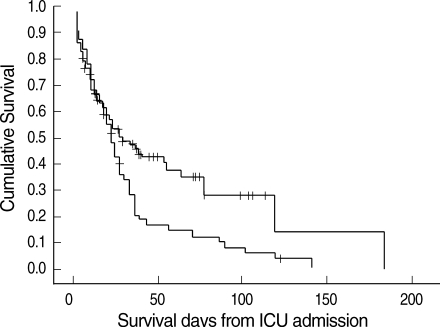
The aim of this study was to determine candidemia incidence among patients in a medical intensive-care unit (MICU) and the associated mortality rate and to identify risk factors associated with candidemia. We retrospectively performed a 1:3 matched case-control study of MICU patients with candidemia. Controls were matched for sex, age, and Acute Physiology and Chronic Health Evaluation (APACHE) II score. Candidemia incidence was 9.1 per 1,000 admissions. The most common pathogen was Candida albicans. Crude mortality was 96% among candidemia patients and 52% among controls (P<0.001). Mortality differed significantly between the groups according to Kaplan-Meier survival analysis (P=0.024). Multivariate analysis identified the following independent risk factors for candidemia: central venous catheterization (odds ratio [OR] = 3.2, 95% confidence interval [CI]=1.2-9.0), previous steroid therapy (OR=4.7, 95% CI=1.8-12.1), blood transfusion during the same admission period (OR=6.3, 95% CI=2.4-16.7), and hepatic failure upon MICU admission (OR=6.9, 95% CI=1.7-28.4). In conclusion, we identify an additional independent risk factor for candidemia, the presence of hepatic failure on MICU admission. Therefore, increased awareness of risk factors, including hepatic failure, is necessary for the management of candidemia.
本研究旨在确定内科重症监护病房(MICU)患者中念珠菌血症的发生率及其相关死亡率,并确定与念珠菌血症相关的危险因素。我们对 MICU 念珠菌血症患者进行了回顾性 1:3 匹配病例对照研究。对照组按性别、年龄和急性生理学和慢性健康评估(APACHE)Ⅱ评分进行匹配。念珠菌血症的发生率为每 1000 例住院患者中有 9.1 例。最常见的病原体是白色念珠菌。念珠菌血症患者的粗死亡率为 96%,对照组为 52%(P<0.001)。根据 Kaplan-Meier 生存分析,两组死亡率差异有统计学意义(P=0.024)。多变量分析确定了念珠菌血症的以下独立危险因素:中心静脉置管(比值比[OR] = 3.2,95%置信区间[CI] = 1.2-9.0)、既往类固醇治疗(OR=4.7,95% CI = 1.8-12.1)、同一住院期间输血(OR=6.3,95% CI = 2.4-16.7)和 MICU 入院时肝衰竭(OR=6.9,95% CI = 1.7-28.4)。总之,我们确定了 MICU 入院时肝衰竭是念珠菌血症的另一个独立危险因素。因此,需要提高对包括肝衰竭在内的危险因素的认识,以管理念珠菌血症。