Center for Sepsis Control & Care, Jena University Hospital, Jena, Germany; Department of Anesthesiology and Intensive Care Medicine, Jena University Hospital, Jena, Germany.
Institut für Medizinische Statistik, Informatik und Datenwissenschaften, Jena University Hospital, Jena, Germany.
Chest. 2022 Feb;161(2):345-355. doi: 10.1016/j.chest.2021.08.081. Epub 2021 Oct 18.
Current guidelines recommend empirical antifungal therapy in patients with sepsis with high risk of invasive Candida infection. However, many different risk factors have been derived from multiple studies. These risk factors lack specificity, and broad application would render most ICU patients eligible for empirical antifungal therapy.
What risk factors for invasive Candida infection can be identified by a systematic review and meta-analysis?
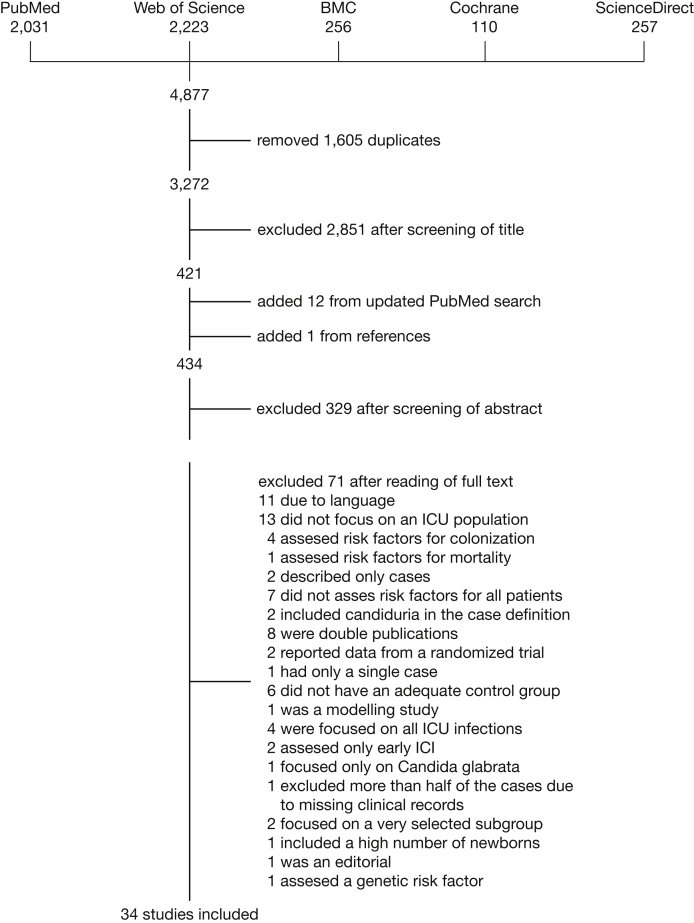
We searched PubMed, Web of Science, ScienceDirect, Biomed Central, and Cochrane and extracted the raw and adjusted OR for each risk factor associated with invasive Candida infection. We calculated pooled ORs for risk factors present in more than one study.
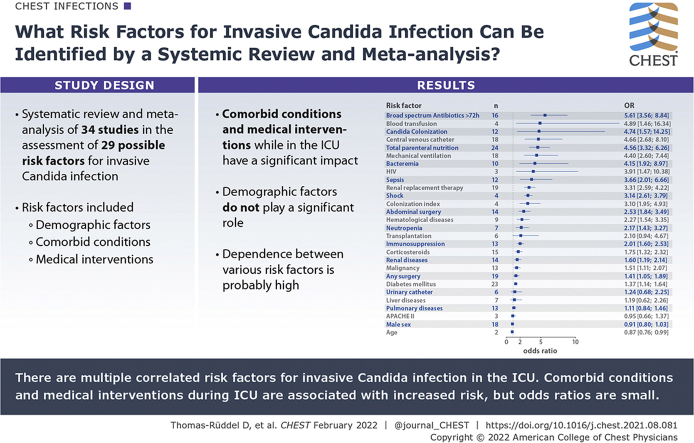
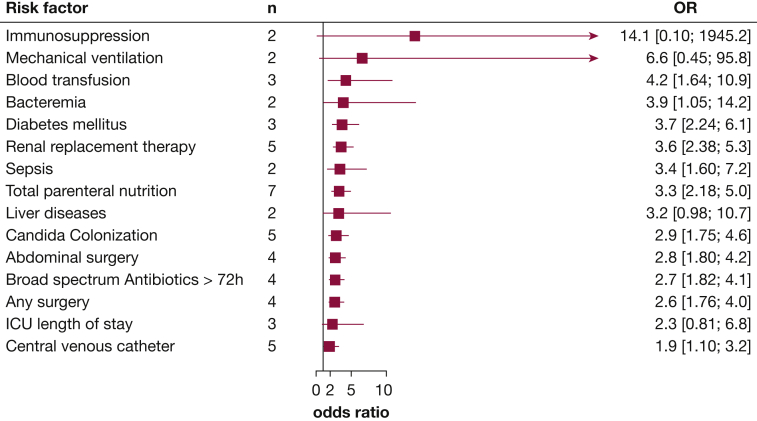
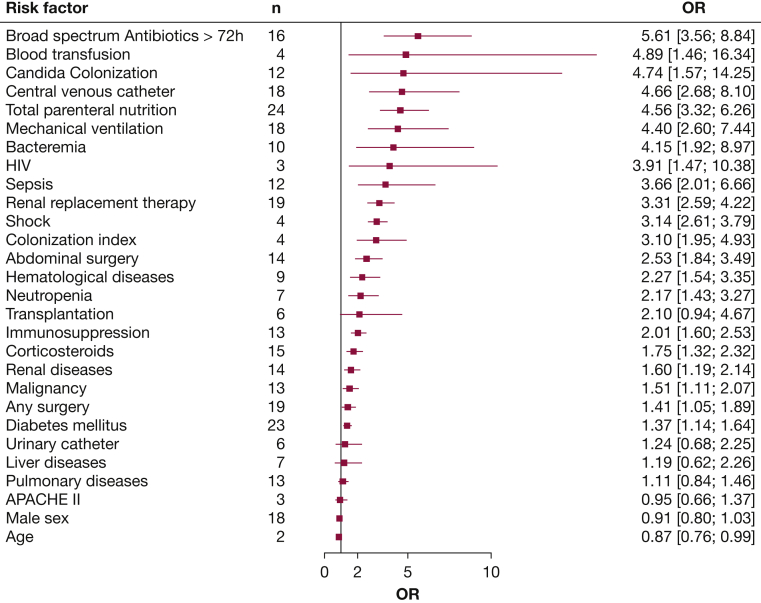
We included 34 studies in our meta-analysis resulting in the assessment of 29 possible risk factors. Risk factors for invasive Candida infection included demographic factors, comorbid conditions, and medical interventions. Although demographic factors do not play a role for the development of invasive Candida infection, comorbid conditions (eg, HIV, Candida colonization) and medical interventions have a significant impact. The risk factors associated with the highest risk for invasive Candida infection were broad-spectrum antibiotics (OR, 5.6; 95% CI, 3.6-8.8), blood transfusion (OR, 4.9; 95% CI, 1.5-16.3), Candida colonization (OR, 4.7; 95% CI, 1.6-14.3), central venous catheter (OR, 4.7; 95% CI, 2.7-8.1), and total parenteral nutrition (OR, 4.6; 95% CI, 3.3-6.3). However, dependence between the various risk factors is probably high.
Our systematic review and meta-analysis identified patient- and treatment-related factors that were associated with the risk for the development of invasive Candida infection in the ICU. Most of the factors identified were either related to medical interventions during intensive care or to comorbid conditions.
目前的指南建议对有侵袭性念珠菌感染高危风险的脓毒症患者进行经验性抗真菌治疗。然而,许多不同的危险因素已从多项研究中得出。这些危险因素缺乏特异性,如果广泛应用,大多数 ICU 患者都有资格接受经验性抗真菌治疗。
通过系统评价和荟萃分析可以确定哪些侵袭性念珠菌感染的危险因素?
我们在 PubMed、Web of Science、ScienceDirect、Biomed Central 和 Cochrane 上进行了检索,并提取了与侵袭性念珠菌感染相关的每个危险因素的原始和调整后的 OR。我们对有超过一项研究评估的危险因素进行了汇总 OR 分析。
我们的荟萃分析纳入了 34 项研究,评估了 29 个可能的危险因素。侵袭性念珠菌感染的危险因素包括人口统计学因素、合并症和医疗干预。虽然人口统计学因素对侵袭性念珠菌感染的发生不起作用,但合并症(如 HIV、念珠菌定植)和医疗干预有显著影响。与侵袭性念珠菌感染风险最高相关的危险因素是广谱抗生素(OR,5.6;95%CI,3.6-8.8)、输血(OR,4.9;95%CI,1.5-16.3)、念珠菌定植(OR,4.7;95%CI,1.6-14.3)、中心静脉导管(OR,4.7;95%CI,2.7-8.1)和全胃肠外营养(OR,4.6;95%CI,3.3-6.3)。然而,各种危险因素之间可能存在高度依赖性。
我们的系统评价和荟萃分析确定了与 ICU 中侵袭性念珠菌感染风险相关的患者和治疗相关因素。确定的大多数因素要么与重症监护期间的医疗干预有关,要么与合并症有关。