Institute of Plant Biology and Department of Life Science, National Taiwan University, Taipei, Taiwan.
J Exp Bot. 2010 Jun;61(10):2843-52. doi: 10.1093/jxb/erq121. Epub 2010 May 5.
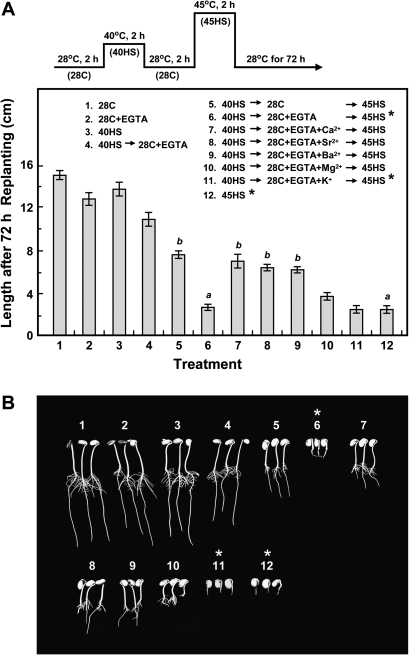
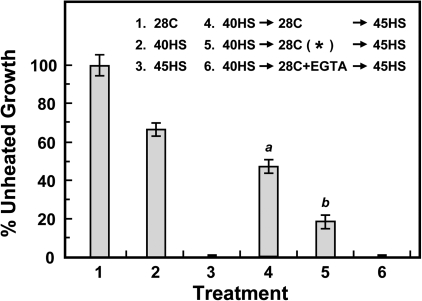
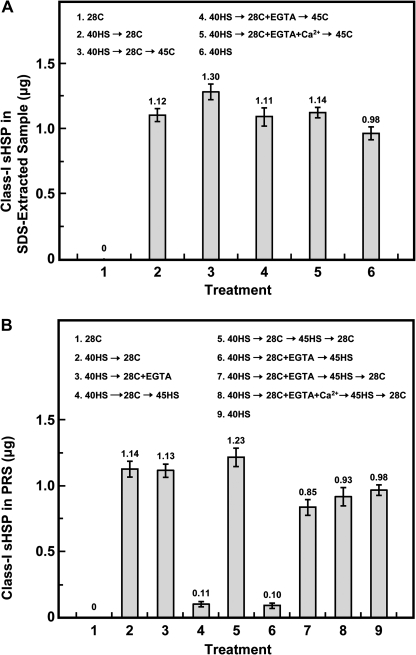
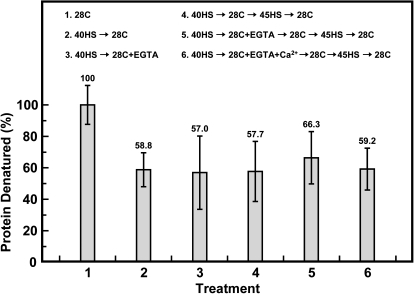
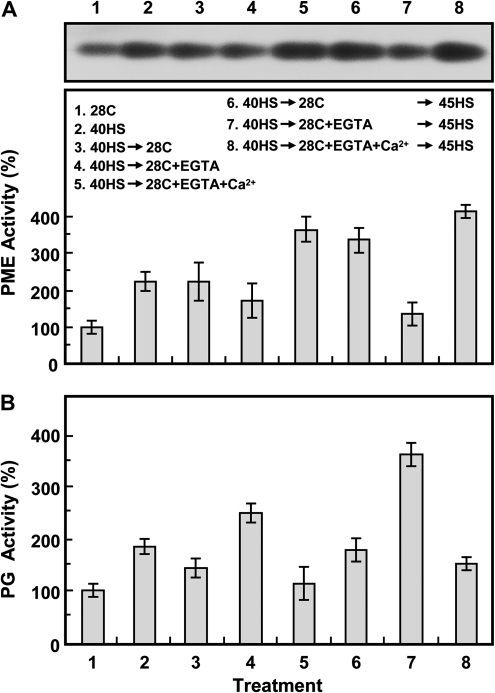
Synthesis of heat shock proteins (HSPs) in response to heat shock (HS) is essential for thermotolerance. The effect of a Ca(2+) chelator, EGTA, was investigated before a lethal HS treatment in soybean (Glycine max) seedlings with acquired thermotolerance induced by preheating. Such seedlings became non-thermotolerant with EGTA treatment. The addition of Ca(2+), Sr(2+) or Ba(2+) to the EGTA-treated samples rescued the seedlings from death by preventing the increased cellular leakage of electrolytes, amino acids, and sugars caused by EGTA. It was confirmed that EGTA did not affect HSP accumulation and physiological functions but interfered with the recovery of HS-released Ca(2+) concentration which was required for thermotolerance. Pectin methylesterase (PME, EC 3.1.1.11), a cell wall remodelling enzyme, was activated in response to HS, and its elevated activity caused an increased level of demethylesterified pectin which was related to the recovery of the HS-released Ca(2+) concentration. Thus, the recovery of HS-released Ca(2+) in Ca(2+)-pectate reconstitution through PME activity is required for cell wall remodelling during HS in soybean which, in turn, retains plasma membrane integrity and co-ordinates with HSPs to confer thermotolerance.
热休克蛋白(HSPs)的合成是对热休克(HS)的响应,对于耐热性是必不可少的。在用预热诱导获得耐热性的大豆(Glycine max)幼苗中,在致死性 HS 处理之前,研究了 Ca(2+)螯合剂 EGTA 的作用。用 EGTA 处理的幼苗失去了耐热性。将 Ca(2+)、Sr(2+)或 Ba(2+)添加到 EGTA 处理的样品中,可以防止 EGTA 引起的电解质、氨基酸和糖的细胞泄漏增加,从而使幼苗免于死亡。证实 EGTA 不影响 HSP 积累和生理功能,但干扰了耐热性所需的 HS 释放 Ca(2+)浓度的恢复。果胶甲酯酶(PME,EC 3.1.1.11)是一种细胞壁重塑酶,它会响应 HS 而被激活,其活性升高会导致去甲酯化果胶水平升高,这与 HS 释放 Ca(2+)浓度的恢复有关。因此,在大豆的 HS 过程中,需要通过 PME 活性使 HS 释放的 Ca(2+)在 Ca(2+)-果胶再构成中恢复,这反过来又保持质膜的完整性,并与 HSP 协调赋予耐热性。