Vanderbilt Center for Health Services Research, Division of General Internal Medicine and Public Health, Vanderbilt University School of Medicine, Nashville, TN 37232, USA.
J Health Psychol. 2010 Nov;15(8):1201-13. doi: 10.1177/1359105310364173. Epub 2010 May 7.
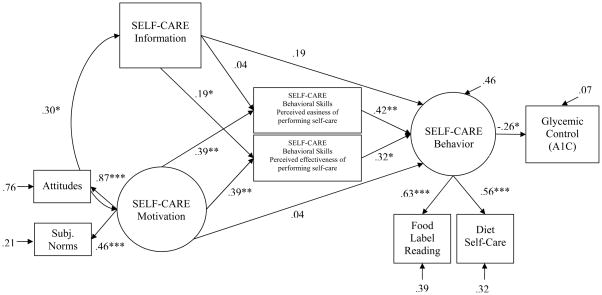
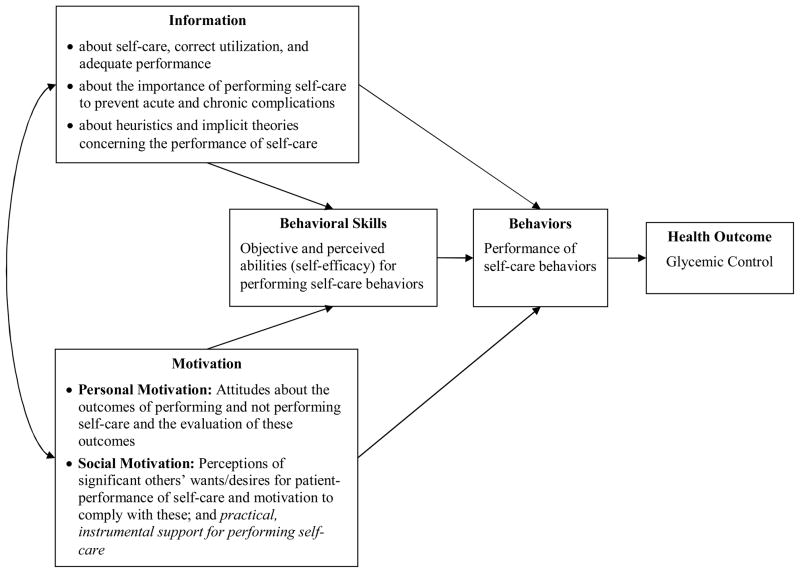
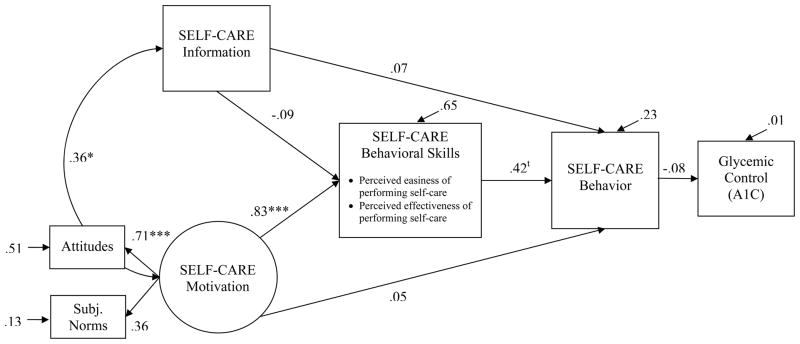
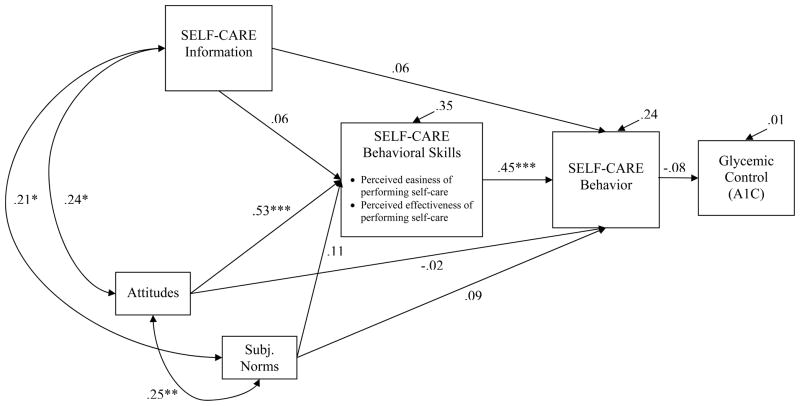
Frameworks are needed to inform diabetes self-care programs for diverse populations. We tested the Information-Motivation-Behavioral Skills (IMB) model in a sample of Puerto Ricans with Type 2 diabetes (N = 118). Structural equation models evaluated model fit and interrelations between IMB constructs. For diet behavior, information and motivation related to behavioral skills ( r = 0.19, p < .05 and r = 0.39, p < .01, respectively); behavioral skills related to behavior (r = 0.42, p < .01 and r = 0.32, p < .05); and behavior related to glycemic control (r = -0.26, p < .05). For exercise, personal motivation related to behavioral skills (r = 0.53, p < .001), and behavioral skills related to behavior (r = 0.45, p < .001). The IMB model could inform interventions targeting these behaviors in diabetes.
需要有框架来为不同人群的糖尿病自我护理计划提供信息。我们在一个患有 2 型糖尿病的波多黎各人群样本(N=118)中测试了信息-动机-行为技能(IMB)模型。结构方程模型评估了模型拟合度和 IMB 结构之间的相互关系。对于饮食行为,信息和动机与行为技能相关(r=0.19,p<.05 和 r=0.39,p<.01,分别);行为技能与行为相关(r=0.42,p<.01 和 r=0.32,p<.05);行为与血糖控制相关(r=-0.26,p<.05)。对于运动,个人动机与行为技能相关(r=0.53,p<.001),行为技能与行为相关(r=0.45,p<.001)。IMB 模型可以为针对这些行为的糖尿病干预措施提供信息。