Unité des Rickettsies, CNRS UMR 6020, IFR 48, Faculté de Médecine, Université de la Méditerranée, Marseille, France.
PLoS One. 2010 May 4;5(5):e10463. doi: 10.1371/journal.pone.0010463.
A bacterial role in the obesity pandemic has been suspected based on the ingestion of probiotics that can modify the gut flora. The objective of our study was to determine if increased Lactobacillus sp. in the gut flora of newborn broiler chicks and ducks could result in weight gain increase.
Female broiler chicks (Gallus gallus domesticus) and ducks (Anas platyrhynchos domestica) were separated into one control and two experimental groups, and inoculated once or twice with 4x10(10)Lactobacillus spp. per animal in PBS, or with PBS alone. Fecal samples were collected before and at 24 hours, 2, 4, 8, 16 and 30 days after the inoculation. DNA was extracted from the stools, and qPCR assays were performed on a MX3000 system for the detection and quantification of Lactobacillus sp., Bacteroidetes and Firmicutes, using a quantification plasmid. Animals were measured and sacrificed 60 days after the beginning of the experiment, and livers were collected and measured.
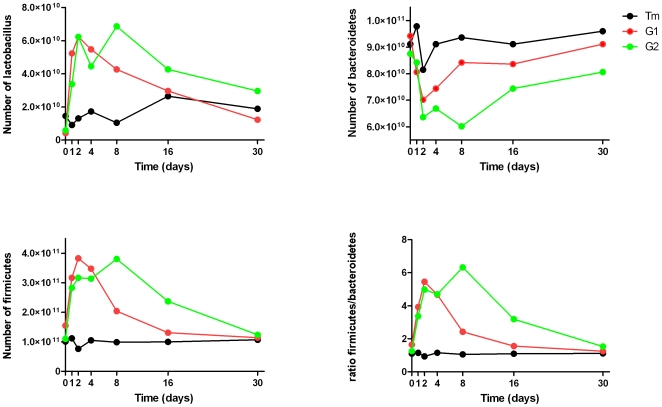
Chicks inoculated once and twice with Lactobacillus weighed 10.2% (p = 0.0162) and 13.5% (p = 0.0064) more than the control group animals, respectively. Similarly, ducks inoculated once and twice weighed 7.7% (p = 0.05) and 14% (p = 0.035) more than those in the control group, respectively. Liver mass was also significantly higher in inoculated animals compared to the control group. Inoculation with Lactobacillus sp. increased the DNA copies of Lactobacillus spp. and Firmicutes in the stools. Bacteroidetes remained stable, and only the second Lactobacillus sp. inoculation significantly decreased its population in chicks. The ratio of DNA copies of Firmicutes to those of Bacteroidetes increased to as much as 6,4 in chicks and 8,3 in ducks.
Differences in the intestinal microbiota may precede weight increase, as we found that an increase of Lactobacillus sp. in newborn ducks and chicks preceded the development of weight gain.
基于益生菌可改变肠道菌群的摄入,人们怀疑细菌在肥胖流行中起作用。我们研究的目的是确定新生肉鸡和鸭的肠道菌群中增加的乳酸杆菌是否会导致体重增加。
将雌性肉鸡(Gallus gallus domesticus)和鸭(Anas platyrhynchos domestica)分为对照组和两个实验组,每组动物用 PBS 或 PBS 单独接种一次或两次,每次接种 4x10(10)个乳酸杆菌。接种前和接种后 24 小时、2、4、8、16 和 30 天收集粪便样本。从粪便中提取 DNA,并在 MX3000 系统上进行 qPCR 检测和定量分析,检测和定量分析乳酸杆菌、拟杆菌门和厚壁菌门,使用定量质粒。实验开始 60 天后,测量和处死动物,并收集肝脏进行测量。
分别接种一次和两次乳酸杆菌的鸡比对照组动物分别重 10.2%(p = 0.0162)和 13.5%(p = 0.0064)。同样,分别接种一次和两次乳酸杆菌的鸭比对照组动物分别重 7.7%(p = 0.05)和 14%(p = 0.035)。与对照组相比,接种动物的肝脏质量也显著更高。接种乳酸杆菌增加了粪便中乳酸杆菌和厚壁菌门的 DNA 拷贝数。拟杆菌门保持稳定,只有第二次乳酸杆菌接种显著减少了鸡群中的种群。厚壁菌门和拟杆菌门的 DNA 拷贝数比值增加到鸡 6.4,鸭 8.3。
肠道微生物群的差异可能先于体重增加,因为我们发现新生鸭和鸡的乳酸杆菌增加先于体重增加的发生。