Biology Department, Stanford University, Stanford, California, United States of America.
PLoS Biol. 2010 May 4;8(5):e1000365. doi: 10.1371/journal.pbio.1000365.
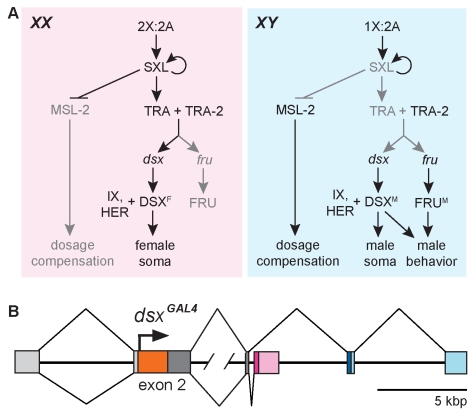
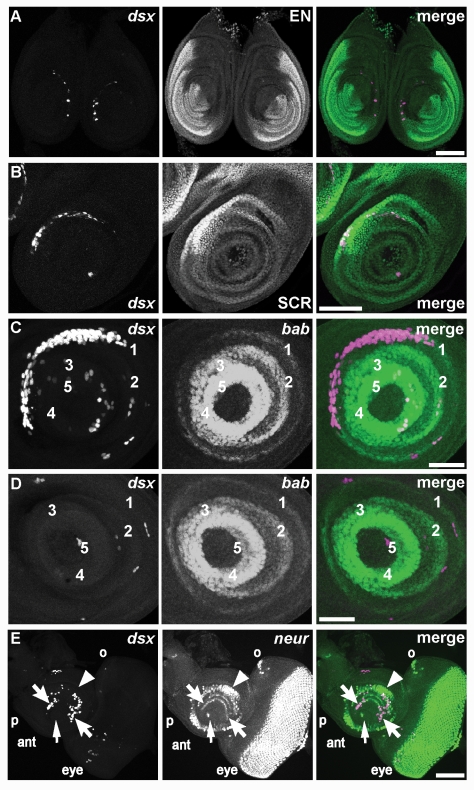
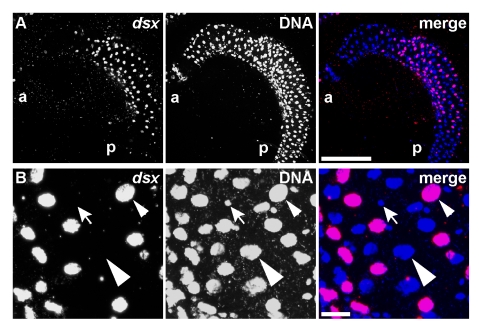
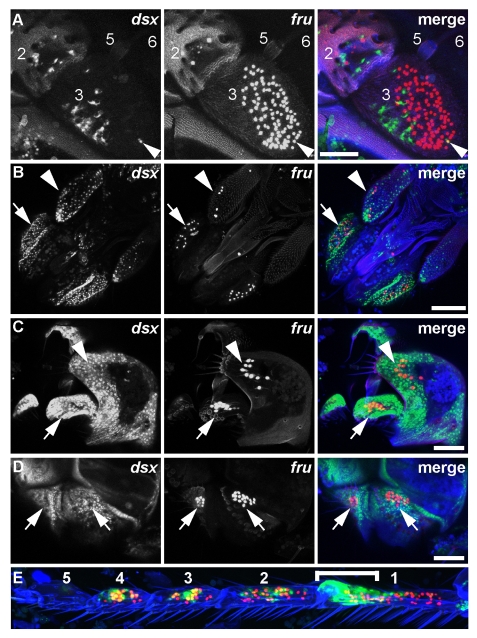
The Drosophila melanogaster sex hierarchy controls sexual differentiation of somatic cells via the activities of the terminal genes in the hierarchy, doublesex (dsx) and fruitless (fru). We have targeted an insertion of GAL4 into the dsx gene, allowing us to visualize dsx-expressing cells in both sexes. Developmentally and as adults, we find that both XX and XY individuals are fine mosaics of cells and tissues that express dsx and/or fruitless (fru(M)), and hence have the potential to sexually differentiate, and those that don't. Evolutionary considerations suggest such a mosaic expression of sexuality is likely to be a property of other animal species having two sexes. These results have also led to a major revision of our view of how sex-specific functions are regulated by the sex hierarchy in flies. Rather than there being a single regulatory event that governs the activities of all downstream sex determination regulatory genes-turning on Sex lethal (Sxl) RNA splicing activity in females while leaving it turned off in males-there are, in addition, elaborate temporal and spatial transcriptional controls on the expression of the terminal regulatory genes, dsx and fru. Thus tissue-specific aspects of sexual development are jointly specified by post-transcriptional control by Sxl and by the transcriptional controls of dsx and fru expression.
果蝇的性别等级通过等级中末端基因双性(dsx)和无果(fru)的活性来控制体细胞的性分化。我们已经将 GAL4 靶向插入到 dsx 基因中,从而可以在雌雄两性中可视化 dsx 表达细胞。在发育和成年阶段,我们发现 XX 和 XY 个体都是 dsx 和/或无果(fru(M))表达细胞和组织的精细嵌合体,因此具有性分化的潜力,而有些则没有。进化方面的考虑表明,这种性别表达的镶嵌现象可能是具有两种性别的其他动物物种的一个特征。这些结果还导致我们对性别等级如何调节苍蝇中性别特异性功能的看法进行了重大修订。不是存在单一的调节事件来控制所有下游性别决定调节基因的活性——在雌性中打开 Sex lethal(Sxl)RNA 剪接活性,而在雄性中关闭它——而是对末端调节基因 dsx 和 fru 的表达存在精细的时空转录控制。因此,性发育的组织特异性方面是由 Sxl 的转录后控制和 dsx 和 fru 表达的转录控制共同指定的。