Department of Molecular Biology, The Scripps Research Institute, 10550 North Torrey Pines Road, MB4, La Jolla, California 92037, USA.
J Am Chem Soc. 2010 Jun 2;132(21):7372-8. doi: 10.1021/ja100365x.
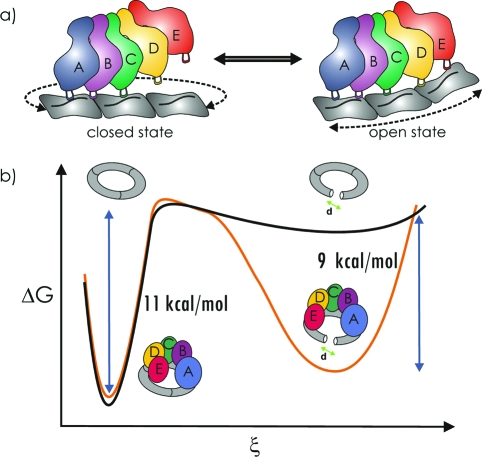
Proliferating cell nuclear antigen (PCNA, sliding clamp) is a toroidal-shaped protein that encircles DNA and plays a pivotal role in DNA replication, modification and repair. To perform its vital functions, the clamp has to be opened and resealed at primer-template junctions by a clamp loader molecular machine, replication factor C (RFC). The mechanism of this process constitutes a significant piece in the puzzle of processive DNA replication. We show that upon clamp opening the RFC/PCNA complex undergoes a large conformational rearrangement, leading to the formation of an extended interface between the clamp and RFC. Binding of ring-open PCNA to all five RFC subunits transforms the free-energy landscape underlying the closed- to open state transition, trapping PCNA in an open conformation. Careful comparison of free-energy profiles for clamp opening in the presence and absence of RFC allowed us to substantiate the role of RFC in the initial stage of the clamp-loading cycle. RFC does not appreciably destabilize the closed state of PCNA. Instead, the function of the clamp loader is dependent on the selective stabilization of the open conformation of the clamp.
增殖细胞核抗原(PCNA,滑动夹)是一种环形蛋白,环绕 DNA 并在 DNA 复制、修饰和修复中发挥关键作用。为了发挥其重要功能,夹子必须由夹子加载分子机器复制因子 C(RFC)在引物-模板连接处打开和重新密封。该过程的机制构成了连续 DNA 复制难题中的重要一环。我们表明,在夹子打开时,RFC/PCNA 复合物会发生较大的构象重排,导致夹子和 RFC 之间形成扩展界面。打开的 PCNA 与所有五个 RFC 亚基结合,改变了封闭到开放状态转变的自由能景观,将 PCNA 捕获在开放构象中。在存在和不存在 RFC 的情况下对夹子打开的自由能曲线进行仔细比较,使我们能够证实 RFC 在夹子加载循环的初始阶段的作用。RFC 不会明显破坏 PCNA 的封闭状态。相反,夹子加载器的功能取决于对夹子的开放构象的选择性稳定。