Cell Biology & Diabetes Research Unit, Department of Biological & Medical Research, King Faisal Specialist Hospital & Research Centre, PO BOX 3354, Riyadh 11211, Saudi Arabia.
BMC Public Health. 2010 May 9;10:234. doi: 10.1186/1471-2458-10-234.
The prevalence of obesity and overweight is increasing globally. Frequently coexisting with under-nutrition in developing countries, obesity is a major contributor to chronic disease, and will become a serious healthcare burden especially in countries with a larger percentage of youthful population. 35% of the population of Saudi Arabia are under the age of 16, and adult dietary preferences are often established during early childhood years. Our objective was to examine the dietary habits in relation to body-mass-index (BMI) and waist circumference (W_C), together with exercise and sleep patterns in a cohort of male and female Saudi school children, in order to ascertain whether dietary patterns are associated with obesity phenotypes in this population.
5033 boys and 4400 girls aged 10 to 19 years old participated in a designed Food Frequency Questionnaire. BMI and W_C measurements were obtained and correlated with dietary intake.
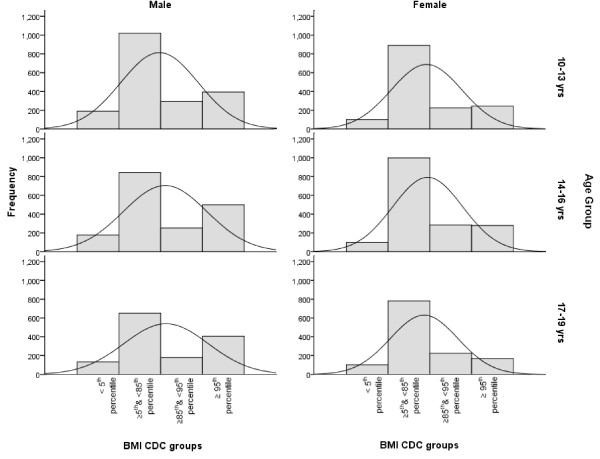
The overall prevalence of overweight and obesity was 12.2% and 27.0% respectively, with boys having higher obesity rates than girls (P <or= 0.001). W_C and BMI was positively correlated with sugar-sweetened carbonated beverage (SSCB) intake in boys only. The association between male BMI and SSCB consumption was significant in a multivariate regression model (P < 0.0001). SSCB intake was positively associated with poor dietary choices in both males and females. Fast food meal intake, savory snacks, iced desserts and total sugar consumption correlated with SSCB intake in both boys (r = 0.39, 0.13, 0.10 and 0.52 respectively, P < 0.001) and girls (r = 0.45, 0.23, 0.16 and 0.55 respectively, P < 0.001). Older children reported eating significantly less fruit and vegetables than younger children; and less eggs, fish and cereals. Conversely, consumption of SSCB and sugar-sweetened hot beverages were higher in older versus younger children (P < 0.001). BMI and W_C were negatively correlated with hours of night-time sleep and exercise in boys, but only with night time sleep in girls, who also showed the lowest frequency of exercise.
A higher intake of SSCB is associated with poor dietary choices. Male SSCB intake correlates with a higher W_C and BMI. Limiting exposure to SSCB could therefore have a large public health impact.
肥胖和超重的患病率在全球范围内不断上升。在发展中国家,肥胖症经常与营养不良并存,是慢性病的主要诱因,尤其是在人口中年轻人口比例较大的国家,肥胖症将成为严重的医疗保健负担。沙特阿拉伯 35%的人口年龄在 16 岁以下,成年人的饮食偏好通常在儿童早期形成。我们的目的是检查与 BMI(体重指数)和腰围(W_C)相关的饮食习惯,以及沙特男女学童的运动和睡眠模式,以确定饮食模式是否与该人群的肥胖表型有关。
5033 名 10 至 19 岁的男孩和 4400 名女孩参加了设计好的食物频率问卷。测量了 BMI 和 W_C 并与饮食摄入相关联。
超重和肥胖的总体患病率分别为 12.2%和 27.0%,男孩的肥胖率高于女孩(P <or= 0.001)。仅在男孩中,W_C 和 BMI 与含糖碳酸饮料(SSCB)的摄入量呈正相关。在多变量回归模型中,男性 BMI 与 SSCB 消费之间存在显著关联(P < 0.0001)。SSCB 摄入量与男性和女性的不良饮食选择呈正相关。快餐摄入、咸味零食、冰甜点和总糖摄入量与男孩的 SSCB 摄入量呈正相关(r = 0.39、0.13、0.10 和 0.52,分别为 P < 0.001)和女孩(r = 0.45、0.23、0.16 和 0.55,分别为 P < 0.001)。年龄较大的儿童报告比年龄较小的儿童吃的水果和蔬菜明显少,鸡蛋、鱼和谷物的摄入量也较少。相反,年龄较大的儿童的 SSCB 和含糖热饮的消耗量高于年龄较小的儿童(P < 0.001)。BMI 和 W_C 与男孩的夜间睡眠时间和运动量呈负相关,但仅与女孩的夜间睡眠时间相关,女孩的运动量也最低。
较高的 SSCB 摄入量与不良饮食选择有关。男性 SSCB 摄入量与较高的 W_C 和 BMI 相关。因此,限制 SSCB 的摄入可能会对公众健康产生重大影响。