Division of Oncology, Center for Applied Medical Research (CIMA), University of Navarra, Pamplona, Spain.
BMC Cancer. 2010 May 11;10:188. doi: 10.1186/1471-2407-10-188.
There is strong evidence demonstrating that activation of epidermal growth factor receptors (EGFRs) leads to tumor growth, progression, invasion and metastasis. Erlotinib and gefitinib, two EGFR-targeted agents, have been shown to be relevant drugs for lung cancer treatment. Recent studies demonstrate that lapatinib, a dual tyrosine kinase inhibitor of EGFR and HER-2 receptors, is clinically effective against HER-2-overexpressing metastatic breast cancer. In this report, we investigated the activity of lapatinib against non-small cell lung cancer (NSCLC).
We selected the lung cancer cell line A549, which harbors genomic amplification of EGFR and HER-2. Proliferation, cell cycle analysis, clonogenic assays, and signaling cascade analyses (by western blot) were performed in vitro. In vivo experiments with A549 cells xenotransplanted into nude mice treated with lapatinib (with or without radiotherapy) were also carried out.
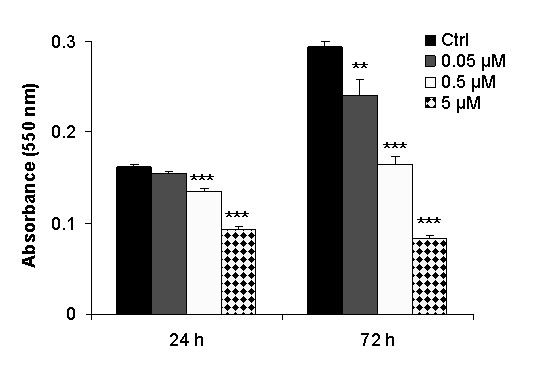
Lapatinib dramatically reduced cell proliferation (P < 0.0001), DNA synthesis (P < 0.006), and colony formation capacity (P < 0.0001) in A549 cells in vitro. Furthermore, lapatinib induced G1 cell cycle arrest (P < 0.0001) and apoptotic cell death (P < 0.0006) and reduced cyclin A and B1 levels, which are regulators of S and G2/M cell cycle stages, respectively. Stimulation of apoptosis in lapatinib-treated A549 cells was correlated with increased cleaved PARP, active caspase-3, and proapoptotic Bak-1 levels, and reduction in the antiapoptotic IAP-2 and Bcl-xL protein levels. We also demonstrate that lapatinib altered EGFR/HER-2 signaling pathways reducing p-EGFR, p-HER-2, p-ERK1/2, p-AKT, c-Myc and PCNA levels. In vivo experiments revealed that A549 tumor-bearing mice treated with lapatinib had significantly less active tumors (as assessed by PET analysis) (P < 0.04) and smaller in size than controls. In addition, tumors from lapatinib-treated mice showed a dramatic reduction in angiogenesis (P < 0.0001).
Overall, these data suggest that lapatinib may be a clinically useful agent for the treatment of lung cancer.
有强有力的证据表明,表皮生长因子受体(EGFRs)的激活会导致肿瘤生长、进展、侵袭和转移。两种 EGFR 靶向药物厄洛替尼和吉非替尼已被证明是治疗肺癌的相关药物。最近的研究表明,拉帕替尼是一种 EGFR 和 HER-2 受体的双重酪氨酸激酶抑制剂,对 HER-2 过表达的转移性乳腺癌具有临床疗效。在本报告中,我们研究了拉帕替尼对非小细胞肺癌(NSCLC)的活性。
我们选择了肺癌细胞系 A549,该细胞系存在 EGFR 和 HER-2 的基因组扩增。在体外进行增殖、细胞周期分析、集落形成试验和信号级联分析(通过 Western blot)。还进行了 A549 细胞异种移植到裸鼠中的体内实验,并用拉帕替尼(联合或不联合放疗)治疗。
拉帕替尼在体外显著降低了 A549 细胞的增殖(P < 0.0001)、DNA 合成(P < 0.006)和集落形成能力(P < 0.0001)。此外,拉帕替尼诱导了 G1 细胞周期停滞(P < 0.0001)和细胞凋亡(P < 0.0006),并降低了细胞周期 S 和 G2/M 阶段的调节因子 cyclin A 和 B1 的水平。拉帕替尼处理的 A549 细胞中凋亡的刺激与增加的 cleaved PARP、活性 caspase-3 和促凋亡 Bak-1 水平以及抗凋亡 IAP-2 和 Bcl-xL 蛋白水平的降低相关。我们还证明,拉帕替尼改变了 EGFR/HER-2 信号通路,降低了 p-EGFR、p-HER-2、p-ERK1/2、p-AKT、c-Myc 和 PCNA 的水平。体内实验表明,用拉帕替尼治疗的 A549 荷瘤小鼠的肿瘤活性(通过 PET 分析评估)明显降低(P < 0.04),且肿瘤体积小于对照组。此外,拉帕替尼治疗的小鼠肿瘤中的血管生成明显减少(P < 0.0001)。
总的来说,这些数据表明拉帕替尼可能是治疗肺癌的一种临床有用的药物。