Division of Rheumatology, Allergy, and Immunology, University of California San Diego School of Medicine, La Jolla, CA 92093, USA.
J Immunol. 2010 Jun 15;184(12):7162-8. doi: 10.4049/jimmunol.0903944. Epub 2010 May 17.
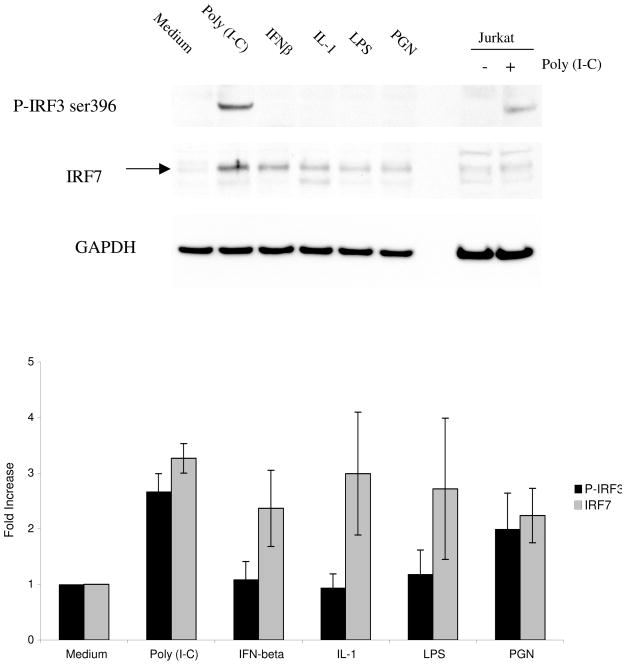
Innate immune responses contribute to synovial inflammation in rheumatoid arthritis. The present study was designed to investigate the contribution of IFN regulatory factor (IRF)3 and IRF7 to type I IFN-regulated gene expression in synoviocytes. Fibroblast-like synoviocytes were stimulated with polyinosinic-polycytidylic acid (poly [I-C]) after transfection with IRF3 or IRF7 small interfering RNA to knockdown transcription factor expression. Western blots, luciferase assay after transfection with reporter constructs, quantitative PCR, and AP-1 DNA binding ELISA were performed to evaluate the role of IRF3 and IRF7 in poly (I-C)-induced signaling and synoviocyte gene expression. IRF3 regulates IFN-stimulated response element (ISRE) promoter activity as well as IFN-beta, IRF5, IRF7, RANTES, IFN-inducible protein-10, MCP-1, and MIP1alpha gene expression in response to poly (I-C). IRF7 knockdown modestly decreased a subset of genes and ISRE activity, although the results were not statistically significant. Surprisingly, IRF3 knockdown almost completely blocked expression of additional genes in which the ISRE is not traditionally considered a dominant promoter site in fibroblast-like synoviocytes, including matrix metalloproteinase (MMP)3, MMP9, IL-6, and IL-8. Transcription factor activation studies demonstrated a role for IRF3 in regulation of c-Jun phosphorylation and AP-1 binding. IRF3 rather than IRF7 regulates poly (I-C)-induced type I IFN responses in human synoviocytes by increasing ISRE promoter activity. IRF3 also partially regulates expression of other cytokines and MMP through activation of c-Jun and the AP-1 promoter site. Targeting synoviocyte IRF3 represents a potential approach to suppress diverse mediators while limiting suppression of IRF7-mediated immune responses.
固有免疫反应有助于类风湿关节炎的滑膜炎症。本研究旨在探讨干扰素调节因子 (IRF)3 和 IRF7 对滑膜细胞中 I 型干扰素调节基因表达的贡献。用聚肌苷酸-聚胞苷酸 (poly [I-C]) 刺激成纤维样滑膜细胞,转染 IRF3 或 IRF7 小干扰 RNA 以敲低转录因子表达。进行 Western blot、转染报告构建体后的荧光素酶测定、定量 PCR 和 AP-1 DNA 结合 ELISA,以评估 IRF3 和 IRF7 在 poly (I-C) 诱导的信号转导和滑膜细胞基因表达中的作用。IRF3 调节 IFN 刺激反应元件 (ISRE) 启动子活性以及 IFN-β、IRF5、IRF7、RANTES、IFN 诱导蛋白-10、MCP-1 和 MIP1alpha 基因的表达,以响应 poly (I-C)。IRF7 敲低在一定程度上降低了一组基因和 ISRE 活性,尽管结果没有统计学意义。令人惊讶的是,IRF3 敲低几乎完全阻断了其他基因的表达,这些基因中的 ISRE 传统上不是成纤维样滑膜细胞中主要的启动子位点,包括基质金属蛋白酶 (MMP)3、MMP9、IL-6 和 IL-8。转录因子激活研究表明,IRF3 在调节 c-Jun 磷酸化和 AP-1 结合中起作用。IRF3 而不是 IRF7 通过增加 ISRE 启动子活性来调节人滑膜细胞中的 poly (I-C) 诱导的 I 型干扰素反应。IRF3 还通过激活 c-Jun 和 AP-1 启动子位点,部分调节其他细胞因子和 MMP 的表达。靶向滑膜细胞 IRF3 代表了一种抑制多种介质的潜在方法,同时限制了 IRF7 介导的免疫反应的抑制。